9-19-2013 – Santa Rosalia, Baja California Sur, Mexico

We’ve spent the last couple of weeks moving south from the Bay of LA to Loreto. The weather has definitely begun the seasonal change to fall. The temperatures have dropped from the high 90’s to the mid 80’s, and the water temps are also a little lower. We’ve been sailing about every other day, stopping frequently along the way and enjoying the local scenery.

The last day we were in the Bay of LA area, we stopped in the village to get one last round of fresh produce and one last fix of internet access. As we finished anchoring, Dan looked down in the water to check the conditions. For some unknown reason, his glasses chose this moment to prefer the force of gravity over the pull of friction, and they slipped into the water. Just like that – plop! – and they were gone. After a few moments of dumbfounded disbelief we developed an action plan. It took us about ten minutes to find the small anchor, round up a float to mark the spot and find and attach a line of the right size and length. Kathy put on a swimsuit and deployed the swim ladder, while Dan dropped the anchor overboard, hoping that Lungta hadn’t swung too far in the meantime (fortunately conditions were pretty mild). Kathy jumped in, formulating a search pattern in her mind. She easily found the float, directly underneath Lungta’s transom, and dove to the anchor at the other end of the line. As it turned out, it took no time at all to find the glasses – because they were pinned directly underneath the anchor! The image of Bambi’s little deer-legs splayed out in the cult short “Bambi Meets Godzilla” came quickly to mind, but those of the Wicked Witch of the West might be just as apropos. Surprisingly there were no (significant) scratches or bends to the glasses, and Dan’s vision has been restored. We had a disappointing internet experience, with seemingly all of the town’s connections either intermittent or just plain down, so we did a quick run to the “abarrote” (grocery store) and headed back to the boat.


We had a good sail to Puerto Don Juan, where the boats had been careened at the beginning of our visit to the area. This time we had the entire anchorage completely to ourselves. We went for a nice hike the next morning, and found a small slot canyon that a friend had told us about. We startled up a small rattlesnake, who was moving somewhat sluggishly because of a recent meal that caused a big bulge in his profile. The encounter was a good reminder for us to stay vigilent. We ended up at the next cove along the coastline, where we saw a portion of a dolphin’s skeleton.


That afternoon we sailed on to an anchorage in the eastern side of the Bahia de las Animas. As we approached, we saw a white structure on or near shore that we spent a lot of time trying to identify. At times we thought it was a small house on shore, while at other times we thought it might be a panga or other boat in the bay. When we got closer to shore we decided that it must be some sort of debris, perhaps a sign that had been knocked down or a large styrofoam float. Once we arrived, we went for a hike along the shoreline, and found that it was a unbelievably large whale’s skull. It was easily 10 feet long and 6 feet wide. We also saw a coyote foraging around on the shoreline, which scampered away as we got close. The area had beautiful pink and grey rocks with intriguing cliffs and arroyos, and we were longing to spend some time hiking around the next day, but as sunset approached we were inundated by mosquitos and decided to move on.

Rather than hugging the coastline, we headed out to a small chain of islands situated about 30 miles off-shore along a ridge which rises from the deepest portion of the Sea of Cortez. This area is frequented by many of the region’s whales, which explains the whale bones that we’d recently seen. We spotted several different kinds of whales, but aren’t familiar enough with them to be able to identify them for you. 🙂 Some were probably fin whales or pilot whales, because these seem to be fairly common. Another group may have been false killer whales; these were traveling in a small pod like dolphins, but were much larger and had a longer, more intermittent breathing pattern like whales. We also had a close encounter with a whale that surfaced about 30 feet away from our stern. We heard a loud exhale just outside our pilothouse door, and when we looked out we were surprised to see how close he was! He surfaced a second time and then turned away. They are often as curious about us as we are about them!

We’ve had a pattern of very slow travel in the mornings, and then the winds pick up to the expected levels later in the afternoons. We arrived at Isla Partida just before sunset, but not so late that we felt compelled to accelerate the process with our motor. 🙂 Isla Partida is a tiny little island, only about 2 miles long, with a large crescent-shaped bay on the northwest side. The very center of the island looks like it’s been pinched, so that there is a small strip of land in between two tall hills on either end. It was cute to notice on our approach that one of these hills was red rock and the other was covered with greenery – much like the navigation lights of a sailing vessel. We stayed here a few days while we waited for a good wind to take us further south. While here, one day we circumnavigated the island by dinghy, finding some interesting choppy waves and current on the south caused by a collision of wind waves and tidal flow. To Dan’s disappointment, we found only one small white sand beach – but it was a beauty! We swung around another nearby islet which hosts a sea lion rookery and enjoyed watching them for a while. They seemed generally smaller than the ones we had observed two months ago in Puerto Refugio, and we wondered if they were a different species. Another day we snorkeled along a reef coming out from a rocky point. This was a wonderful place to see lots of fish, and we returned later to fish. While snorkeling, though, we saw a little cave entrance which we swam through and discovered that it opened up to the sky in a fully contained “room” about 10 feet in diameter. It’s hard to convey the sense of discovery and magic that we found in this secret spot. There was a quiet little gull patiently sitting on the rocks in there the whole time we were marveling at the place, and it swam out after us when we were done. We realized that when the tide was higher or there were waves coming from the north, this area would form a blowhole and be dangerous to approach as we had.

When we left Isla Partida, we thought that we might stop at one or more of the other islands in this chain, but it didn’t work out that way. Although the winds were in a favorable direction, they weren’t strong enough for us to get to an anchorage in one day, so we pushed on through the night and sailed into Bahia San Francisquito the next day. Ironically, the wind picked up during the night and we had a brisk and delightful sail throughout the night. San Francisquito is a very large bay with a long white sand beach that pulled Dan’s heartstrings. Shortly after dropping anchor we took a quick foray to shore to explore. We found lots of coyote tracks and holes in the sand dappled by the tiny claw-prints of red crabs. We started to wander up into the neighboring countryside, where there were some wonderful curved cliffs carved in golden sandstone, but we were swarmed by mosquitos and turned back quickly. We spent a quiet day catching up on our sleep, and decided to continue on our way. San Francisquito looks like a wonderful place to spend a week or two, and we hope to visit it again next summer, before the rains breed a new generation of mosquitos.

Our next stop was the town of Santa Rosalia. It was another long day’s hop, and we arrived in the wee hours of the morning. We spent a couple of days in Santa Rosalia, visiting with friends, catching up on email, refilling our fridge, and watching a (very small) parade in celebration of Mexico’s Independence Day. The parade consisted entirely of groups of school children and military ranks, some with marching bands. We remarked on the difference between American parades, which tend to be very noisy festive occasions, and Mexican parades, which seem to be more somber business-like affairs. Certainly there were celebrations elsewhere, but not during or immediately after the parade at 8 in the morning! We wanted to take advantage of some nice weather conditions, so we pulled our anchor and got moving. We stopped at the fuel dock on the way out, since there isn’t another one for 200 miles and that one has been reported to be out of fuel much of the summer. As we pulled away from the fuel dock, a contrary wind pushed us back onto the dock’s corner, causing a largish scrape on our hull. It was the kind of scrape that could ruin your day (or week!) if your boat was fiberglass, but our cement hull was unperturbed. Dan was able to fill and paint it in about an hour a few days later, and the patch is virtually invisible, even if you know there’s something to look for! We’re *very* happy with the space-age paint that we chose this time: PSX-700.

Santa Rosalia was about the halfway point in our journey from Bahia de los Angeles to Loreto, so I’ll break the story here, and continue the second half in another posting.

Posted in Uncategorized | Comments Off on 9-19-2013 – Santa Rosalia, Baja California Sur, Mexico

8-31-2013 – Bahia de los Angeles, Baja California, Mexico

Another month has passed, and we’re still living in Paradise.  🙂 We’ve spent most of this time in the area around a bay called Bahia de los Angeles.  The region is about 50 square miles, with the bay itself about a quarter that size.  There are roughly a dozen islands nearby, ranging in size from big rocks to one that’s 7 miles long and has a volcanic cone at its head.  There’s a small village in the main bay, and clusters of houses in a few other places, mostly gringo vacation homes.  Since this is the hottest time of the year, most of those houses are vacant right now.  The region is beautiful, with rugged hills along the Baja peninsula and clear turquoise waters, and the wildlife is abundant.  There are lots of places to hike, swim, kayak, snorkel, fish and enjoy other recreational opportunities.

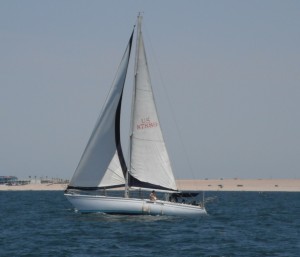
This area is just north of a group of large islands which stretch across the Sea of Cortez, in the narrowest portion of the Sea.  This creates a pinch-point which restricts the flow of water during the tidal changes, creating more current than we’ve seen elsewhere in the Sea.  This area also has rather high tide swings – as you may remember, we saw tides of roughly 20 feet in Puerto Penasco, among the largest tidal swings in the world.  We encountered large tides and strong currents on our trip up to Alaska two years ago, so they are familiar and make for some additional interest and challenge in navigating.  The numerous islands frequently funnel and redirect the wind in unexpected ways, and we’ve had some spectacular sailing up here.  We’ve changed anchorages often, sometimes for practical or social reasons, but often because we are just enjoying the opportunity to sail!  Both of us have learned a lot about sailing here, and we’re feeling more capable and relaxed than ever before.  Dan even took an opportunity to sail solo one day (Kathy is flirting with the idea but is not quite ready for that challenge).


Much of the region is home to whale sharks, and people are often comparing notes on when and where they were last sighted.  There can be up to 8 or 10 at a time, although usually there are no more than 2 or 3.  They gently cruise along at the surface, scooping up plankton into their huge mouths.  Many of the people we’ve talked with have jumped in the water and swum with these dumb giants, but we haven’t yet had (or made!) that opportunity.  We did encounter one while kayaking one morning, when it circled around a couple of times and went alongside Dan’s kayak and directly underneath Kathy’s! Apparently they bear live young (unusual for sharks), can live to 70 years, and leave no skeletons because they’re built of cartilage rather than bone.  Any unusual ripple in the water can cause us draw in our breath and hope to spot a whale shark.

There are also whales in the area, although not as many as we’d expected.  We’ve sighted perhaps half a dozen in the last month.  There are several types of whales that frequent these waters, but we haven’t learned to differentiate between them yet.  Nonetheless, seeing a spout rise against the hills on the other side of a channel will always cause a moment of excitement, as we wait for a second one.  One anchorage that we enjoyed was right along a channel called the Canal de Ballenas (Channel of Whales), where we heard whales spouting throughout the night.  Dolphins are fairly common here, usually traveling in large schools.  Since these schools are feeding there is often a crowd of various birds overhead, typically boobies and pelicans, with an occasional gull.  At times the dolphins appear to be celibrating life, because they leap out of the water, and occasionally add a flourish of their tails, making a loud slap.


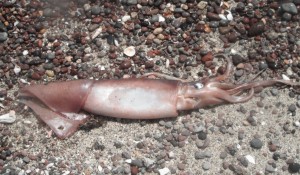
This area is home to lots of coyotes, and we often spot them on the shore.  In some locations there is a wonderful chorus around sunset and sometimes later in the night.  They seem to do quite well here, hunting birds and scavenging at low tide.  Early in the month, we saw a lot of squid washed up on the beach in the morning.  Most of them had been visited by birds, but a few were still flopping around and we were able to help one back into the water where it quickly swam away.  Although these were “only” about 30 inches in length, we think they were Humboldt squid, which are said to frequent these waters and can grow to 5 or 6 feet.  Several times in the last week we’ve also had one or two turtles neaby, periodically popping up their heads for a breath of air before diving back below the surface again.  At least one of them seems to have a pattern of surfacing three times in a row before disappearing for a longer period.


We’ve done less snorkeling and more hiking this year than last, for no particular reason.  🙂  The hiking is amazing, with such a varied terrain and myriad tiny puzzles to ponder.  We’ve really enjoyed picking up rocks of different textures and colors, weighing them in our hands, inspecting their grain, and breaking them open to see something that no one has ever seen before.  There are translucent quartzes with beautiful crystalline structures, shiny obsidian-like pieces, crumbly sandstone, shelves of flaky rock that looks like bark mulch.  There’s iron pyrite, fool’s gold, along with stories of veins of gold that have been mined or searched for in centuries past.  We often see golden sparkles in the sand and along trails. The rock comes in pink, green, salmon orange, grey, and of course various rich shades of brown.  Along the beaches we’ve enjoyed combing for beautiful shells and inspecting unusual finds of bone.  Some beaches are covered with pebbles, some with sand, and some completely with seashells.  We find lots of clams and conches, cowries and others that we don’t yet know the names for.  Many of them have beautiful mother-of-pearl linings or patches of brilliant color at the entrance.  Some have delicate fingers stretching out in a ridge.  In one special location, delicate paper nautilus are known to wash up, and we found a good sized fragment of one.  We’ve allowed ourselves to save a few here and there, and intend to maintain a small collection of our current favorites, until we find the next favorite.  Collecting seems to be an instinctive behavior of humans and occasional other species. 🙂


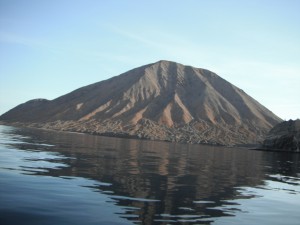
Our favorite place here was almost certainly Isla Coronado.  For those who have a keen memory, there is another Isla Coronado in the southern Sea, which we visited several times last summer.  Both have a volcano that poses an implicit – and irresistable – challenge.  We hiked to the summit of both, for the spectacular views and for the athletic experience.  The one here is 50% higher than the one further south, and the trail more direct and therefore steeper.  It’s not for the faint of heart!  We got an early start, to try to maximize our time in the cooler morning hours and minimize the time with the hot sun blasting down on us.  Even so, the rocks were uncomfortably hot to the touch when we were descending.  The hike was difficult, but not insurmountable.  We’d done a few “conditioning” hikes recently, and were well-prepared for this one.  It took about 90 minutes to reach the top, and we spent about 30 minutes wandering around the summit.  Although the caldera isn’t very pronounced, we walked around the rim.  We flushed out a large iguana, but otherwise mostly enjoyed the view of the neighboring islands.  Coming down we were drawn by the beautiful sight of the cool waters of the bay where we’d stashed our dinghy.


Many of the anchorages here have lagoons hidden inside of the beach, barely visible from the anchorage.  There’s often a small entrance, leading to a channel which may immediately go to a lake-like body of water or wind around some hills first.  We’ve enjoyed kayaking into these lagoons several times, and once or twice we coincidentally timed it well so that we were entering as the tide was rising, causing a nice current to help pull us in.  The first time this happened, the lagoon was huge; we rode the tidal current for somewhere near half a mile.  We rushed past mangrove bushes and several other sorts of plants that were tolerant of wet/dry conditions.  There is a different mix of bird-life in these lagoons, with lots of long-legged storks, herons and egrets, and we enjoy occasionally spotting a red-beak WABA (with-a-bird-attached).  Because the lagoons are usually quite shallow, the water in them is often warmer than the water in the main part of the anchorage, and it can feel like a warm bath or a hot tub on the inside of the dividing berm and a cool splash on the other.  We’ve learned that these are good places to look for clams, should you have a reason to want to. 🙂

As it approaches the full moon (and also the new moon), the tides get higher (and lower).  In places like this, they provide an opportunity that is not used as frequently as in times past.  Boaters can intentionally bring their boats up on the beach, grounding them on the outgoing tide, so they can work on the hull.  This is called “careening” the boat.  Two of the boaters in the area did this shortly before the August full moon, and caused a bit of a stir in the process.  Both of these boaters were sailing alone and knew their boats inside-out.  They each chose to do this because they are independent people who didn’t want to go to a boatyard and pay to have the boat hauled out for a relatively minor issue, but one which needed to be attended to sooner rather than later (one needed to paint the bottom, the other had a leak that needed to be investigated).  Although neither of them wanted much attention, word got out and there were 9 boats in the “best” anchorage at the time.  Everything came out well for both of them. and it was interesting for us to see the thought process that they used in choosing when and where to careen their boat, how they positioned the boat, and the precautions they took before, during and afterwards.  Although we did not careen our boat, we learned a lot about the process, and are more capable of doing it with Lungta should we ever need to.

We’ve been enjoying sleeping outside on the deck recently.  There have been lots of shooting stars in the night sky.  In early August is the annual Perseid meteor shower, which this year fell during a period with a nearly new moon.  This means that the sky was quite dark when we were awake and watching.  For whatever reason, there have been few shooting stars that we’ve both seen, but we’ve both seen quite a few this year, some of them with quite spectacular long tails.  We’ve also enjoyed a few nights with lightening shows on the horizon.  Even nighttime in paradise is wondrous!

The weather has been lovely, but is just now starting to change.  As the water in the Sea warms up into the 80’s, the tropical storms forming in the lower latitudes are starting to become more likely to head up into this area.  So far we’ve only seen the decaying remnants of these storms, in the form of clouds and some gusty winds.  As many of you may know, the tropical storms that exceed gale force winds are given a name, with the names chosen from an alphabetical list, starting at ‘A’ each season.  Historically the ‘J’ storm has often been a rough one for the Baja peninsula and the Sea of Cortez.  There were some nervous comments and nail-biting this last week, as we waited to see what “Juliette” held in store, but it has come and gone, leaving a wet mass of clouds behind as it headed out west into the Pacific Ocean.  Last year this series of storms began coming into the Sea earlier than this year, and the peninsula greened up in relief after a few years of no rain at all.  We’ve had two days with rain so far, and are looking forward to seeing the green re-emerge.  September is typically a turbulent month for weather in the Sea.  We’re staying up-to-date with the weather forecasts via our ham radio, and always have a safety plan in case a hurricane heads our way.


Soon we’ll start traveling south again, visiting some places we haven’t been before, on our way to places we have.  We’ll be meeting up with friends and family in October, before crossing the Sea again for the winter season, such as it is in the sub-tropics. 🙂  More time in Paradise…

Posted in Uncategorized | Comments Off on 8-31-2013 – Bahia de los Angeles, Baja California, Mexico

7-30-2013 – Puerto Refugio, Baja California, Mexico

We’ve found our way back to paradise.  It seems that we are the only cruisers in the northern Sea of Cortez.  We pinch ourselves daily in wonder.  We’ve seen no other cruisers for months, since we headed north of Guaymas on our way up to Puerto Penasco in April.  We rarely even see a fishing panga up here.  From our conversations on the morning ham radio net, it sounds like there may be no cruising boaters within 40 miles of us.  Go figure!

We left Puerto Penasco mid-day on a Saturday, escorted by the Cabrales family on Salvador-the-Younger’s sailboat, ‘Jenny’.  He’s enthusiastically learning all about sailing this salvaged boat, and might, just might, one day become one of our number.  They sailed out the harbor entrance with us and alongside us for an hour or so, before returning home.  We were touched by this friendly send-off, and hope that our paths will cross again some day.

We couldn’t have asked for a nicer day to sail across the Sea to the Baja side, although the winds did peter out before we arrived in Willard Bay the following evening, after a 36 hour sail.  Willard Bay is on the north side of Isla San Luis Gonzaga, and protected from winds from almost any direction.  We dropped anchor and happily dropped into bed.  🙂  In the morning, we hopped in the dinghy and poked around our surroundings, finding the bay ringed with small homes, a tiny town along an estuary, and a tide-dependent sand-spit connecting the island to the mainland.  We squeezed over the sand-spit in the inflatable, and toured down the coast of Gonzaga Bay, a much larger and less populated space than Willard Bay.  Because the view suited us better (fewer man-made structures and more beautiful natural vistas), we moved Lungta 6 miles to the southern side of Gonzaga. 

As we arrived, we were greeted by 4 (not 1, not 2, but 4!) whale sharks lazily circling around the bay.  What a beautiful sight to behold!  These large animals are dark gray on top, and speckled with strings of pale spots that look like sunlight dappling through the water.  They have very wide mouths to bring in as much water as possible for them to strain out the plankton that they live on.  We watched them on-and-off for the entire afternoon.

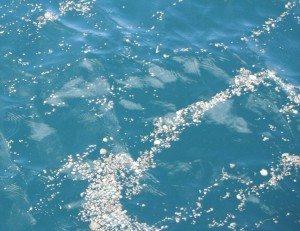
We spent just over a week in the southern portion of Gonzaga Bay, and we totally loved it.  We went ashore a few times, to walk along the beach.  On one of the beaches, the pebbles were collecting in interesting arrangements.  It turned out that these pebbles were super-light pumice, and had been easily shifted into any hollows in the sand as the tide receded.  Later during high tide, we saw these same pebbles floating on the sea!  Who knew that rocks could float?  Makes us feel less precarious about our cement boat. 🙂

One day while we were playing on the beach, we saw a couple of small fishing boats tuck into a nearby cove and disappear out of sight.  We later took a dinghy ride and poked into that cove to see what there was to see.  It turned out to be a long skinny body of water which ended in a sandy beach that shallowed out very gradually, so the width of the beach varied dramatically depending on the level of the tide.  The little boats we’d seen previously were still there, and turned out to be a private party and not a commercial venture at all.  A local land-owner and several guests were enjoying the afternoon in this cove, pulling clams out of the muddy sand with their toes, then prying them open and garnishing them with a dollop of hot-sauce and a squeeze of lime – yum!  They showed us how to harvest some of our own, and we enjoyed a quick and easy clam chowder later that night.  There were three coyotes scampering around on the beach that afternoon. 

One of the locals told us that he viewed the coyotes as a nuisance because they gathered in packs to kill the bobcat cubs, which upset him.  Later that night, and every day afterwards, we noticed coyotes on the beach near our anchorage, including at least two families with a couple of pups.  We really enjoyed watching these guys running around on the beach, foraging and playing together.  One night we even heard a chorus of coyotes yipping and howling in the hills!

While here, we continued our push to have a freshly painted boat.  Our pilothouse now matches the hull, which to us goes a long way towards making her look “finished” again!  We’ve still got a long list of painting projects for the remainder of the summer, but the size of the items on the list is shrinking dramatically!  The one large area left is the deck, and we don’t have the paint for that yet so it may be delayed a while.  🙂

There was one other, distasteful chore that we took care of while in Gonzaga Bay.  We had picked up a stowaway while in the boatyard: a rat that was leaving cute little footprints in all the dust that we accumulated, hard dark pellets in holds and on surfaces throughout the boat, and ragged holes in bags containing food.  Kathy saw him one night while we were still in Puerto Penasco, rounding a corner on the deck.  Ugh!  He was about 6″ long, plus a tail slightly shorter than that.  We had a hard time imagining that a rat could have gotten into the boat, propped up as it was in the boatyard with a nearly vertical steel ladder connecting us to the ground.  But we figured out that we had also left a rope connected to a bucket several nights, which was used to raise and lower tools, groceries, etc, and it seems likely that he could have climbed that.  We purchased a few traps before we left town, but it took nearly a week to catch him.  First we tried sticky traps like fly-paper on steroids, but the rodent just stepped one paw in and then smeared it across the floor as he left.  Then we moved up to the classic mouse-trap style with the spring-loaded wire.  This was a disturbing technique – even more so for the rat, I acknowledge! – but it was successful after a few nights of trying to find an interesting enough morsel of food to use as bait and a way to secure it to the trap.  (A slice of apple was our best solution, which could be tucked under the flange on the trap.)  We set another morsel out without the trap the next night, to make sure that we were only dealing with one beastie.  I guess we’re collecting all of the classic boating experiences, some better than others.

From Gonzaga Bay we sailed 40 miles south to the northern end of Isla Angel de la Guarda, to an anchorage named Puerto Refugio.  We’ve heard this place glowingly described for years, and have been looking forward to making it up here.  It bears a lot of similarity to San Juanico, our favorite spot from last year.  It has a rough, craggy, multi-colored rock coastline, with a few small beaches sprinkled here and there.  It also has a number of rocky reefs, which are great for snorkeling, diving and fishing.

One day we walked a beach covered with fist-sized smooth stones, and collected a few beautiful shells – but, for the record, we want to be sure you all know we’re *not* collectors!  🙂  There were also a number of sun-bleached bones on this beach, including a 9-foot whale rib.  What happened to the rest of the skeleton?  Nearby were a couple of unfamiliar artifacts that Dan suggested might be a (part of a) baleen; they consisted of a roughly 12″ triangular lattice of something like cartilage, with a thick fringe of 2″ bristles along the edges.  We snorkeled here and saw more small stingrays than we’ve seen anywhere else – there must have been a convention!  They were almost all searching along the sandy bottom for food, and many of them had a school of small fish eagerly hanging nearby to snap up morsels that the ray flushed out but didn’t consume.

There are a few outlying islands, one of which, Isla Granito, is a sea lion rookery.  We heard them barking continually at all hours of the day or night.  Although we haven’t yet learned how to communicate with them, we enjoy their language, especially when we’re sailing at night and one comes alongside letting out a call.  We occasionally respond, and the conversation that ensues is pleasant if not exactly communicative!  We spent a few hours one afternoon at Isla Granito, communing with the sea lions.  We took the dinghy over along with our snorkeling gear, intending to swim with them, but there were a number of large bulls around who seemed to be threatened by us and the dinghy, which made us a bit nervous.  So we dropped our small anchor and just watched.  Dan pointed out that it isn’t every day one gets to live a National Geographic episode.  We hung around 4 different groups, trying to make out the stories of the different characters.  Each group consisted of anywhere from 5 to 20 adult female sea lions many of which had a tiny pup nearby.  There was invariably one big male bull with a neanderthal brow swimming back and forth, braying his intention to protect the females and pups from any threats (that would be us, apparently).  A few of the males had serious injuries to their tail flukes, which we interpreted as a sign of quarrels with other males.  One of the males was missing one of his “feet” (half of his very prehensile tail).  On shore, the pups endearingly clambered over the rocks and other sea lions, while the females lazily enjoyed the late afternoon sun.  After we moved on down the coast a few slipped into the water, leaving us to wonder that our presence was disturbing them.  At the end of the island was another group that appeared to be less organized.  We determined that these were the single males who had no “harem” of their own.  By contrast, as we approached many of them jumped in the water and began cavorting all around us.  Although they were interacting with each other, it seemed that our arrival on the scene initiated all the activity.

We’ve had more encounters with the Mexican sweat bees that we met last year.  Unfortunately Dan has had a few miscommunications with them and has racked up three stings in as many days, mostly because he stepped on or bumped up against one that he didn’t know was there.  The resulting welt is painful and then itchy for 3 or 4 days.  These guys are quite persistent in their search for water, and they can smell it around our boat.  One day we left on a dinghy trip and returned 2 hours later to a boat filled with the buzzing of bees.  It didn’t take long to usher two dozen of them out the windows – they are pretty docile little fellows.  We’re now living with the screens back in all our windows, and rarely have more than 2 or 3 bees in the boat at any time.  But if we’re out on the deck during the day we need to be vigilant, because they’re constantly poking around all the corners of our “stuff”.  They disappear when the sun does.

At night we’ve been enjoying sleeping outside on the deck.  As the moon wanes and rises later each night, we get nice views of the amazing celestial show.  The Milky Way is clear as a bell, and the stars bright and glistening.  I’m certain there are more there now than we had last year!  We’ve seen satellites and planes go by, and we’re starting to see quite a few shooting stars.  Apparently there are three meteor showers coming up in the next few weeks.  One of the planets (Venus?) is extremely bright on the western horizon, and we’ve watched it set many nights.

In Refugio we spent some focused time on repairing some leaks on our dinghy.  We had a slow leak in one of the inflatable pontoons, and were having to pump up every few days.  We also had a leak of water through the floor, which was getting much worse and we had to bail every time we used the dinghy.  The motor was finicky and we needed to do some more work on the carburetor, and one of our tires had gone flat (again!).  The air leak turned out to be a tiny pin-prick, probably from a fishing hook before we even made the chaps.  The water leak took a few tries to get under control, but is now manageable.  The engine is working much better, thanks to a new set of carburetor gaskets.  And we’ve come up with a fix for the wheels that we hope will protect them from future trouble.  We’ve had three tires go flat now, and it seems that the weak point is the fill stem, which must be breaking free from the rubber under some form of pressure.  Dan’s theory is that it happens when we get mired deep in sand.  So we crafted some wedges from some scraps of wood, which fit into the wheel base and surround the stem.  Hopefully this will help protect them and we won’t have to deal with this problem again!  We love our Danard dinghy wheels!  They’re sturdy and easy to use.  And now, hopefully, ours will be even more reliable for us to bring our dinghy ashore.  It feels good to make changes to our surroundings, even relatively minor ones, that improve our quality of living.  The cruising life offers lots of opportunities for this.  🙂

So that’s the news for now.  We’ll post again when we’re back in range of the internet.

Posted in Uncategorized | Comments Off on 7-30-2013 – Puerto Refugio, Baja California, Mexico

6-30-2013 – Puerto Penasco, Sonora, Mexico

Puerto Penasco has turned out to be one of those “sticky” towns for us, where one stays longer than originally expected.  We planned to paint our boat and be gone in about a month, but it’s turned into a stay roughly twice that long.  Fortunately now we can clearly see the light at the end of the tunnel (please, no replies referencing railroad trains!)


We had the boat sandblasted, which saved us loads of time on sanding the old paint off the hull, but then we had to put a protective layer back on before painting.  We planned to spread on a smooth layer of epoxy by hand, give it a quick sanding and proceed from there.  Roughly a week’s work, right?  But then this guy walked by the boat and started talking with us about the paint-job.  He and his wife run a painting business in Phoenix, and have a house in Puerto Penasco that they visit almost every weekend.  He said it would be “fun” to spray the boat for us (his words!) with his professional airless sprayer.  Wow!  We decided that if we were going to have a “fancy” paint-job (our words) then we ought to fair the boat smooth, because a smooth and shiny paint would show all of the bumps and ripples in our hand-built boat.  So we purchased a super-high-tech paint, courtesy of Craig’s wholesale discount, and our one layer of epoxy turned into two, then three, and the sanding of each layer became more and more thorough.  Unfortunately somewhere in there a terrible mishap occurred: Craig’s lower back threw out not one but two disks.  Ouch!  So we’re alternating between cursing him and blessing him for starting us down this path of fairing Lungta’s hull smoother than we ever expected.  Even so, it’s probably a good thing that we’re rolling the paint on, because we’re really not body-work professionals and what’s smooth to us is not going to be mirror-flat.  The gentler ripples of a rolled-on finish will help to accent the big curves of the hull while downplaying the many smaller ones (we hope!).


Puerto Penasco is near the northern end of the Sea of Cortez, and only 60 miles from the U.S. border.  It is known for having one of the highest tides in the world – up to 23 feet changes at times!  (See above for what difference a 17-foot swing can make.) During the second week we were here, we borrowed a truck from the boatyard and drove up to Phoenix for a whirlwind two-day trip.  We enjoyed being on the road for a while and appreciated all the shops with familiar products and hard-to-find items, including specialty foods and boating needs.  This seems to be an annual trek so far, but we don’t expect it to continue once we’re beyond Mexico.  We were told by several people that Arizona has more boats per capita than any other state, but we did not find as many marine services as we expected.  (For example, we need a gasket set to rebuild the carburetor for our Suzuki outboard motor, but couldn’t find a Suzuki marine dealer in the entire Phoenix area.) However we’ve also learned of a business that has a wonderful shipping service for Americans in Puerto Penasco.  The guy runs a gas station in a town called Lukeville, that’s just 200 feet across the border.  He accepts shipments of packages for folks who can drive up to the border to pick them up, and charges just $10. 


While we’ve been here, Dan did some internet research and finally tracked down a replacement starter motor for our 1964 Rolls-Royce locomotive engine – not an easy find!  Attentive readers of this blog may remember that we’ve had several rounds of trouble and corresponding searching for someone who could repair our starter, and although it works about 80% of the time (and we’ve learned what to do to get it to work in 80% of the times when it doesn’t) that’s not a confidence-inspiring hit-rate!  So after asking lots of questions about obscure measurements of the current starter, they found a new one that should be able to replace it.  When we first began looking, Dan estimated that a replacement would cost about $2000, so we were prepared to wince and move on, but SW Diesel were our heroes of the month, finding us a new starter for less than $600 (even with the $10 receiving charge at the border 🙂 )! Surprisingly, it’s a lot smaller than the original, 27 pounds as compared to 65.  Two of the three mounting bolts (including the one Kathy has dubbed the “impossible bolt”) are now much more accessible than before – although we don’t really care about that if we never have to remove it again. 🙂  It’s a generic modular model which can be mounted in three different positions.  Unfortunately its lumps and bumps are arranged differently than the original, and none of the three is a straight drop-in.  We had to replace a rigid hose for the engine’s coolant system, using a flexible hose.  Since we’re out of the water right now, and the engine can’t get any seawater, we can’t fully test the starter yet, but we’re excited and hopeful that our starter woes are over!

Puerto Penasco is a small town with a big tourist industry and a small harbor supporting a shrimping fleet.  The harbor has a large resident population of mullet.  How do we know they’re mullet?  As one long-time resident fisherman told us “mullet jump”! You can’t look out into the harbor for more than 5 seconds without seeing one.  It doesn’t seem to have anything to do with time of day or tide or any other pattern we can discern.  They just jump – it’s actually somewhat mesmerizing, the randomness of the jumping all over the water’s surface.

The boatyard we are in is owned by a family that runs a small shrimping fleet, but also services most of the boats in the town’s fleet.  The shrimping season begins in September, and virtually every boat gets hauled out some time between June and August for painting and whatever repairs are needed from the previous season.  Many of them get sand-blasted before repainting, spewing huge clouds of dust on everything within a quarter mile downwind!  We live with a perpetual layer of dust on all surfaces.  With the high summer temps we have to keep the windows open to survive so the dust covers the interior of the boat as well.


They’ve got an ingenious system for the lettering of the boat’s name: they have cut-out letters which get welded to the steel hull, causing the letters to be raised from the surface.  Then when it’s time to paint the boat, the raised letters are easy to paint from a roller on a long pole from the ground.  All of the shrimping boats here are made of steel, and we saw one feature of steel that’s really efficient – if the engine (or any other major piece of equipment) needs servicing, they can cut a big hole in the side of the boat, weld a couple of hinges to it, and use it as a door to remove the equipment needing to be replaced.  Then when they’re through, they simply weld the door shut and the boat is sea-worthy again.  I’m pretty sure we couldn’t do that on our cement boat!


Both father and son of the Cabrales family, who own the boatyard, are named Salvador.  This was initially a little confusing for us to distinguish who we were referring to, but it’s a common practice in Mexico.  Both men are genuine and thoughtful people, and have made our stay here pleasant and productive.  They are accomodating with whatever unusual requests we may have, generous with their facilities (remember the truck that we borrowed early on to visit Phoenix), and offer advice or help when needed, but are very comfortable with allowing us to do most of the work ourselves.  Many boatyards that service primarily cruisers are hungry for the additional revenue that comes from doing the work for the clients, and frequently prohibit owners from doing the work.  A visit to a boatyard can be a very expensive proposition, but our visit to the Cabrales boatyard was quite reasonable.  By the way, the name of the boatyard is Astilleros Cabrales, where the word “astillero” is derived from “splinter”, because the traditional boatyard dealt with wooden boats.  The family is enthusiastic about bicycling, and does long rides together several times a week, sometimes with a small crowd of friends.  we’ve noticed that bicycling is fairly common in Puerto Penasco, more so than any other Mexican town we’ve visited so far.  We’ve been enjoying using our bikes to get around town as well, and have begun to feel like we know our way around pretty well.


Well, June is turning into July, and summer is passing us by.  We’re working long days, and going to bed exhausted. It’s a good feeling, but we’re about ready to move on – we can count the days until we will be heading back into the water (11 🙂 ).  And now, it’s time to get a bowl of gazpacho and call it a day.

Posted in Uncategorized | Comments Off on 6-30-2013 – Puerto Penasco, Sonora, Mexico

5-23-2013 – Puerto Penasco, Sonora, Mexico

We’re currently sitting 15 feet above the ground, in our boat, but “on the hard” – in Puerto Penasco, way at the northeastern end of the Sea.  We spent most of the last month traveling up the western coast of Mexico (but inside of the Baja peninsula) in order to get the boat hauled out of the water for a new paint job.  It was a full trip, with a variety of experiences, and some surprises! 

We started out by heading just a few miles west of La Cruz, to Punta Mita where we had first visited with Kathy’s mom just a few weeks previously.  There were a number of boats there, and we spent a very pleasant evening gathered with most of them on a friend’s boat,”Final Escape”.  We were enthusiastic about getting underway, so we left early the next morning.  We had a lovely sail for a few days, in light winds with calm seas.  There wasn’t as much wildlife as we’ve sometimes seen, but we did spot a few whales, one of which was breaching repeatedly.  He must have jumped a dozen times in a row – it was very impressive!  We also saw quite a few of the small leaping mobula rays, which make us grin whenever we see them.  We caught a couple of fish on this stretch, the first one a sierra which puts up a bit of a fight, but is worth the effort.  The second fish was a bit of a surprise, because the line was hanging straight down, almost as if it might touch the ground, but it was clearly moving back and forth as well.  It turned out to be a red snapper, locally called huachinango, and it was a big fish too – about 25 pounds!  It is a beautiful copper-orange color, and offered 12 very tasty meals. (But at this point we decided that we had enough fish in our freezer for time being, and didn’t put the line back out again for the rest of this passage.)

We try to stay in touch with the weather when we’re underway, using the morning ham radio nets. Actually there are two that we’ve been using, one of which, the Sonrisa net, is a ham net, and the other, the Amigo net, is a marine single-side-band net.  SSB is very similar to ham, but with fewer requirements for training/credentials.  The Sonrisa net begins at 7:30 and the Amigo net at 8:00.  Both of them have weather forecasts 15 minutes later, so if all goes well we can catch two versions of the forecast each morning.  However it turns out Murphy was a sailor, and it’s rare that we get both forecasts.  Fortunately we are also able to get weather forecasts via internet, so whenever we are in cell range we can get that important information.  The radio communication is affected by all kinds of factors, including weather, distance, proximity to obstructing objects, and solar activity, and it tends to degrade as the sun gets higher.  We often hear some of the conversation but not all of it.  Every day the net controller is someone else, so some days we are close enough to hear them, and some days we don’t hear them very well.  On this trip, we frequently heard 3 boats check in daily who are on their way across the Pacific to the Marquesas Islands.  That was pretty exciting!  And we knew two of them from our travels in the Sea of Cortez last summer.

About 3 days after we left Banderas Bay, a strong northerly wind blew through, which was predicted well in advance.  This weather pattern is pretty common in the winter and dies off as summer approaches. It brings with it very strong winds coming directly from where we were headed, and creates big waves over several hundred miles of fetch, so we decided that it would be more pleasant to be tucked out of the way than underway and decided to push to reach Mazatlan in time for that event.  We entered the harbor in the evening, and anchored in the same place we’d been before, Club Nautico. This is the place where our dinghy was stolen, so we were a bit jumpy while we were there, but our stay was actually quite pleasant.  We were there three days while the wind howled outside the harbor.  We’re getting to know a few more places around town, and it’s “familiar” when we return.  That’s kinda cool!


We were ready to go, though, as soon as the weather permitted.  And once it did, we jumped.  We had another 4 days of lovely sailing.  We saw a few sea lions on this leg of the journey, a first for us on this side of the Sea.  They were very curious about the boat, and they would swim alongside for quite a while, checking us out.  Several times we saw them doing something odd: they were floating along at the surface with their fins sticking straight out into the air.  We had seen this once before in San Diego, from a distance, and we thought it was a carcass.  But this time it was clear that they were doing this intentionally.  Dan thought they were sleeping; Kathy thought it was more like sun-bathing.  Whatever the intent, we thought it was cute!  We also saw a lot of sea birds in this region, all the usual suspects but in larger quantities than before: frigates, pelicans, boobies, terns, and even gulls.  At night the frigates and sometimes boobies would try to perch on top of our masts or the spring-stay that connects them.  We wouldn’t mind, except that they make a mess down below, and every morning we’d wake up to a deck full of white patches.  So we took to chasing them off whenever we could.  We usually do this by shaking the shrouds from the side of the boat, which causes the mast and other stays to jiggle, causing them to lose their balance.  But Dan figured out a new, very effective night-time technique: shining a very powerful flashlight at them when they circle around to land again.  Presumably the bright light makes it difficult for them to find their footing on the skinny line.  The frigates are very persistent, though, and will circle around repeatedly, frequently more than a dozen times!  This game isn’t always a fun one for whoever was sitting watch at 3am!


Shortly before reaching Guaymas, we contacted the boatyard again, to clarify some details about our haul-out, including what route to take through the very shallow harbor to get to them.  Unfortunately, it turns out that the harbor is too shallow for our “deep draft” boat – even at high tide – and this had been overlooked the first time we contacted the boatyard.  So we passed on by Guaymas, and hurriedly came up with a Plan B.  Friends on Dejala had told us that last summer they spent some time in Puerto Penasco, and that there was a big shrimping fleet there.  So we contacted the biggest boatyard there and found that they had the capability and space to haul us out.  They regularly have tides over 15 feet, and occasionally up to 23 feet, so we knew we could get to their front door at least once a day, any day.  But that meant an additional 400 miles of travel – how awful is that!  🙂

We spent the next night at an anchorage just north of Guaymas/San Carlos, and as we pulled in we saw that there was another boat already there.  Shortly after we dropped our anchor, a young man on that boat dropped a surfboard into the water and paddled over to greet us.  He wanted to know if we’d had a recent weather forecast.  He and a friend were sailing around the area for a couple of weeks, and didn’t want to bite off more than they could chew.  We told them that another northerly blow was due in a couple of days, and discussed a few possible places to “hole up” while it blew by.  The next morning we took off again and motored the last several hours to make sure that we’d be in a well-protected place when the wind raged once again.  Our starter has begun acting up again, and Dan had to go down below to give it a nudge.  Immediately after the engine started up, the fishing pole let out a squeal: we had another fish on the line.  This was another sierra: they seem to have a funny knack for biting at oddly inconvenient moments!  When the boat accelerates right after starting the motor, the lure jumps in a way that seems appealing to a hungry fish – who ends up satisfying a hungry human instead!  We reeled it in, cleaned it up, and popped it in the freezer for the next few days.

We stopped along the southern side of the largest island in the Sea, called Isla Tiburon.  Apparently it was a holy place for the indigenous people, and visitors are discouraged from exploring the interior very much.  We only stayed 36 hours, but the winds really howled, ramping up from the late afternoon and through the first half of the night – we saw gusts of 38 knots, which is comparable to the fringes of Hurricane Paul last summer!  Finally around midnight it peaked and began to settle out, although it wasn’t at all calm until almost dawn.  We waited until the middle of the next day before we poked our nose around the corner and began heading north again.  We had another great sail, and enjoyed lots of wildlife sightings, from huge pods of dolphins to squadrons of birds plummeting down on a roiling bait-ball of fish.  There were a number of islands around, but we stayed several miles off. 

This area does not have much to offer with respect to anchorages, so we were committed to going the  remaining couple of hundred miles without stopping.  We didn’t have much in the way of a weather forecast either, so we were hoping that following close after a norther might be a good strategy. There is a saying, “when it rains, it pours”.  Well, we didn’t get any rain, but we got wind, in spades!  We took three more days to get to Puerto Penasco, and were traveling quite briskly most of the time.  It was an exciting ride, and although nothing especially bad happened, we found it a little too exciting for much of the time.  As the winds increased, so did the choppiness of the waves.  We repeatedly reduced our sail exposure, and the for last several hours before arriving at Puerto Penasco we were down from 5 sails to a single sail, the smallest one – and still traveling around 5 knots in 30 knot winds.  The winds blew incessantly the last 48 hours. Even in the middle of the night the winds never calmed below 25 knots.  We did everything shy of setting a drogue to slow down the boat but we arrived at 4am and dead low tide, so we had to wait a few hours for both the sun and tide to rise.  We faced into the wind and waves and turned on the motor to try to smooth things out a bit.  During this time, Kathy noticed that the dinghy was not hanging off the back the way it should be.  When we looked a little closer, we found that one of the lines holding it up had chafed through in all the turbulent waves, so it was hanging from lines that were only supposed to prevent it from swinging wildly and not intended to bear much weight.  It was canted steeply to one side, and many of the things inside (gas tank, small anchor, paddles) were threatening to fall out.  Fortunately nothing did fall out, and the outboard motor was not yet submerged.  We managed to tie on another line, a halyard from our mizzen mast, so we were able to use a winch to haul it back up temporarily.  It has a slow leak in it, and after 3 weeks of travel it was collapsing pretty seriously.  The whole thing looked pretty sad.  We were wiped out after the long trip, and glad when conditions finally allowed us to enter the small harbor.  We actually came in a little earlier than we should have, because we saw readings of 11 and 12 feet on our depth gauge as we transited the entrance channel. (Since we draw 10 feet, this is cutting things a little close, but we knew that the rising tide would lift us off within minutes if we ran aground.)

We arrived about a week earlier than we’d expected, so we needed to find a place to wait until we could get into the boatyard.  We had heard that there was a big side-tie slip that was not used during the week, while the resident boat was away on passenger trips.  So after looking around for other likely candidates, we pulled up to this slip.  The dock was completely covered with pelicans, so when Kathy jumped off Lungta to tie off our dock lines, it was very slippery with at least 1/4 inch of slimy pelican poop covering the entire surface – yuk!  A guard came down the ramp, though, and told us that we could not stay, even for a few hours while we looked for another place.  So we pulled away again.  We were unable to find anything else, so we just dropped anchor off to the side of the harbor’s center.  We reinflated the dinghy and dropped it in the water, found the boatyard and met our contact there.  He gave us a quick tour of the place and told us that they could get us in at noon the next day.  We checked in with the harbor-master who told us it would be OK to leave the boat where it was until we hauled out, so we went home and fell into bed for several hours of restorative sleep.  It was good to be in a calm harbor again after sailing the entire length of the Sea of Cortez without once getting off the boat.

Posted in Uncategorized | Comments Off on 5-23-2013 – Puerto Penasco, Sonora, Mexico

4-5-2013 – La Cruz, Nayarit, Mexico

Almost a month ago, I began a new blog article with “We’ve recently returned from our latest “excursion”, where we stash the boat in a safe place and leave home for a while.” Well, it’s no longer “recent”, so rather than give you the blow-by-blow of our “planes, trains, and automobiles” trip (although more accurately it was a “bus, ferry, and automobile” journey), I’ll give you the Reader’s Digest version and then share some other events that have also unfolded in the last few weeks.  

In late February we made our way back to Baja, via ferry from Mazatlan. We met Kathy’s sister Jean in Cabo and went to San Ignacio to see the gray whales that had been calving.  The hope was that we would find a friendly mother and baby that wanted to spend some time with some nice Gringos.  We did indeed see quite a number of mother/baby pairs, some of them breaching or more often spyhopping, where they poke their noses up into the air to see what’s “out there”. We joined up with a boat full of exuberant Italians that were playing with a pair.  We each had the opportunity to touch both mother and baby, and to look into their faces.  (In case you’re wondering, Kathy decided that a gray whale’s skin feels much like a slightly ripe plum: smooth and fleshy but not overly soft.)  A few days later we took another tour in Magdalena Bay, where we spent time watching juvenile males and mating couples and spent quite a while near a mother/baby pair on our way back through the channel.


We spent several days driving around the lower Baja, sometimes on the verge of being lost.  We passed through a place that was platted out to be the town of Aguas Blancas, where the only thing missing was  EVERYTHING but the already weather-worn street signs; no buildings, no roads, no infrastructture at all but the carefully and hopefully constructed street signs and some advertising, already in need of replacing.  It was all in middle of the desert and 200 feet off the beach.  We followed another road that led to the town of La Purisma, an oasis in a canyon many miles from what most of us would call “civilization”.  It was spectacular, with tall cliffs, lots of palm trees along a river running through the desert and the largest and most colorful bougainvillea known to man.  Actually we visited three of these oases, and coincidentally, three missions from the Spanish colonial days that are still active. It was wonderful to spend a week with Jean, and fun to see some places by land that we’ve only passed through when traveling by sea.


After we got back to La Cruz, we dove into the social scene for a couple of weeks, knowing that we weren’t going to be here long. We met up with several of the boats that we had known last year, we visited with a few folks that are land-based locally, and we added a few new boating friends to our list.  MaryJo (who was our crew in January) and Alyssa (who headed south with us to La Manzanilla in December) are now roommates and actively planning lots of events for The Octopus’ Garden (aka The Pulpo).  We went to a fashion show that they organized, saw Aly perform hula-hoops in the park, and joined them for MaryJo’s birthday party.

We’ve worked on a few projects around the boat that turned out to be bigger than expected, but are satisfying to have done.  We installed a small 2.5 gallon hot-water heater near the shower in the forward head, so that we don’t have to heat 15 gallons of water in the full-size one for just a shower.  We can now flip on the inverter and take a hot shower 10 minutes later instead of running the generator for two hours. We discovered a new type of plumbing that appears to be widely used here in Mexico.  It’s like PVC pipe, but more flexible and coated with a thermoplastic layer that gets melted with a special heat plate tool to join the pipes and fittings.  It’s quite easy to get a good joint (unless you try to avoid the special tool and use a heat-gun 🙂 ), and we expect that the flexibility of the material will result in fewer leaks over time.  But we had a bear of a time getting the connection to our old brittle copper pipe to be leak-free!  We were without water for a full day, without water in the forward head a second day, and lived with switching the water on whenever we needed it in the forward head for the week that Kathy’s mom was visiting!  Fortunately we finally addressed all the side-issues, and are now enjoying good hot showers for much less power.  We also installed an outdoor shower (cold only, but fresh water) because it sounds like a really nice thing to be able to rinse off after a dip in the sea, or a couple of hours of working on the hull or…  Kathy made some covers for various items to protect them from the sun, including propane canisters, gas cans, and lots of bungee cords that we use to secure things around the deck.  Although we love the sun, we also have to be constantly attending to its damaging effects.

Kathy’s mother Marilyn came to visit for a week in late March, and we took a break from (most of) the boat work.  We took her for a short sailing trip, stopping in Punta Mita on the north-west corner of Banderas Bay.  We hadn’t been there before, but lots of our friends enjoy it, so we showed her something of what it’s like to go adventuring.  We saw several whales along the way, at a distance, but breaching dramatically and repeatedly.  She also enjoyed seeing a passing school of dolphins and watching the pelicans and blue-footed boobies dive-bombing kamikaze style into the water in pursuit of dinner.  They seem to dive so confidently and then come up so pleased with themselves, it is quite charming.  Bringing the dinghy in past the surf break was a little unnerving for us, but we talked with a few people beforehand and got the scoop on how to approach it.  We timed it just right, and looked as if we were old pros.  We went to a great pizza place that we’d heard of, run by a very sweet Swiss woman who also bakes multi-grain bread and something like challah – we got a loaf of each! We had a really nice sail in both directions, and impressed our neighbors by leaving the anchorage under sail (as opposed to motoring).  Her last full day with us, we ventured into Puerto Vallarta and beyond, in search of the Botanical Gardens.  We enjoyed a small lunch in the restaurant on the hill looking down on the whole park, a peek through the orchid and vanilla greenhouse where we saw some plants of amazing colors and shapes, and then a nice stroll around some of the hilly trails in the jungle.  It’s a small non-profit organization that has done a nice job putting together a beautiful natural sanctuary.

This last week there have been several scary events in the anchorage, where boats dragged their anchors and were at risk of serious damage.  The first one actually went on the rocks, but just barely, and after a couple of hours of hard work 6 or 7 dinghies and 2 or 3 power boats were able to pull them back onto the water and brought them to the marina to check for damage.  The second one drifted clear across the anchorage, missing quite a few other boats, coming to a crunch on Lungta!  It was a largish catamaran (40 or 45 feet long), and it ran into our bow-sprit and got tangled up in our anchor chain and the chains going up to the tip of the bowsprit.  We were just working on fending it off and keeping it from damaging the anchoring system, our solar panels or anything else, when 3 or 4 dinghies materialized out of nowhere and joined us in addressing the situation.  Someone had noticed the crisis and put out a call on the radio and everyone who could came out to help.  We put our spare anchor and some heavy line on the catamaran, and our friend Bo from Aquarelle figured out how to start the boat and maneuver it. Eventually the group was able to get it to a good anchoring place, drop both the original anchor and ours, and get a message to the owner who had been in Puerto Vallarta for the day.  Our boat sustained very little damage, essentially only scratches, and the “other guy” had a good bit of work but all relatively minor compared to the potential damage of running aground.  Whew!

The third event was the most dramatic yet.  On Monday afternoon a call went out on the radio for help, as a boat out in the bay was having engine troubles and wanted someone to tow them in before they were blown aground.  They had tried to deploy their sails, but their boat is an unusual design that does not go into the wind very well, mostly just down-wind.  Unfortunately the winds were blowing directly on-shore, so without an engine they were in trouble.  They didn’t manage to deploy their anchor until they were already in surf, and the breaking waves prevented them from getting a good set on the anchor, so they ended up hard aground.  The only good thing about the situation is that the ground they hit was very smooth sand, no rocks at all; as a matter of fact, it was a prime swimming beach for a fancy resort hotel!  The boat is an unusual one, a Chinese junk built in 1925 and brought to Washington state for the 1974 World’s Fair in Spokane.  It had a colorful but sad series of owners – including a brothel – before it came to be owned by an artist, the father of a friend of ours in Portland; over the course of the next 20 years or so, Sergei and his father lovingly restored it to a beautiful showpiece.  The Flying Dragon is not really designed to be a sea-going vessel so we were extremely surprised to see it appear in Mexico roughly a year after we last saw it in Oregon!  A youngish couple had bought it and brought it down the coast with her 11-year-old son.  The Flying Dragon is about 50’ long and weighs about 20 tons, including at least one ton of rocks stored in the lowest hold of the boat.

Folks came out to help them that evening, and they spent all night trying to pull them off.  High tide was near 4am, but ropes kept breaking and the waves kept marching the boat further up the beach.  By morning they were sitting in less than a foot of water.  They put out a call for more assistance (but volunteer, because the family has virtually no other resources than this boat that is their home), ranging from power boats to pumps to heavy ropes.  Dan realized that, although we aren’t a power boat with a lot of pulling power, our anchor system could be used to help bring them back out on the water by providing a steady pull whenever the waves lifted them just a little bit. They found a back-hoe that could be used to scoop out sand from behind the boat or to lift or tug on the boat as needed.  A rigging specialist showed up to offer help with setting up bridles that would safely bear the loads.  We motored over and dropped our anchor, then went ashore to participate in a planning conversation, where it was decided that we should relocate a little bit to one side.  It’s funny how sometimes things that go smoothly under normal circumstances develop problems when they are more critical (or perhaps more public). Somehow our anchor got twisted in the chain rode, such that it was upside down with one of its flukes wrapped around the chain going up to the boat.  Just lowering it like that would not allow the anchor to set and this was not the time to accept marginal holding!  So while Kathy stalled the shoreside team via radio, Dan and two other guys (Merle from Kenta Anae and Frank from Fluenta) pushed and prodded the anchor until they were eventually able to take the weight off and unloop the chain from the anchor’s fluke. Finally we were able to get a good set on the anchor, and extended out 350 of our 400 feet of anchor rode (200 feet of chain followed by 150 feet of rope).  A swimmer brought a tow rope out through the surf and a dinghy brought it to Lungta.  We tied it to another bridle on Lungta’s stern.  After taking in the slack, we tried to just maintain a steady pressure using our relatively substantial anchor windlass, taking in any additional slack that appeared whenever they were able to turn the Flying Dragon’s bow a bit more out to sea, or the waves picked up the boat ever so slightly and allowed it to inch seaward.  We used the motor to take the pressure off of the windlass most of the afternoon, and even to try to pull the boat off the shore once we gained more confidence.  Although we originally thought that we were really just trying to keep them from getting pushed further ashore until another bigger effort could be made at the high tide at 4am, over the course of the day it began to look like we might be able to get them off before then.  A couple of power-boats tied into the tow rope and each pulled as well for a few hours, and it was clear that progress was being made.  As the Flying Dragon inched off the beach, we maintained the pressure on our anchor line, inching Lungta slowly away from shore.  When Flying dragon was about 30 feet off the beach, we ran out of rope and needed to switch over to pulling on the chain.  As Dan was working on this switchover along with Merle and Frank, and just as the sun was setting, the power boat Island Grace was able to pull the last bit to get the Flying Dragon out of the surf.  Flying Dragon was towed in to the Nuevo Vallarta Marina, to the great joy of Regis, Sybil and the hundreds of people who had either participated in the rescue, listened to the  unfolding story over the VHF radio, or just witnessed the events on the beach while staying in the resort hotel. 


We were ready to go home, so we went to pull up our anchor, but something went wrong and after about half of it was up a loud bang came from the windlass and it stopped working.  The brass “key” that keeps the shaft turning along with the motor’s sprocket had sheared.  This is an unusual event, but not new.  This design feature is to protect the shaft from shattering or some other more serious damage to the windlass in the event of an overload.  We recognized what had happened and quickly switched modes to finish pulling the last 100 feet of chain and the 230 pound anchor up manually, using a long rope to get a bite on the chain and bring it back to the biggest winches we have, at the back of the pilothouse.  We took turns cranking and retieing the knots that grabbed onto the chain.  It took us close to an hour to get it all up, and we were exhausted!  Another hour later we motored into the anchorage and fell into bed.

The next morning we surveyed the “damage”: our dinghy had developed a significant leak because of a gash it got when we were trying to untangle our anchor from its chain; and the windlass shear-key needed to be replaced, along with a large fuse that protects the windlass and had blown for reasons that we still don’t understand.  On Wednesday we got our dinghy patched, but it had to stay unpressurized for 24 hours, so it didn’t go back into the water until Thursday.  We also found an electrical shop that had the large fuse we needed for the windlass.  Apparently they’re used widely in house electrical boxes, not for individual circuits but rather for the whole house.  We found one with a cool design; they call it “renewable”, and you can unscrew the cap to open it up and replace only the fusible element rather than having to buy a whole new fuse.  We got one fuse and 12 replacement plates (hopefully a lifetime supply!) for the same price as two whole fuses would have cost – hurray!  We also tracked down a machine shop that could help with the shear-key.  They could get material and cut it to size by mid-day Friday.  Thursday we disassembled the windlass, and as often happens when you’re tired it didn’t go easily.  We broke a dead-blow hammer in the process, and we now have hundreds of teeny-tiny lead pellets rolling around on the deck. 🙂  But we did eventually get it apart, removed the sheared brass key and installed a new one that Dan was able to fabricate from a larger piece of brass we had on board.  So on Thursday evening we went to bed exhausted but essentially with our boat functional again – still a shambles, but functional!

Now we’re going to resume our previously scheduled program.  We’re going to do a bit more socializing for the next week, finish up a few more smallish boat projects, and head north into the Sea of Cortez.  We have been planning to go directly to a boatyard and do some major painting, and we’ve let the marine growth on the bottom get out of hand. Then we were told that the boatyard is full and we thought we had been caught in a big blunder.  Our haul-out plans have been on-again, off-again a couple of times, but today it looks like we’ll be able to haul out in May instead of shifting it to October.  We’re looking forward to having a pretty boat again!  Lungta is looking scratched up and much the worse for wear these days.

So now you’re caught up with Life on Lungta.  Hope spring has all of you feeling renewed and excited about the things that are happening in your life!


Posted in Uncategorized | 1 Comment