5-6-2014 – La Cruz, Nayarit, Mexico

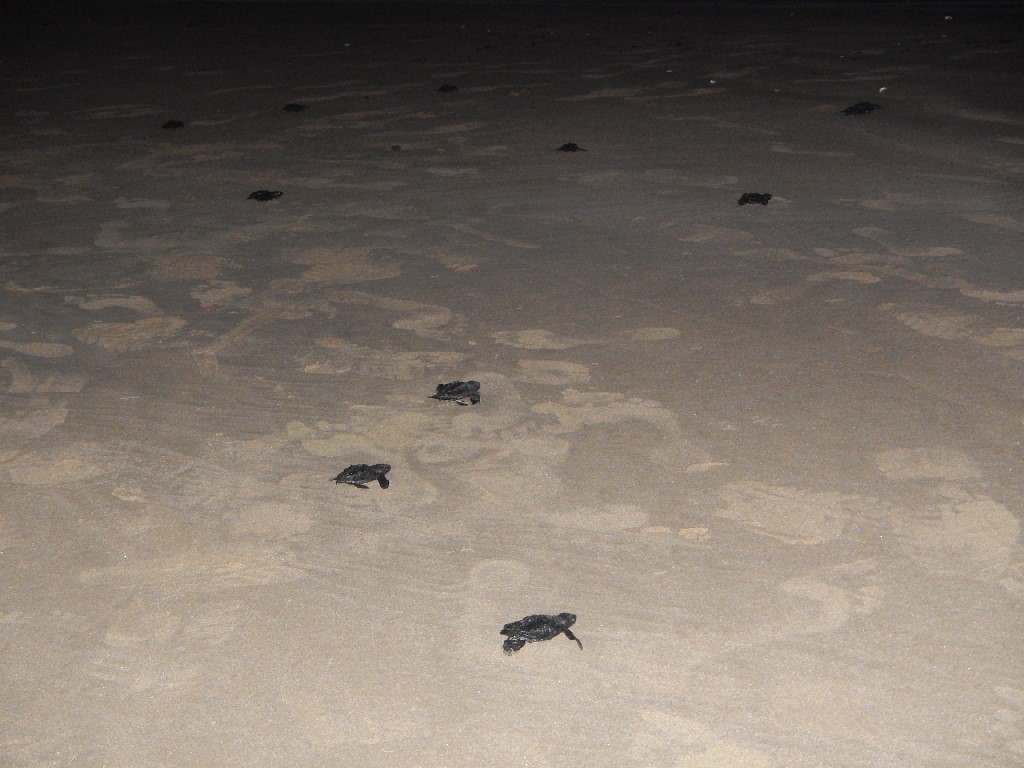
Somehow more than a month has come and gone. Although our last blog was posted from Zihuatanejo, that is now a distant memory in our rear-view mirrors. (Can I mix metaphors or what?) We had a slow but relatively uneventful return journey up the coast from Zihuat to La Cruz. There was a persistent bloom of red tide in Zihuatanejo Bay, and we were reluctant to dive into the discolored water to clean the bottom of the boat. Unfortunately that meant that we left with a lot of growth on the bottom, slowing our movement through the water significantly. Although we tried to choose a favorable weather window, the prevailing winds at this time of year are from the north, heading down the coast, and there’s a regular ocean current of more than a knot that pushes down the coast as well. The net result is that we traveled *very* slowly, and occasionally backwards! In those circumstances we either bobbed around hoping for a change or we fired the engine up and motored for a few hours until conditions changed. We pulled out of the wind and current for the night several times and anchored in some marginal places just to prevent negative movement. As we left Caleta de Campos one morning, we noticed an unusual sight. The big cliff near the town is called Bufadora Bluff, and we saw the blowhole for which it was named spouting. It sends up a huge plume of water, but only when the conditions are right. Pretty cool! We were also pleased and surprised at the sheer quantity of turtles that we saw on this passage. We surmised that this is a different species than we see further north, and that the egg-laying season is a bit later. We probably saw a dozen turtles each day of this week! Once we passed Manzanillo, though, we didn’t see another.

Circuitous Route   Bufadero Bluff   Turtle!

We took about a week to travel that first 200 miles to the Manzanillo area, where we pulled into an anchorage that our book talks about but was new to us. Ensenada Carrizal sounded quite lovely, small but secure. As we pulled in late in the afternoon it looked perfect, but by dusk the red tide had washed in and along with it were a million jellyfish (well, we might have miscounted one or two). We went to bed feeling less than enthusiastic about cleaning the hull first thing in the morning, which had been our intention in selecting this anchorage. Fortunately when we got up in the morning, both red tide and jellyfish had been flushed out. We grabbed our gear and spent a busy but rewarding couple of hours scraping growth off of our hull, inviting the sea life to find another home. 🙂

When we left, our boat moved much more quickly and smoothly – and we felt lighter too, just knowing that we’d done some good work. We stopped briefly in Barra de Navidad, to reprovision and enjoy one last visit from the French Baker, then traveled the remaining 400 miles to Cabo Corrientes relatively uneventfully (albeit still slowly due to the prevailing winds and currents). We turned the corner of Cabo Corrientes very early in the morning, and began tacking our way back and forth towards the far end of the Bay, where La Cruz is located. We expected it would take all day, but at least the destination was in sight. After an hour or two of trying to sail without much wind, with the sun still low on the horizon and the world just waking up, we heard our name paged on the radio – a bit of a surprise since we were still too far from La Cruz for radio traffic, and no one would have seen us yet anyhow! It turned out to be Libra, a boat that we had just recently met when we stopped in Barra de Navidad a week earlier. They’d left roughly at the same time we had, but they were in a faster boat and had a schedule to keep so we didn’t expect to see them again. Coincidentally we were heading into the bay at the same time! Well, not such a happy coincidence. They had developed transmission troubles shortly after leaving Barra and had been sailing continuously since then, going backwards or even waaay out to sea at nighttime when the winds changed direction or died off, and then eking their way back nearer shore when the winds were more cooperative. They were calling to see whether we had good winds yet, and whether they could hope that they’d be blown into the bay sometime soon. When we learned their plight, we offered to tow them into the bay, at least as far as the favorable winds we were both seeking. We motored towards where they were bobbing away, heading out to sea (again). An hour or so later, we reached them, tossed them a heavy line, and we each tied our ends to a sturdy cleat. We carefully turned the train around and headed back into the bay under power. With Lungta’s engine running slightly above an idle we were soon towing this 51 foot boat at better than 5 knots – Lungta barely noticed they were there! In the early afternoon, a fresh wind blew up, as it typically does in this area, enough for each of us to be able to sail independently the rest of the way. Hooray – Lungta saved the day again! 🙂 At one point in the afternoon, we saw a whale breaching – not just once but over and over again. Each time he surfaced his leap was somewhat lower than the previous time. He was clearly tiring himself out. Altogether we counted a dozen breaches, but there may have been a few more. It was even on a regular cadence, so Kathy was able to get a photo that wasn’t terrible. 🙂

Libra Tow   Breaching Whale   Breach Splash

We arrived in La Cruz a few days before we needed to begin our preparations for our next journey, (two weeks in Denver and Atlanta visiting some of our amazing family) so we spent a little time catching up with friends who had gathered in the area and putting the boat back in order after our long travels. We were pleased to learn that our friends on Velella Velella would be moving into the Paradise Village Marina the day after us. They are going to leave their boat for the whole summer while they go back to Washington State to work (and have a baby!). After a very pleasant dinner with Velella Velella, the family from a neighboring sailboat, Fluenta came over to Lungta and we got to know them better – it’s not unusual to cross paths with another boat a few times before both schedules align and you get to really meet, even though you feel like you’ve known them for a while. Fluenta had been instrumental in organizing the successful effort to haul Flying Dragon off the beach a year ago and they were just days from setting off across the Pacific with their three small children. Although we had moved in the same circles for the last couple of years, this was the first time we found the time to get together. They are a wonderful family with really cool kids. To cap off a wonderful evening, it was the night of the full lunar eclipse. We stayed up until 2am (well, most of us) watching the moon rise and then grow a flat spot and then a bite and then disappear altogether. None of us was up for watching the reverse process, though, so we woke the kids, pointed out the eclipse, and said our goodbyes. Another bittersweet parting, but with hopes that our paths will cross again.

The next morning we gathered our bags and hopped our plane to Denver. United offered us a crazy itinerary that was too good to be missed. We were going from Puerto Vallarta to Atlanta, and they offered us a flight that included a layover in Denver – of almost 24 hours! Since Kathy’s wonderful sister lives in Denver, we grabbed that itinerary without hesitation, and got two family visits in one! We arrived late at night and drove around town looking for a post office that was open until midnight, because it was tax day and we were carrying a few stamped letters from other boaters that looked like tax returns. It’s a nice convention that’s been established among the boating community in this area, whenever someone takes a trip to the States or Canada, they offer to bring mail up with them. We dropped our mail in the box at 12:09am; we sure hope it was in time! We had a pleasant morning with Jean, including brunch and a quick stop at the county courthouse to get married, before catching our next flight to Atlanta where Dan’s father was waiting to meet us (although it took some cell-phone coordination to figure out just where!). 🙂

Denver Art

David and Shlomit were wonderful, generous hosts, and we had an amazing time with them! Shlomit described Atlanta in June as being like a bride on her wedding day, a turn of phrase that seemed very poetic before we arrived. Although she demurs and says it’s a stock Israeli expression, it is quite apropos – there were flowering bushes and trees everywhere and the weather was almost perfect, even including the couple of days of sporadic rain. We arrived during the second half of Passover, and enjoyed a number of meals that are traditional at this time of year, including matzoh-brie and gefillte-fish. We also enjoyed several meals at different ethnic restaurants, including Thai and Indian. Although we love Mexican food, we do miss the variety of cuisines that are available in the States, and we take the opportunity to sample them again whenever we go visiting. We also took advantage of the local shopping – from shorts at Goodwill to storage containers at The Container Store, we enjoyed our visit to the Land of Plenty. 🙂 Last year during a storm, we lost the beloved Tibetan singing bowl which we had purchased in Sausalito as we traveled down the California coast. We’ve been mourning that loss, and hoping to find a comparable replacement. We looked unsuccessfully in New York during our Thanksgiving visit, and we’ve looked online a few times but it’s pretty difficult to choose a work of art online. So we resumed our search on this trip, visiting 4 different places. Although we found a number of beautiful options, none of them spoke to us quite like our original – except for the one that David and Shlomit had purchased several years ago on a trip to Dharamsala, India (while visiting the Dalai Lama and setting up a program to teach the monks physics). They left us dumbfounded when they oh-so-generously offered us their bowl. It’s a little smaller than our previous one, so we will need to tailor the padded ring for it to sit on, but it has a beautiful and accessible tone, it’s got attractive styling, including a few symbols that are familiar to us, and it comes with more love than any other purchase could possibly bring. Wow!

While we were in Atlanta, we also helped out on a few home projects, the most significant of which was to refinish the top of a huge dining table that was greatly in need. We removed the sliding glass doors to the back deck and set up shop on the deck just outside. Dan spent a full afternoon sanding, with a little help from David and Kathy. The next three days we put on 6 coats of clear varnish, and the grain just glowed through! We were all quite pleased with the results. We were also pleased to get to spend a good bit of time with Dan’s half-sister Aria (who had joined us for the first two months of our travels up to Alaska). She is preparing to move from Atlanta up to Boston this summer to begin grad school. Rather than pay the painfully high local rents, she’s decided that she would prefer to own her own place – a boat! She’s currently in the throes of a search for the perfect starter boat, and we spent hours engaged in what-if discussions about various possibilities. Together we all fell in love with a couple of different boats during our visit, but nothing has worked out yet. One of them was located in New York’s Finger Lakes, and we schemed about joining Aria and David on the trip to bring it from there to Boston Harbor via the Erie Canal, the Hudson River and Long Island Sound.

The day before we were scheduled to return, Kathy got sick (a fever and some digestive upset too). She was doing enough better the day of our departure that we decided not to change our flight, but by the time we got to Denver she was miserable again. We entertained the notion that it was a recurrence of the illness the previous month which we thought might be dengue fever, but decided it was something different when Dan got ill the afternoon we were with Jean. She was a sweet host, thoughtful to the core, and if you have to be sick while traveling you couldn’t ask for a better place to do it, but it was a real disappointment to have missed out on the quality time with her that we’d looked forward to. The next morning we were both moving pretty slowly, but we hucked up our 150lb packs and made it to the plane on time. When we arrived in Puerto Vallarta, we treated ourselves to a taxi ride home to the marina (rather than taking the city bus which would be our usual mode of transportation), and fell into bed for the afternoon. Over the next few days we slowly improved, Dan more quickly than Kathy. During that time, we did a few boat projects, but tried to do so at a measured pace. Now we’re back to normal, but still feeling concerned about the string of illnesses that we’ve experienced. It may be that we’re living enough away from population centers that when we do go back to the States we are more at risk than usual. Still thinking about this… We did visit a local doctor, mostly for Dan’s lingering cough, and while there Kathy asked about getting tested for exposure to dengue fever. He said that an antibody test is not readily available (in Mexico?), but that the symptoms sounded exactly like dengue fever. So that’s where things stand: a confirmed diagnostic opinion, and a course for any potential future encounters. Of course, the best course here will be to avoid getting bitten by mosquitoes! And one of the purchases we made in Atlanta was some mosquito netting to make a screen for our main entrance. We just have to be diligent about using it.

Back at home, we’re getting lots of small projects accomplished, and a few larger ones as well. But we’re also spending some time enjoying ourselves. One day as we went into to town on some errands, we saw the start of a kite-surfing competition on the beach. So we stopped and hung out, observing the participants set up and launch their kites. There were nearly 100 competitors, and it was quite a sight to behold, all the colorful wings laid out on the sand, and then later all of them swooping and swerving around in the air. It got us excited about pulling ours out and learning how to use it! 🙂

Kites on the Beach   Kiters on the Water

All towns in Mexico have a patron saint, and all saints have a unique day of celebration. In La Cruz, the patron saint is Santa Cruz, whose day is in early May. From an outsider’s perspective there was hardly a break between the celebrations leading up to Easter week and this week of local festivities. The Fiesta de Patronales lasts nine days, with music and food, carnival rides and parades. The festivities last well into the wee hours of the morning, with some partyers continuing their merrymaking until 7am on the last night. There are fireworks of various levels throughout the week, leading up to the piece-de-resistance at midnight on the last night. It was a tower of sparklers and bottle rockets that had spinning pinwheels and various colors and sounds going off in succession, with a “crown” that ejected itself into the night sky at the very end. There was a bandstand where many acts performed over the course of the week. We saw some local children give a recital of some Hawaiian dances they’d been learning, and some very professional folklorico dancers with the women dressed in frilly skirts and the men in leather tasseled jackets.  The local farmers/ranchers ride in on their horses and show off how they’ve taught them to “dance” on command – but Dan was disappointed that the horses seemed to have very little sense of rhythm. 🙂  We wandered around the town square, where all the booths were set up and the townspeople were strolling in their finest, 2 of the last 3 nights. We stayed out until 1am the last night, well past our usual bedtime, but for many the party was just getting started. This was a totally authentic local Mexican event, and it felt very exotic to us gringos. A fun time was certainly had by all.

Fiesta de Patronales

Now we’re working on the last few projects that we want to finish up before heading up towards our summer haunting grounds. We’re thinking we might stop along the way to haul the boat out for a bottom paint refresh, but that plan is still in the making. Whatever happens, though, we’ll share it with you next month. 🙂 Hope you are all enjoying life at least half as much as we are!

Posted in Uncategorized | Comments Off on 5-6-2014 – La Cruz, Nayarit, Mexico

3-15-2014 – Zihuatanejo, Guerrero, Mexico

We ended up spending a week in Barra de Navidad, but it’s hard to say exactly where the time went.  We learned of a new place to spend the afternoon, around the swimming pool of the Cabo Blanco resort.  It’s just up a short flight of stairs from a decent dock at the end of a half mile long canal where we can leave the dinghy.  The pool has a two large sections connected by a slightly narrower portion which has a volleyball net strung across it.  We spent a couple of lazy afternoons here, visiting with friends, munching nachos, and playing around in the fresh water.  A very pleasant way to while away an afternoon.

When we visit Barra, we have to be careful to time our entrance for a high(-ish) tide.  The anchorage is located in a huge lagoon, but most of it is *very* shallow.  The channel that comes in from the entrance is deep enough for our boat, but not generously so, and the walls to the channel are quite steep.  This means that we have to be very careful to stay within the channel.  At the end of the channel, the lagoon widens out dramatically, but is shallower.  There’s lots of space for plenty of smaller boats to anchor out in the lagoon area, but we have to stay within the channel.  So our trick is to anchor at the very end of the channel.  Even then, as the water goes out at lower tides, we end up sitting on the soft mud bottom for a few hours most days.  🙂  It’s funny to see all the boats turning as the wind’s direction changes – with only Lungta staying put.  We are not the only ones who go aground here: every year there are one or two examples which are the talk of the fleet for a few days.  This year one boat turned left instead of right when they were coming in through the channel, intending to go into the marina.  They hit the side of the channel and stayed there for a full cycle of the tides, listing dramatically to one side.  It’s also pretty frequent for boats to drag on their anchor, sometimes quite a ways through the anchorage.  Because of the shallow depths people often don’t put out a lot of anchor chain, but the muddy bottom is quite slippery and there’s not much for the anchor to catch hold of.  The winds often pick up in the afternoons, and sometimes this additional force is enough to overcome an anchor’s tenuous grasp.  It’s a little disconcerting to return to your boat after a day in town and find it somewhere different than where you remembered leaving it!

The last day we were in Barra, we took a day’s excursion with some friends from another boat.  We took the bus to the nearby town of Santiago, which butts up against Manzanillo.  We wandered around the two towns, did a little shopping, and had lunch at a fun pizza joint called Godzilla’s, which is run by an American ex-pat who retired early and moved down here to sunnier climes.  We hopped a local bus for the loop around the hotel zone of Santiago Bay, which is quite hilly and built up with spectacular homes and small resorts.  The views were incredible! 

Shortly after we returned to Tenacatita we made a quick decision to leave again.  A few of our friends on other boats were heading south to Zihuatanejo for the annual Guitar Fest, and we decided to join them.  We’d been talking on and off about going down, but had settled into Tenacatita life and it was looking like we might stay put.  But then the switch flipped again, and we were OFF!  Coincidentally, we spent the first night at anchor in Santiago Bay, within view of the beautiful cliff-side tour we’d taken just days earlier.  But we weren’t there to stay.  It’s a 200 mile journey, and we had a schedule to keep.  Oftentimes we regret setting a schedule like this, but not always.  We told ourselves that we could dawdle on the way back north.  So we sailed through the first night and stopped one night in Maruata. 

DSCN0307  DSCN0321 DSCN0324 (2)  DSCN0346 (2)

Maruata is a tiny little cove about halfway between Tenacatita and Zihuatanejo.  We were very impressed with the scenery and the tiny town when we stopped there last year, and really wanted to see it again.  It’s situated right beside a chain of large rocks called Los Dedos de Dios, or God’s Toes.  There are lots of fissures through these rocks, and the waves thunder around in the internal caverns and roar back out the other side.  So there are several places where, although the rocks completely obstruct your view of the ocean, big waves erupt from the side of a cliff and crash on shore.  I’m not sure words are adequate – it’s quite impressive, and we were not disappionted!  This area attracts surfers, and the waves coming ashore are quite large.  Last year we were a bit intimidated and we didn’t bring the dinghy ashore.  We anchored it outside the break and swam the last 50 feet or so.  This year we watched the pangas coming in to find the route that was most protected, and timed a perfect beach landing.  It’s a good feeling to see one’s competence growing over time!  In the late afternoon there were hundreds or perhaps thousands of birds of many sorts swirling around, not well organized into a feeding frenzy, but striking up quite a chorus and putting on a lovely show.

The night before we stopped in Maruata, Kathy came down with a fever.  It came on so suddenly that she got the shakes and decided to wake Dan 30 minutes early for our shift-change.  The battery on our thermometer was dead, so we never did get an accurate read on how high it went.  We sailed on to Zihuatanejo with her still battling this fever.  Ibuprofen did a good job of keeping it contained, but whenever she was late in taking the next dose or pushed her energy limits the fever spiked again and took up to a couple of hours to get back under control.  We consulted with a friend on another boat who is a doctor and she brainstormed with us.  Although there are certainly other possibilities, we ended up concluding that dengue fever was among the most likely.  When we get back to Banderas Bay, we’ll find a clinic to get tested for exposure.  Dengue fever is transmitted by mosquitos, directly from one infected person to another.  Kathy has always been a tasty target for mosquitos, and both Barra de Navidad and Tenacatita had their share.  The good news is that once one goes through dengue fever you get a lifetime resistance to that strain.  The bad news is that there are 4 or 5 different strains and exposure to one strain often makes you more susceptible to a bad reaction if/when later exposed to a different strain.  There are no vaccines or cures available for dengue fever, but at 50 million cases annually it’s the disease most commonly transmitted worldwide via mosquitos or ticks. (Isn’t the internet wonderful?!)  A few days after arriving in Zihuatanejo her fever broke and she began to return to her normal energy level.

The reason for our schedule to Zihuatanejo was the annual international music festival called Guitar Fest, and it did not disappoint.  They had 14 performers, mostly individuals but a few duos.  There was a dinner concert and another on the beach every night of the week-long festival.  Each concert had a cover charge of $10-$20, though, so that kept a lid on our attendance.  All of the performers were at the opening and closing concerts, which were held on the beach.  We sat in the dinghy for the opening concert, rafted up with our friends from Moments.  Although we had fun, it turned out to not be the best choice, because the surf made it difficult to really hear the music, and it was a bit disappointing not to see the performers up close.  We could hear the beach concerts from our boat, but even less than from the dinghy.  Later in the week we attended one of the two free concerts, and were amazed at the energy we felt by being up close and part of the crowd.  We brought some lawn chairs and set them up near the 5th row.  It was *wonderful*!  So we paid for seats at the closing ceremony, and also enjoyed that a lot!  We’ve heard that “the place to be” is actually the after-concert jam that regularly gathered at a particular bar on the other side of town.  Some of the performers played until the wee hours of the morning, but we were generally fading by 10 or 11 when the concerts ended anyhow. 

Zihuatanejo is in a beautiful bay with half a dozen small beaches scattered around the perimeter.  The town is geared for tourists, but is still small enough to not be overwhelming.  A cruise ship came in early one morning, catching all of us cruisers by surprise.  It anchored out in the bay along with the rest of us, and there was a continuous stream of small boats ferrying guests to and from town.  Then they were gone before the music began.  We wondered if they even knew of the festival!  The town is nestled in amongst a number of low hills, and the architecture is attractive and nicely landscaped.  There are even sidewalks throughout town, so we know it’s a town of a certain size (and/or with a certain amount of money)!  There’s a small but nice stretch of beach set aside for the dinghies to land, and there are 2 or 3 young men who have set up a business “helping” that process.  Although most of the time the landings are quite easy and no help is needed, there are times when it is quite helpful to have an extra person who doesn’t mind getting wet to push you off in between sets of larger waves.  They seem to have someone there round the clock, although we haven’t really tested *all* 24 hours of the day.  🙂  It’s also nice to know that there’s someone there watching that none of your stuff wanders off while you’re away.

After the music festival, we went on a road trip together with three other boats.  We rented a couple of cars and drove about 4 hours into the hills to a town called Paracho.  Paracho is a small town of about 30,000 residents.  They have a nice town square with a beautiful and apparently well-utilized church along one side.  There’s a nice market just next to the church where one can find all kinds of produce and some housewares, and which also has a number of food stands where one can get a steaming bowl of soup, fresh-made tacos or an enchilada dinner.  It’s a vibrant corner of town! 

DSCN0373

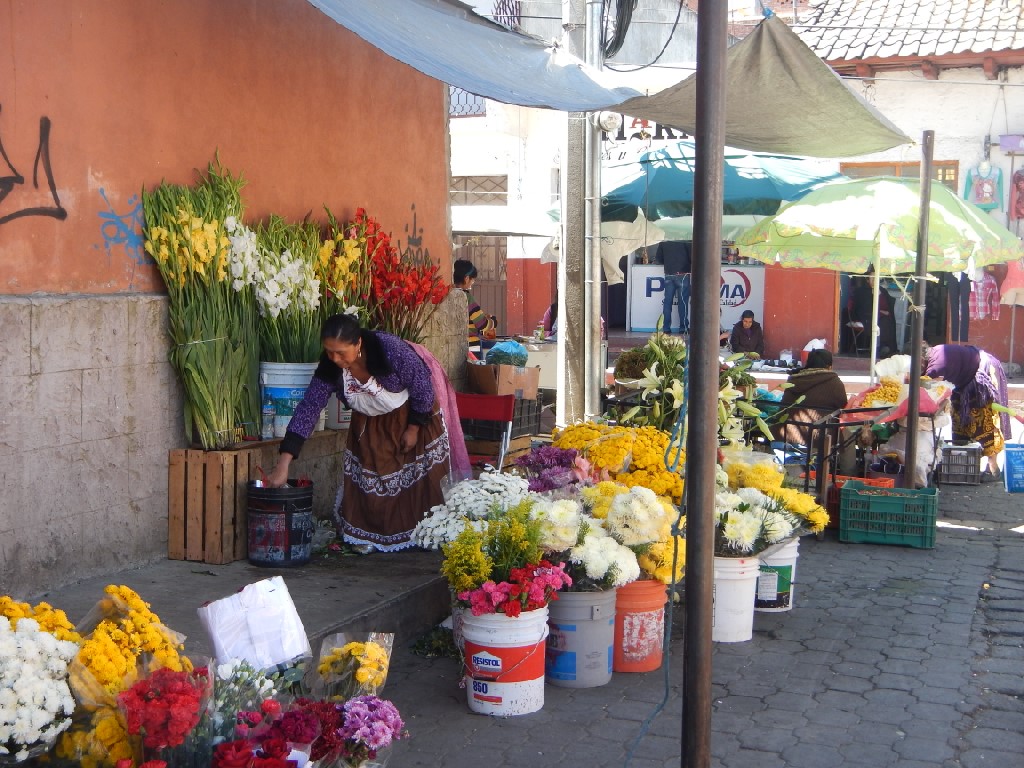
There’s quite a presence of the local indigenous people, who are called the Tarrasco.  The women wear fancy colorful skirts with aprons often trimmed in lace.  They wear a sarape around their shoulders in the chilly mornings and fold it atop their heads for shade in the hot afternoons.  They also use it to swaddle a small child on their backs, or occasionally to tote other loads.  Many of these women are visible in the town’s streets going about their business or crocheting tortilla warming cloths while displaying produce or flowers for sale.  We saw few young women, perhaps because they were occupied at home or maybe because their hard life aged them prematurely.  We also didn’t see many of the men, and surmised they were busy working in the fields or shops.  While we were in town there was a celebration of the 6th anniversary of the elementary school.  There was a sweet little parade with lots of children riding bicycles, tricycles or even strollers.  Later there was a presentation in the town square where each class of children performed a dance to recorded music.  One class was dressed as monarch butterflies, one as train conductors.  These were very young children who were easily distracted from their simple dance in a ring by the presence of their parents and the others in the crowd.  The whole event was quite charming!

DSCN0380  DSCN0371

Paracho is widely recognized as a world-class center of excellence for luthiers, or guitar-makers.  There is another smaller town nearby named Anguihuan (?) that specializes in making violins, many of which are sold in Paracho.  There was also another nearby town called Capacuan along the road that specialized in carved wooden furniture.  We spent two days strolling from one guitar shop to another, and were invited a few times to visit the workshops where the work was done.  Most of these workshops were behind the craftsman’s home.  Some of them were tiny places where only a few instruments were made at a time, and others were housed in tall-ceilinged buildings that housed dozens of employees and hundreds of instruments.  The prices range from $30 for a mass produced guitar to $10,000 for the best handmade guitar of the most exotic woods. Some woods are local, while others are imported from all around the world.  Walking around town we saw lots of piles of wood stacked or laid out in the sun to dry for up to 8 months.  The guitars also vary in the detail of the trim-work, some including fancy inlays of abalone or other woods.  We were looking for a second guitar for our household, so that we could enjoy playing together, and also a nice case to protect both from the rough life that a boat seems to offer.  One of  our friends also purchased a “starter” guitar, and another bought both a mandolin and a violin.  It turned out to be quite a successful excursion! 

DSCN0367 (2)

We quickly figured out that the guitar we were looking for was somewhat unusual here; we wanted one with steel strings, rather than the nylon strings that are the norm in Mexico.  We learned a lot about guitar construction, including the different requirements of the types of strings.  Steel strings exert much more force on the guitar at both ends, so the tuning pins, neck and insertion pegs need to be beefier than a guitar with nylon strings.  We ended up purchasing a guitar from a shop that had a few dozen, slightly unfinished guitars.  The owner told us that there was roughly 8 months worth of work in the instruments we were looking at, and that he could custom-finish one for us in a day.  All that remained to be done was to add the bridge and nut, and the strings and connecting parts: the tuning pins at the top and the plate and pegs at the bottom.  We also asked him to add some markers on the top of the neck to help find the correct frets and a pick-guard to keep the face from getting scratched up over time.  The one we bought has a Canadian cedar face, and German spruce back and sides, and a graphite support down the center of the neck to strengthen it for steel strings.  When he was working on the bridge and nut, he started with a small piece of bone, held it in his hand, braced up against a wooden table, and quickly whisked a hand-planer back and forth, whittling the piece down to size.  When we commented about how close the sharp edges were coming to his fingers, he told us that on his driver’s license that it said he had no fingerprints.  Yikes!  We were thrilled to be doing business with the luthier who actually built our guitar, and we feel that we got a good guitar at a very good price.  We are now both practicing several times a day, Kathy learning basic chords, Dan learning more complex picking and strumming, and both of us strengthening our hands, wrists, fingers – and fingertips!

It turned out that finding a case was also non-trivial, because for reasons that we don’t completely understand, steel string guitars seem to come in a slightly larger size (locally called “country” or “texano”).  We ended up deciding that what we wanted was a rigid foam case, rather than a soft-sided one or one made of cardboard or wood.  After some adventurous running around town, we found the perfect case, except that it was just a bit too small.  The factory could modify it for us, but it would take 3 days.  At first we discussed having them ship it to us in Puerto Vallarta, but then Dan came up with the brilliant idea of just purchasing the parts, so that we could make the modifications ourselves and finish putting them together.  The business owner was open to the idea, and we had a lively and interesting conversation as they pulled together all the parts and showed us the various steps involved in assembling them.  We think we have what we need, but we’ll find out when we actually sit down to the task!

The region that we were traveling in has apparently had some recent problems with drug cartel activity.  We saw a LOT of federales and state police along the roads, often setting up roadblocks to inspect vehicles or passengers.  Although they were heavily armed, they were all polite and friendly to us.  We noticed that some of the vehicles that were stopped for more extensive searches included expensive cars driven by young men.  Even with all of this activity, it turns out that some of the local towns have been dissatisfied at the success of the government to keep the drug activity away, and have formed local militias to “take back” their towns.  Although we saw no trouble, we did hear that it was a good idea to avoid travel through this area at night, and we had no problem following that advice!  On our drive back to the coast, our two cars got separated.  There are two roads that traverse this countryside, one is a newer toll road, and the other is an older “free” road.  One of our cars missed the entrance to the first section of toll road (of four) and ended up on the free road.  They later told us that instead of the federales posted along the roadside there were lots of people in white T-shirts marked “Libre Lombardia” (Free Lombardia) carrying archaic weapons.  They came to a roadblock marked with rocks and smoky fires, and were questioned about what they were carrying with them (“guitars and beer”).  They also had some difficulty getting back on the toll road, because the entrance was blocked off, but they were able to go around the obstruction and get back on their way.  This is the first we’ve seen in our travels of the challenges that Mexico is having with the social unrest brought about because of the drug trade.  It certainly gives one pause for thought, and appreciation for the safe and comfortable environment that we’ve grown up with!

Now we’re back in Zihuatanejo, our bags are unpacked, and we’re preparing to head back north towards Banderas Bay.  We’re watching for a weather window, showing winds heading north instead of south.  Should be just a few days until we’re on our way…  Until the next time, we wish you all the wonders that Spring has to offer!

Posted in Uncategorized | 1 Comment

2-10-2014 – Tenacatita, Jalisco, Mexico

As I write this, we’re gliding across Tenacatita Bay listening to Enya with all of Lungta’s sails up.  The winds are gentle, but we’re making good enough time to arrive at our destination before the sun sets.  We’re heading to Barra de Navidad for a few days, mostly for a change of scenery and to visit with a few friends who happen to be there at the moment.  (But, truth be told, we are also happily anticipating croissants from the floating French baker in the morning.)

It’s hard to believe that we arrived in Tenacatita almost exactly three weeks ago – how time flies!  We left Banderas Bay in mid-January after inviting some new friends to join us for the journey down.  We met Enrique and his 16-year-old daughter Pamela on New Years’ Eve.  He’s a wonderful yoga instructor – the best Kathy has seen since leaving Portland 3 years ago!  She enjoyed a couple of his classes while we were still in La Cruz, and a few more while they were with us.

They are both thoughtful and easy-going people, making for delightful guests.  They were new to boating, so it was fun to see their joy and excitement at many of the things that are part of our everyday life: the gentle rocking of the boat, the beauty of the full sails, swimming in a remote cove, and all the birds and sea life that surrounds us.  We had a particularly fruitful day of whale-watching as we crossed Banderas Bay on our way south, with pods of dolphins punctuating the stretches in between sightings of the larger animals.  We enjoyed talking about life – and Spanish grammar – with them for the better part of a week.  The end of their stay came all too soon, as we realized that their bus journey back to Banderas Bay would consume most of the last day of their vacation.  We dinghied about 5 miles across Tenacatita Bay to La Manzanilla, arriving less than 10 minutes before the local bus which was the first leg of their trip back.

Estuary  DSCN0210-small

Tenacatita has been a familiar friend, living up to all of our memories from last year.  It’s a beautiful large bay with a long beach and a little palapa restaurant.  At one end of the beach is an entrance to an estuary which goes back a few miles and makes for an interesting day-trip through the mangroves.  We dinghied there with Enrique and Pamela, and were enthralled to see a small crocodile lazing at the surface and to catch a glimpse of a coatimundi climbing a tree.  The small town of La Manzanilla is convenient for provisioning runs and an occasional dinner out.  There was an “Art Walk” event shortly after we arrived, where more than a dozen local artists (most of them ex-pat Americans and Canadians) opened their homes to the public or displayed their works in a gallery.

One day when we went to La Manzanilla for our weekly produce, we had a more exciting than usual departure.  As with many of the Pacific towns, the beachfront faces the sea and has breaking waves to contend with.  Due to the changes in wind, some days have gentle waves and some days have steeper waves.  This particular day wasn’t terrible, but it did manage to catch us by surprise!  The waves coming ashore come in sets, a group of small waves followed by a set of larger ones.  The trick is to time your launches and landings when the small waves are happening, avoiding the larger ones that have the potential to flip your dinghy over.  An overturned dinghy can mean much more than getting wet and losing your dignity.  If the outboard is running it can be quite dangerous.  And we recently heard a story of someone whose hard dinghy flipped and lodged in the sand with him underneath it.  His very heavy dinghy made contact with the sand all around, producing a suction that was too strong for him to overcome alone, and he was fortunate that there were some bystanders on the beach who saw what happened and came to lift the dinghy up off the sand.  Our story was not nearly as dramatic as that.  We started to push off during a small wave, hopped into the dinghy and started the motor just as the first larger wave arose right in front of us.  The dinghy’s bow rose higher and higher, threatening to flip over backwards.  Kathy slipped out of the dinghy and held onto the pontoon on her side to try to keep it flat.  Dan didn’t have enough time to do this, though, because he’d been facing aft to start the motor.  He got thrown around a bit, and his knee got a deep gash from the motor’s clamp.  It was a scary moment, although all turned out OK.  His wound is healing quickly and we got a gentle reminder that choosing your window is critical to a safe dinghy launch.

There’s a nice cruising community that springs up in Tenacatita every winter.  This year there are 25-35 boats, with a daily turnover of anywhere from 0 to 6 boats.  Some people just use this as a stop on their way while others view this bay as the destination.  There’s a boat named Harmony that comes here every year and stays for several months.  Robert has adopted the title Mayor of Tenacatita, and Virginia is therefore the First Lady.  They provide some continuity and organization for events and activities.  Virginia swims from her boat to shore every day and invites anyone else who would like to join her to come to Harmony at 1:30.  Robert accompanies them in his dinghy, rowing nearby to help make sure that they are visible to any other boats that may be in the area.  This last week, the Tenacatita Swim Team broke 10 participants most days.  Once ashore the fun continues, while some folks strike up a game of dominoes in the palapa restaurant, some walk the beach, and others a game of bocce ball.  Sometimes someone pulls together a volleyball game, a yoga class, or conducts an art project under the palm trees.  It’s easy to fall into a delicious rhythm of recreational activity and socializing!

DSCN0234-small DSCN0265-small

One day we walked down the beach with one of the other swimmers, and learned that there was a small hatchery for sea turtles who lay their eggs on this beach.  Perhaps the government requires it, or perhaps they support it financially.  Whatever the case, these hatcheries are fairly common along the Pacific coast.  This one is run by a resort hotel, the only development on this section of beach.  The hatchery consists of a 10’x20’sandy plot completely enclosed in chicken wire with 20 or 30 little signs looking eerily like a cemetery.  Each sign identifies a batch of eggs that were collected nearby, and shows how many eggs were found, the date they were laid, and an estimated date for hatching.  Near this enclosure is a 3×15′ cement pool with gently sloping sand at one end and a thatched roof overhead keeping it cool and out of sight of predators.  The eggs typically hatch overnight, so early in the morning a caretaker checks to see if there are any new tortuguitas.  If so, they get relocated from the sandy enclosure to the pool for the day, and that evening they are released into the sea.  Any hotel guests or anyone else who cares to show up just before sunset can participate.  The baby turtles, who have spent the day swimming around and learning how to lift their heads up to breathe and how to flip themselves over if they somehow end up on their backs while scrambling around, are gently removed from the pond and put into a bucket for transport to the beach.  The caretaker draws a line in the sand about 25′ from the water, for the guests line up behind.  He hands each guest a tiny turtle to be placed in the sand.  Apparently they need to spend some time on the sand in order to get their bearings on where they will return years hence to lay their own eggs.  (Someone described this as getting their GPS bearing”.)  The day we went there were 20 babies in the pond, and 6 of us showed up to help with the release.  It was really cool to participate in this tiny act of stewardship of nature, although we know that it was just a drop in the bucket.  We learned that the survival rate of turtles like these is normally around one in 100, and that the ones we were releasing had roughly double that chance of surviving to adulthood and laying eggs for the next generation.  It’s quite a gauntlet that these babies must run, but we were there cheering them on for the first few steps along the way, until they each were swept away by a wave and on their own.  Just now, on our journey across the bay, we had a happy sighting of a pair of turtles at the surface together; they appeared to be working on the next generation.

VoyagerScott-DanAndKathy

Every Friday evening, the Mayor organizes a social event for the whole Tenacatita fleet.  Everyone gathers together an hour or so before sunset on our dinghies, tieing off to one another to form a large circle (mas o menos!) and using Robert’s anchor to keep the whole group from drifting ashore or out to sea.  Everyone brings an appetizer to share, so we never go home hungry.  The Mayor gives a short speech, welcoming people to the festivities, and concludes with asking a leading question and we go around the circle introducing ourselves and including a personal response to the question.  Last week he asked us to “wax poetic” about our boat, explaining just what made our boat special to us.  He also offered an opportunity for anyone who wanted to show off their talents, especially musical, which made for a delightful and sociable evening.

DSCN0229-small

Probably of no surprise to most of our readers, we also include some boat-work in our mix.  We brought the dinghy on deck and disassembled the transom, where the leak we mentioned in our last posting was coming from.  The previous owner had done some work back there and tried to seal every joint with 3M 5200, a tenacious marine sealant.  Unfortunately, the gaskets intended by the dinghy’s design team were not installed correctly, so no amount of caulk would correct the problem.  Dan’s sharp eye noticed the uniquely cut shape did not match the way it was seated.  Resituating the gasket to the right sealing surface solved our problem, and for the first time in two years we’ve been traveling in a dry dinghy ever since!  Before we left Banderas Bay, a friend of ours agreed to do an art project for us: painting the cowling of our outboard.  We’ve been admiring Leann’s work ever since we first met True Blue V last summer up in Bahia de los Angeles, but hadn’t spent long in the same place since we both moved around pretty frequently.  Finally we anchored near each other in La Cruz for more than a week and had some leisurely time to spend together.  She has painted several outboards for cruisers, producing a unique masterpiece each time – we’re thrilled with ours!

DSCN0272-small

Although chaps for our dinghy, to complete the spiffy image, are still a gleam in our eye, the sewing machine has not gone unused.  We’ve spent some time reupholstering the pilothouse with the fabric we purchased over Thanksgiving.  The project is coming along nicely and should be complete in the next week or so.  We’re loving how the rich burgundy color complements the wood in the pilothouse!  We also spent a couple of days finishing the resurfacing of our decks.  As you may recall, we started this project about a month ago when Kathy’s college friend Suzanne was visiting.  We did about half of the deck area at that time, but the color turned out to be something that Kathy was unhappy with: too yellow.  So we added more white and a hint of red into the mix and ended up with a color that we both really like a lot – and then we painted it on the whole area.  It went a lot faster this time, since we’d already pioneered the process.

And it feels so good to check off the projects on our to-do list.  🙂  We’ve struck a pleasant balance between the various aspects of our life, and expect to be here for another month or so.  We keep hearing of cold weather back in the States, and have been enjoying the photos of snow posted to FaceBook – while we sit in our lovely anchorage watching golden sunsets. 🙂  This is what the cruising life is all about!

Posted in Uncategorized | Comments Off on 2-10-2014 – Tenacatita, Jalisco, Mexico

1-8-2014 – La Cruz, Nayarit, Mexico

Our last posting left off with us in a challenging situation, having just lost our dinghy and outboard and about to have guests.  Life has a way of continually moving, helping to put such situations in context.  Not too surprisingly, we have found a replacement dinghy and outboard, and our lives look remarkably similar to the way they looked before this shake-up.  We found a used dinghy being sold by a couple in the La Cruz marina who wanted to upgrade to a larger one.  It’s a fancier dinghy than the one we lost, including two benches with small storage compartments and even cup-holders, but has been somewhat heavily used.  Water leaks into an as-yet-unidentified place in the stern, so we’re bailing daily, but we expect to resolve that problem in the next few days.  We’ll need to make a new set of chaps (just like the last dinghy), to protect it from the intense sun – for Kathy, this is the biggest loss of the saga 🙂 .  We found a used outboard on consignment at the only full chandlery in town.  Normally they don’t carry used equipment, but through an unusual set of circumstances they happened to have a four-stroke 15HP Mercury outboard, exactly what we needed – except that the price for a 3-year-old motor was the same as a new one would have cost in San Diego.  C’est la vie!

IMG_5347

Kathy’s mom and two sisters came to visit for a week in early November, the week after the storm, so we quickly moved into the Paradise Village marina, both to help us regroup and to make our guests more comfortable.  This resort opens all of its facilities to marina patrons the same as to hotel patrons.  There are several nice swimming pools that we have enjoyed in the past (and certainly will again in the future!) as well as several hot tubs.  While they were visiting, the resort had a “welcome event”, which included a performance by some local dancers that was quite dramatic.  The dancers had flamboyant costumes, and leaped around pots of fire.  They entered by running down the aisles through the audience, banging drums and crying out to one another in a primal voice.  Quite a contrast to the rest of the show which involved introductions to the resort’s services and facilities, an audience participation game-show, and a raffle.  In addition to lots of good conversation, we enjoyed some fun Scrabble games together, visited Sayulita, a nearby town with a nice beach, spent a couple of nights at anchor (and heard whale song through the hull at night!), sailed out into the bay on a whale-watching jaunt, wandered the Sunday Crafts Market, and played tourist for a day in downtown Puerto Vallarta.  It was a nice visit, diminished only by the fact that Kathy’s brother Andy lost his passport and was unable to join us at the last minute.

DSC02410

The day after they left, we moved back into a marina (this time Nuevo Vallarta Marina, which has no swimming pools but is less expensive) to keep the boat secure while we “popped” up to New York to visit Dan’s mother.  Although the weather was a balmy 50F when we arrived, the climate-shock was nearly as great for us as the culture-shock!  Altogether we spent nearly 3 weeks in New York, with one of them being spent in up-state New York at Aunt Nancy’s farmhouse for the extended family’s Thanksgiving celebration.  This year’s distinguishing feature was dessert, both for quality and quantity.  Somehow there was a miscommunication when assignments were handed out, and the 3 people who were asked to bring dessert all thought they were bringing all the dessert needed for 20 people.  That meant that we ended up with 3 times the dessert needed – all told there was enough for everyone to have an entire pie!  Some of the desserts were traditional pumpkin or pecan pies, while others were more exotic, especially the yuzu fruit and the mocha icebox cake.  No one left with their sweet-tooth still active!  While in the NYC area, in addition to the nice family connections, we saw two films that were pre-release – Liv and Ingmar, and Some Velvet Morning – both of which we enjoyed quite a bit, attended an off-Broadway play (which actually turned out not to be our favorite, but the live-theater in-the-round experience was a rare treat for us – or at least for Kathy!), visited the Rubin Museum which focuses on Asian religious art, and each made a few connections with some folks from our distant past.   We also spent a ridiculous amount of time in a wonderful upholstery shop, trying to find the perfect fabric to repair the seats in our pilothouse.  Failing to find a good match for the existing fabric, we came home with enough to instead redo all of the cushions in the room, which will be a lot of work but a nice upgrade!  Kathy got a new laptop – with the dreaded Windows 8 – and has spent numerous hours figuring out this brand new paradigm; it’s literally been decades since she learned a new OS! She also came home with a solid case of the flu, but as far as we know the correlation to Windows 8 is as yet unsubstantiated.

As usual, we had full suitcases when we returned, nearly bursting with parts and supplies for projects around the boat.  We spent several more days in the marina working on the most critical of these projects (like a new raw water cooling pump for the main engine, without which we weren’t going anywhere) and then moved back out to the anchorage.  We went through a period that felt to Kathy like “one step forward, two steps back”.  Things were breaking faster than we could attend to them – and we had another guest visit during this period.

Kathy’s dear friend Suzanne, from graduate school days in Texas, came to visit for the last 2 weeks of the year.  While she was with us we participated in a Huichol sweat lodge ceremony on a beach north of La Cruz, visited a friend of hers in the town of Chacala (an hour’s bus ride north of La Cruz), perused the Sunday Craft Market,  and spent a wonderful day hiking along the coast south of Puerto Vallarta – from Boca de Tomatlan to Quimixto.  Suzanne is always ready to jump into something new, and she enthusiastically helped us to put a new coat of paint and anti-skid on our decks (or at least the half that we were ready to do!).  The visit was full and fun, but (because of schedules, weather and boat projects) not the one we’d anticipated.  She’ll just have to come back for more.  🙂  But perhaps we can convince her to leave the rain behind the next time…

IMG_5203  IMG_4924

We spent New Year’s Eve on a nearby boat, celebrating with a pleasant group of cruisers and locals.  It was an enjoyable mix of making new friends, great food, Spanish practice, and watching nearly a dozen distant displays of fireworks all around the bay.  We joined in a cute Mexican tradition, where we ate a dozen grapes as the bell tolled midnight, with each one representing a month in the coming year – if you pay attention, you may learn which months will be sweet and which may be a bit sour.  Dan says June will be a bit bland, but August is going to be positively juicy!

Now things have settled down, and we’ve made substantial headway on the list of problems that was causing Kathy to fret – cleaned out the hoses to our forward head that has been out of service for two months, repaired the watermaker that has been unable to desalinate water since we returned from New York, replaced the cooling water pump for our main engine which had been leaking more water into the bilge than it was pumping back out to the sea, repaired the heat exchanger for our generator so it no longer overheats after 20 minutes, installed two hooks to hold up the portholes in the galley where people frequently whack their heads, etc…  But it’s not all work – La Cruz offers a tempting array of events and activities to join in!  We’ve attended a movie or two, a musical event or three, and Kathy has relished a few yoga classes.  As is so often the case, we’ve enjoyed reconnecting with friends on several boats who we haven’t seen since last year, as well as meeting new friends who we hope to see again.  We’re now preparing to head south a few hundred miles, hopefully in about a week.  We’re looking forward to spending more fun times at anchor in Bahia Tenacatita, in the lagoon of Barra de Navidad, and in several of the other smaller stunning coves along the Pacific coast.  We’re hoping to make it a little bit further south this year than last, with the town of Zihuatanejo in particular calling.  But if it doesn’t work out that way, so be it; it’s the journey more than the destination.  We hope that each of you is also able to enjoy your journey, wherever it may take you…

Posted in Uncategorized | Comments Off on 1-8-2014 – La Cruz, Nayarit, Mexico

11-4-2013 – La Cruz, Nayarit, Mexico

Although this last month has been full, I’ve put off writing the next blog entry because there hasn’t been enough noteworthy to write about.  But last night that changed…

We began the month with a visit from our Portland friends, Duncan & Marie.  We met these folks on the dock in Tomahawk Bay marina, when they bought a boat and moved it in near ours.  They were doing a lot of work on it, so we saw them often on the weekends.  They decided to come visit us in Mexico, and couldn’t have picked a better time!  October is a time of change in the seasons, and although sometimes the weather is a bit unsettled, often it is ideal.  We couldn’t promise which end of the spectrum we’d get, but we lucked out and had clear skies without the sweltering heat of the summer.  Immediately after they left – the very next day, in fact – we had heavy skies and rain, from the edges of a tropical storm that happened to be in the neighborhood.  We spent a lovely week with them, sailing a few days and snorkeling most.  They are considering “leaving the dock” themselves to go cruising, and wanted a better feel for what it might be like.  We showed them a nice time, and shared what we could to help them make an informed decision.  The Sea of Cortez is a great place to begin a cruising adventure, and there’s a lot of community to share the learning curve with.  However, there are so many variables that it is unclear whether this life would suit them, and also whether they will choose to give it a try.  It would certainly be fun to spend time with them again in a remote anchorage.

After our visit with Duncan & Marie, we hopped 15 miles south to Puerto Escondido, where we could find a more protected place to anchor than Loreto to sit out the inclement weather.  We were also looking forward to connecting with several friends that had followed a different route the last several months.  Our friend Bernard just returned from a trip to the US, carrying lots of boat parts – meaning boat projects.  His boat is in the boatyard in Puerto Escondido, and if he runs true to form, he will be there approximately three times as long as his current estimate.  🙂  Our friends Phil and Janet came back from a long visit home to Canada, and then promptly sailed north 4 days from La Paz to meet us (and others in the area).  We tried to convince them to sail across the Sea to Banderas Bay with us, but they’d only just arrived and weren’t ready to go just yet.  Another couple, Tom & Susie, we met in San Diego almost exactly two years ago and thought they would be leaving San Diego the week after we did, but we didn’t see them again until now.  They’re getting “stuck” more often and for longer than we are, one place at a time.  We met a few new friends as well who we’ll look forward to seeing again next year.  We spent an enjoyable social week catching up on news and good meals, vowing to get together again next year, if not sooner.

Then we began our journey south for the winter season.  We left a little bit early, because we have once again created a schedule with several items back-to-back.  Kathy’s family – mother and 3 siblings – will be visiting us the second week of November, arriving in Puerto Vallarta, and we thought it would be a good idea if we were there at the same time! 🙂  Right afterwards we will be going back to New York to visit Dan’s family for Thanksgiving.  A bit of a whirlwind month, but we’re looking forward to it.  So we left in mid-October for our crossing of the Sea of Cortez.  Last year it took us 8 days, but we were becalmed for quite a while.  However, we left from La Paz, a good bit further south.  This year we went directly from Puerto Escondido all the way to La Cruz, roughly 450 miles.  We did it in 9 days, a new personal maximum, and felt good about the accomplishment.  As stated above, the trip was basically uneventful.  We kept a close eye on Hurricane Raymond that stayed around for quite a while but never directly impacted our travel.  We did have a bit of rain and dark clouds near the end of our trip, but the associated winds turned out to be a nice finish.  Once in Banderas Bay, we passed through a few areas of feeding jacks, which caused the water to roil all around us.  There were some flocks of terns that were joining in the activity some of the time.  It was pretty exciting!  We also noticed that the water was experiencing a red tide, turning dark red to Coca-Cola brown in patches and whorls – yuk!  We arrived on Friday evening, dropping anchor just after sunset, and went straight to bed.

The day after we arrived, we went into town and visited a few people.  The second day, Sunday, was the first farmer’s market of the season, and we enjoyed the bustling scene.  After we got back to the boat, we spent the afternoon working to prepare for our guests.  The winds picked up in the afternoon, as they often do in this area, but they kept on getting stronger.  Soon we noticed that we were really bouncing around, and we tried to button things up, including adding a backup “snubber” to our anchor chain.  The snubber is a line with some stretch to it, often a nylon rope, which is attached in such a way as to prevent the chain from getting pulled up straight, to make a smoother ride and cause less wear on the gear when the boat pitches. The snubber we usually use is a 25 foot length of 5/8″ three strand nylon line. Shortly after that, right before sunset, the winds approached 20 knots, the chop grew to about 5 feet and the main snubber broke. We had to rig up a replacement.  The second one wasn’t situated as nicely, and it ran over a corner which was unfortunately a strong candidate for chafing through the rope.  We found some pieces of leather to wrap around the affected area, and used cable ties to secure it.  We knew that we needed to check it frequently, though, because it was definitely not a strong design.  Our original snubber is connected to the point where the bow meets the water, at a strong and low point called the stem fitting.  Unfortunately, by the time we were rigging up the replacement, conditions were rough enough that it was no longer feasible to attach another line all the way down there.

The weather continued to pick up, and the boat was really pitching.  We checked the snubber’s chafe protection every 30-45 minutes and every time had to make some changes, whether to slide the leather back into place, or to add more ties to replace some that had been pinched through, or even to add another couple of layers of leather.  By this point, we knew that it was shaping up to be a long night.  In addition, our dinghy was hanging on the davits at the stern, and although it was tied up to prevent it from swinging, it was not secured in a way that could handle being slammed up against the davit arms by the sea and dropped back down every time the bow pitched up.  Around this time, one of the lines holding it onto the davits broke, and the dinghy was hanging and swinging wildly at a funny angle.  We removed the extra lines and cut the other davit line, leaving the dinghy to float behind in the water from the usual painter line.

Shortly after this we noticed that a large commercial fishing boat at least 90 feet long, which had been anchored almost a mile away for the last day was suddenly a lot closer.  Although we never found out exactly what went wrong, something caused him to lose his connection with the ground and begin drifting downwind directly towards us!  it was pitch dark but he had all of his massive lights on and we could see them rapidly getting larger and larger – and closer and closer.  We tried to contact them on the radio, we turned on lots of deck lights to be sure he could see us, we yelled through our radio’s loudspeaker – in short, we did everything we could do to get his attention so that he could move off of this collision path.  We also started our motor, in the hopes that we could dodge him if need be, although we didn’t have time to pull up all 200 feet of our anchor gear, so we wouldn’t be able to move far.  At times he was pointed in the same direction as us, upwind, and at times he was turned sideways, making it difficult to know if he was out of control or moving intentionally.  Our radar showed him approaching us steadily, until he was just a few hundred yards away. We were pretty sure that we would lose the boat if he hit us, because he was so big and heavy. We never saw anyone moving on deck, and he never responded to our verbal calls, but finally he stopped moving closer and then it was clear that he was moving away.  You cannot believe our relief!

But this night there was no time for celebrating.  Just about this time Dan noticed that the dinghy was no longer riding behind the big boat.  The painter line had snapped and the dinghy was lost into the night.  There was also no time for mourning, because just then our new snubber failed, breaking with a bang. This was a 20′ length of 1″ line which should be good to at least 30,000 lbs. It failed at the chafe point, but when we later retrieved the pieces we found another spot that was in the process of failing and which had no chafe at all.  The forces were staggering.  We had a couple of other ropes in place providing lesser protection, but decided to keep our engine running at idle but in gear into the wind to take some of the pressure off of these lines.  We spent the next four hours keeping a close hand on the helm, to point straight into the wind and neither override the anchor nor fall back and overload the snubber arrangement.  Finally about 2am the wind began to drop down from the high teens (gusts in the mid-20’s) to low teens, and the steep waves followed suit.  As the boat settled down to a low roar, We turned off the engine and went to bed for a few hours of sleep. We got up early this morning to mount a search for the dinghy, hoping that we might find it before someone else did.  We lowered the kayaks into the water and then climbed over the rails.  We paddled in the direction that the wind had been blowing during the worst of the rough stuff.  We checked out probably 4 miles of coastline, breath held each time we saw something about the right size or shape ahead on the beach – but no luck.  So we are now in the market for a replacement dinghy, with guests arriving in 3 days.  Tomorrow we’re moving into a marina for a few days to gather our resources and recreate a comfortable place to entertain from the shambles around us.  We’re confident that everything will look a little different around a nice swimming pool with family.

It turns out that this weather event was probably the fringes of Tropical Storm Sonia, that went ashore in Mazatlan, 150 miles north at about the same time.  People are saying that it was an unusual situation for this area, especially this late in the year.  One friend said “we’re nearly out of alphabet, so the hurricane season MUST be coming to an end soon!” We sure hope so.  We usually have wonderful things to relate – we often comment that we’re living in paradise.  But occasionally we have a day from hell, and in the interest of balanced journalism we share that here too.

Posted in Uncategorized | 3 Comments

9-30-2013 – Loreto, Baja California Sur, Mexico

After leaving Santa Rosalia, we did a few longish hops, broken up by some nice stays.  The first hop down to Punta Chivato, just at the entrance to Bahia Concepcion, took about sixteen hours. 

Punta Chivato is well-known as having a spectacular shelling beach, so we had to stop.  As advertised, it’s a very long sand beach completely covered in sea-shells perhaps two feet deep.  It drops off fairly steeply to the water, which may be part of the reason that it gathers so many shells.  At any rate, we did a bit of beachcombing but were surprised that we didn’t come home with many treasures.  There are perhaps half a dozen types of shells found here, some fairly large, but nothing that struck us as spectacular.  It seemed like a good place for someone to come who wants to make some art with “classic” sea-shells.  Also, there is a long string of beach homes, mostly unoccupied during the summer months, which made it less appealing for us. We’ve been spoiled.

 birdfall

We did watch a nice bird-fall while we were in the area, and perhaps this video will convey the scene to you.  Sometimes when there’s a large school of fish near the surface, the word gets out in the bird world and dozens or hundreds will quickly gather and begin feasting.  If there’s enough birds diving into the water, it starts to look like a continuous stream of them, and Dan coined the word “bird-fall” for the phenomenon.  The diving birds circle around until they find a target, then angle downwards and pick up speed.  Just before they hit the water, they fold in their wings and form a bullet shape.  They hit with a big splash, and pop back out of the water several seconds later.  When there are many birds in an event like this one, the splashes form a cluster, which takes on a life of its own.  As the birds come back to the surface, they take flight again, almost always in the same direction (upwind?).  With large quantities of birds, this stream of birds also takes a life of its own.  They fly along the water’s surface until they get enough speed and then they rise and circle back to join the crowd above.  The whole event can last for several minutes, but it drifts and stretches and is continually evolving.

As we continued our way into Conception Bay, we had a small pod of dolphins join us for a while, taking turns playing in the wake at our bow.  It’s fun to look down on them from the bowsprit and imagine them looking up at us, each of us wondering about the other’s experience, almost but not quite reaching across the divide between worlds.  We could hear their chittering communication as they danced in and out of the stream.  We also had a string of good fortune on the fishing venue, where we caught three dorado in a row.  These beautiful fish never cease to delight the eye – and the palate!

Bahia Concepcion is a very large bay, sometimes called a “sea within a sea”.  It’s more than 20 miles in length and 2-4 in width.  Because the water doesn’t mix as widely, it warms up and forms a whole micro-climate of its own.  It’s frequently 5-10 degrees warmer than the neighboring region in the Sea of Cortez – which in the middle of summer is not always welcome!  The water temperature was just under 90F, which we found delightful for swimming, and we swam several times every day during the week we were there.  Our refrigeration, however, uses the water outside to cool the freon inside, and it was less pleased with the warm water.  It should cycle on and off as the heat is removed from the freon, but we found that here it was running nearly 100% of the time.  This is causing us to give some thought to redesigning our refrigeration systems, before we head further south into the equatorial zones.

While in Bahia Concepcion, we paid a visit to a local celebrity.  Geary, the weather guy, collates all the relevant weather information for the cruisers in the Sea of Cortez, and whoever else might find it of interest.  He gets up at 4am to begin his day’s work, and presents it to all of us on the Sonrisa ham radio network at 7:45, so it’s a non-trivial pursuit which he does 7 days a week out of the goodness of his heart.  He touches dozens of lives daily, and can’t be told enough how much he’s appreciated.  It turns out he’s just another guy, not really a saint, but a very nice guy nonethe less. 🙂  He lives on a sweet little beach in a palapa he built for himself almost 20 years ago.  Although there are a couple dozen other homes on this beach, they’re almost all empty much of the year, so he (almost) has a private beach to himself.  His business card says he’s a “Beach Bum Extraordinaire”, and that about sums it up – except that he’s also part of the local community.  While we were there, he was helping to build a fire station in which to store their newly-acquired 1969 fire truck.  He’s also been instrumental in maintaining a medical and dental clinic in the nearby town of Mulege for more than two decades.  What a pleasure to have met this great guy!

We had Geary and his girlfriend Sonia over to the boat for dinner one night.  Sonia is a very interesting woman: although she grew up in Mexico City, her ancestry is Jewish and she speaks both Hebrew and Yiddish – in addition to Spanish and English, of course!  She is bright and inquisitive and has a warm heart.  We all enjoyed the conversation, the dorado and, of course, the chocolate fondue!  The next morning, bright and early, we went for a nice hike with Sonia in search of some petroglyphs which we’d heard of but had been unable to find on our own a couple of days earlier.  With Geary’s advice, we were able to find the cluster of carvings which had been tossed aside when the construction crew was building Mexican Highway 1.  We saw more than a dozen of them, and I’m sure there were more for the careful eye to discover.  We also poked around a couple of decent-sized caves nearby and imagined how they might have provided shelter to the indigenous people who had made the carvings however many generations ago.  Each cave had two or three areas which might have been like different rooms in a house.  Elsewhere on the trail, there are some rocks which “ring” like a bell when struck, reportedly because of the high iron content.  We encountered these when we’d gone hiking previously, but weren’t able to find more to share with Sonia.  We did, however, enjoy the view of the cove from our vantage point.

After we left Concepcion Bay, we continued further south to reconnect with our journey from last year.  We spent nearly a week in Caleta San Juanico, which had been our favorite place from last summer and the furthest north we’d gone.  This year has been a very different experience, and we’re very glad that we decided to spend some additional time in the Sea of Cortez!  The water in San Juanico was breathtakingly clear, pleasantly warm (but 10 degrees cooler than Bahia Concepcion), and completely empty of other boaters!  A couple of days we spent some time snorkeling in different corners of the bay.  This may be the best diving we’ve yet encountered in the Sea of Cortez.  The terrain was varied and interesting, and provided nooks and crannies for an amazing assortment of fish to duck in and out of.  We swam through schools of tiny silver fish with super-reflective blue stripes.  We watched a dozen or more jacks feeding on these very same baitfish, and wondered at how every one of them has a strong sense of the space around them: you never see fish run into rocks or other fish because they weren’t paying attention. 🙂  We saw triggerfish and parrotfish and rabbitfish and grouper and cabrilla and angelfish and damselfish and … and … and …  The whole scene was a riot of color and movement, and we were completely entranced.

While in San Juanico, we experienced another of the “weather events” that people are always talking about.  This one is called an “elefante” because of the characteristic clouds that often accompany them, which look like an elephant’s trunk. The event is a period of high wind, coming over the peninsula into the Sea of Cortez from the Pacific Ocean, and it’s caused by the difference in water temperature on either side.  We pictured the long cloud running in the direction of the winds, perhaps funneling along a canyon.  But what we saw were bands of clouds running parallel to the coast in very long streams.  Dan initially compared it to a snake rather than an elephant, but we weren’t here soon enough to have naming rights.  🙂  These winds blew strongly (averaging 20mph, with gusts over 30) for about 2 days, and then petered out.  If they’re really driven by the water temperatures, we’re not sure why they come and go so quickly.  Life is full of mysteries!

Although we enjoyed the water and the beach in San Juanico, we also used the time to do some boatwork, running power tools to fashion some planks of wood into light fixtures and trim for our forward stateroom, in preparation for our guests who are arriving in Loreto any day now.  We left a little reluctantly, but are confident that we’ll be back.  Now we’ve sailed one more leg to Islas Coronados – the southern island of that name, with the volcano cone that we climbed last year.  As we pulled into the bay and began to drop our anchor, the windlass was set to pull up instead of down, and Kathy pushed it a little too long – just until a loud bang signaled that something wasn’t right.  She was able to get it to lower our anchor, but the brass key that connects the motor and the shaft had snapped and wouldn’t be strong enough to haul the anchor back up.  Drat!  Ron and Ashley will remember this scenario: they were visiting us just about this time last year when the same thing happened.  Fortunately we had the parts and the know-how to make a repair.  It cost us a couple of hours slaving away in the hot sun and cool breezes of paradise.  This sure is a rough life, but we’re proud to say that we’ve stepped up to the challenge!

We’re winding up another segment of travel, so this seems like an appropriate place to wind up this blog posting.  By the way, for those who are following us regularly, we have set up a Yahoo group, to which we send an email whenever we put up a post here.  That way you’ll know when there’s a new posting and you don’t have to check the blog to see if there’s something new. If you’re interested, respond to this posting and we’ll let you know how to find it.  Our next posting will probably come from our “winter grounds” on the Pacific coast of mainland Mexico. Talk with you soon…

Posted in Uncategorized | Comments Off on 9-30-2013 – Loreto, Baja California Sur, Mexico