10-10-2014 – Santa Rosalia, Baja California, Mexico

We’ve now been in Santa Rosalia for more than two weeks, and we’re antsy to be moving again.  We had expected to leave last weekend, but another hurricane (himicane?) Simon had other ideas.  Although initial forecasts sounded like it would stay small and away from the Baja peninsula, it grew rapidly into a category 5 storm and turned towards the central peninsula.  Before it came ashore, though, it passed through some colder waters and some wind shear which caused it to break up quickly.  Although it came ashore very close to us in Santa Rosalia, we ended up with nothing serious to worry about, a bit of strong wind and rain.  Now we’re ready to resume our journey south.

During our stay here, we spent a lot of time at work.  We set up our portable workbench on the back deck and pulled out the power tools.  One goal was to deploy as much of our “wood-pile” as we could.  The largest portion of this was given to Carlos, the carpenter we had hired to change out the old sliding door in the pilothouse for a hinged, arched door that was removed from the forward stateroom in 2010 when we reconfigured that area to add a chain locker.  This sturdy teak door was custom made for this boat, and we were loathe to throw it out.  Now it’s in a very visible place in the boat, and will do a much better job than its predecessor at keeping the weather out.  One major design feature is that we had Carlos build the frame in three separate pieces, an arch overhead and two removable posts on either side, so that we could widen the doorway to accomodate something like a washing machine.  It turns out that this design also made it much easier to carry the doorway out to the boat on our dinghy. 🙂  Unfortunately this job was more challenging for Carlos than we had expected.  He does a lot of furniture, but uses soft woods which are then painted.  The wood that we provided him is very hard and requires some different techniques, and since we love the wood grain, we don’t want to cover it over.  His blades needed sharpening more often than he was used to and he broke a number of bits when screwing things together without pre-drilling large enough holes.  Overall he did a fine job, but it took a lot more time than he expected and we had to consult with him more frequently than he is used to.  We will need to do a lot of the finish work, such as plugging the screw holes and fine-sanding the surfaces before oiling the wood.  He provided a nice set of hinges, but we need to find a latch set that we like – for now we mostly leave the door open for ventilation anyhow!

Carlos in the Shop

Installing the Doorframe

Our New Doorframe Arch

Carlos is a sweet man, 63 years old with 6 kids (2 of them still at home).  He’s a Jehovah’s Witness, which means that each day we worked with him had a component of “sharing” about the tenets of his faith. (Did you know that Adam lived to be 1000 years old, or that Jesus was a Jehovah’s Witness?)  He has been doing carpentry work for over 40 years, and enjoys mentoring “his boys” in the shop.  He spent a few years in his youth living in Michigan, so he has a good grasp of the English language, allowing us to have much more significant conversations with him than our rudimentary Spanish allows when we’re purchasing groceries, for example.  We enjoyed dropping in on him just about daily, to check on the progress of our various projects.  In the interest of full disclosure, though, I have to admit that there was a cute puppy chained outside the shop that we also liked to visit.  He belonged to one of the young men who work for Carlos, but there wasn’t much love lost there.  🙁  So we got a nice dose of puppy love whenever we came by and said hi.

After finishing the door project, we had four more smaller projects that we wanted Carlos to help with, but there were only a few days in which to do them.  Somehow he managed to get all the work done, and the boat is feeling much more “complete” than before!  He built a cabinet for the aft head, complete with back and side walls and a hinged door.  We assumed that he would build the door in his shop but build the frame in place, so we were surprised when he delivered a fully-assembled cabinet!  Fortunately we only had to remove one of the two doors along the way.  We screwed the cabinet in place and created a few trim pieces to make for a finished look.  The other projects that Carlos did for us were all cabinet doors, located in the galley, in the forward head and in the office, to enclose the sewing machines.  There’s a little bit of finish work to be done there as well, mostly to sand and oil the beautiful wood surfaces, but each room is already nicer.  While Carlos was working on the main door and the cabinet, we installed more flooring – on the floor, if you can imagine that!  The aft head got quite a facelift, between the new cabinet and the flooring, but wait, there’s more!  We also built a nice surface for a settee in there, which had been covered with the same carpet as the floor, and replaced a strip of LED lighting which had dimmed over time.  The room is now much brighter and much prettier with all the rich wood-tones on all of those surfaces.  Dan also replaced the old incandescent bulb in the forward head with several strips of LED lighting, so now you can actually see yourself when showering or looking in the mirror!  🙂

But the last two weeks hasn’t been all about carpentry.  The aftermath of Odile has played strongly into our activities as well.  And Lungta has had another opportunity to save the day. 🙂  One of the boats that went aground here in the Santa Rosalia harbor was a 45′ power boat called Sun Hunter.  We had seen various bits of activity over several days.  One day as we walked past the wharf we noticed that the fire department was out there helping pump out the interior with some big pumps, but when we walked back everything was quiet again.  Another day there were two or three pangas  tugging on some lines tied to the stern of the boat, trying to pull it into deeper water.  Several people were running around on deck pointing and calling out suggestions and bits of information, but it looked like they weren’t making much progress.  Sun Hunter weighs 22 tons, so it’s a pretty substantial boat.  We dinghied over and offered to help out on the high tide of the next morning, and they enthusiastically accepted.  So we pulled out some really beefy lines (the same ones we’ve used previously to help out Libra and Flying Dragon).  The next morning, we backed the boat up in the direction of all the activity, letting out more and more of our anchor chain.  We tied our two lines end-to end, attached one end to a big cleat on our back deck, and handed the other out to a dinghy who ferried it over to the Sun Hunter.  We all stayed in radio communication while the pangas pulled the stern backwards and Lungta pulled the bow around to point towards the deeper water.  This plan came together beautifully, and within 20 minutes Sun Hunter was floating again in the middle of the harbor.  We retrieved our lines and pulled in our anchor chain, settling Lungta back into place (although the spot was somewhat different, since we’d stretched out that anchor chain in a different direction than before).  During this time, the winds were picking up, until the movement of the Sun Hunter was more from the wind than from the half-dozen small boats circling around.  The goal was to move her over to the new marina and tie her up there where the owner  Jim could begin the major job of cleanup and repair.  Although it felt like a bit of a three-ring circus, with several different plans/ideas active at any given point, it all came together nicely with a small community of line-handlers on the docks, dinghies (and a panga) acting as tugboats and “several born leaders” calling out orders.  Jim was very happy to be back aboard, and he took everyone out to a local Chinese restaurant to celebrate.

Moving Sun Hunter

Turning Sun Hunter

In the last posting, we mentioned a single-hander who was not quite so lucky during the hurricane.  She lost her boat, her home, when it went aground about 40 miles north of Santa Rosalia, but was picked up, along with all she could carry, including her cat, by another passing cruiser and brought to the marina.  The next day they were ready to have their boat back to themselves, and we welcomed Mary to join us for a couple of weeks while we traveled down to Loreto.  She has been curious to see how different our lives are on this big boat than hers was on the smaller one.  She’s used to being alone much of the time, so she has alternated between holing up in the forward stateroom reading with her cat snuggled up nearby and enjoying lots of conversation, which understandably tends to focus on immediate needs and short-term plans.  But we’ve also enjoyed hearing stories of her past, which included a single-handed trip around the world.  She even wrote a book about her travels, and has shared a copy of it with us.  We’ve been enjoying reading about her experiences and dreaming/planning some of our own!

There’s still a bit more wood on our deck, and several more projects nagging at us, but it’s time to move on with the next chapter of our lives.  We’ll move from the Santa Rosalia area towards Loreto, spending our last few weeks in the anchorages of the Sea of Cortez. 

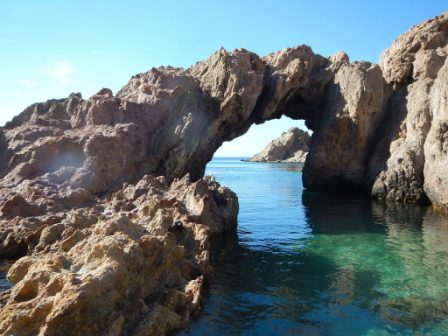
P.S. Yesterday we took a short hop across the channel to Sweet Pea Cove, on Isla San Marcos.  We had a gentle sail over, and arrived with enough time to go for a nice snorkel adventure on the north of the island, where we had loved so much when we passed by earlier this season.  Here are a few photos from that adventure:

San Marcos Cave

Underwater

School

DSCN1231


Posted in Uncategorized | Comments Off on 10-10-2014 – Santa Rosalia, Baja California, Mexico

9-21-2014 – Santa Rosalia, Baja California, Mexico

Our summer in the northern Sea has come to a close, and we’re now southbound again. We had some plans that led us to leaving the amazing Bahia de los Angeles a little earlier than most boaters; most leave when the end of hurricane season has arrived. Unfortunately we squeezed that date further than we should have, and we had our closest brush yet with extreme tropical weather when hurricane Odile followed a course that was different than predicted.

Shooting Moon   Mitlan Sunset

Our big project for this summer was to do some carpentry work around the boat, largely in preparation for our journey to Central America this coming year. We have a “wood-pile” on deck that really should be stowed more securely before beginning an ocean passage – and although the coastal travel down to Central America may not be “pure” ocean travel it’s close enough to be worth the effort! Most of this material was purchased four years ago when we came up with the brilliant idea of updating all of the flooring in the boat, and found some beautiful jatoba, aka Brazilian cherry. Somewhere in the process of measuring all of the spaces we made a mistake, perhaps by adding in the fudge factor twice, leaving us with lots of extra. In addition, we later decided not to replace the parquet flooring in the galley because it is actually quite nice and in good shape. We’ve been using the excess for various trim projects around the place, but our intention for this summer was to reduce the wood-pile (by the way, no self-respecting sailboat should have a wood-pile on deck!) by actually installing that wood in various strategic places around the boat, such as the floor 🙂 in the aft head and stateroom. We also wanted to replace the lightweight sliding door into the pilothouse with the sturdy hinged door that we removed from the forward stateroom when we remodeled that area three years ago to accommodate a chain locker, a double bed for guests and a nice storage space for large items like our welder and scuba tanks. This door is one of a matched set of doors that were custom made for this boat’s initial fitting-out, and we have been excited at the idea of being able to reuse it somewhere else on the boat. It has an arched top and it is taller and narrower than the current door, so the work of framing it in is not a trivial project. But we were determined to set our intentions there.

When we passed through Santa Rosalia on our way north two months ago, we tracked down a carpenter to help prepare the flooring boards for this construction project by planing off the factory finish and the grooves on the bottom intended for glue channels. While we were in his shop, we noticed some of the nice cabinetry that he was making. We were also impressed with the quick turnaround and the low price that he charged us for this work. As we left, we got to thinking about how nice it would be to have him build a few cabinet doors for us, to cover open storage in the galley (from removing a 110V ice maker), office (storage for the sewing machines), and both heads – using more of this same excess flooring material. So we’ve been thinking about Carpenter Carlos for over a month now, and decided to ask him to do the difficult work of framing in our main door. We cut short our summer travels by two weeks in order to get this work done, and we began our journey south in early September, more than a month before the end of hurricane season. (Beginning to sense some foreshadowing yet?).

We allowed a full week to get to Santa Rosalia, and hoped to travel slowly and enjoy the pristine anchorages along the way. And we did, for the first two days. There was a prediction of a few days of strong southeasterly winds on Monday and Tuesday, which would be directly on our nose and make for uncomfortable travel. So we thought about which anchorages would work well in these conditions and identified the bay of San Francisquito. We knew that hurricane Odile was brewing down south of the Baja peninsula, and were following its progress closely by checking in on the weather news daily. The forecast was that it would move parallel to the Baja peninsula on the western side, and eventually turn westward as it degenerated. Each day, though, the track seemed a little bit closer to the peninsula. As it turned out, Odile came ashore that same Sunday, slamming into Cabo San Lucas. We considered running back north to the hurricane hole of Puerto Don Juan in BLA, or racing south to Puerto Escondido. The predictions kept suggesting that the system would lose its steam as it hit land, and that by the time it was as far north as we were the winds would be manageable.

Monday morning we heard news that Odile had hit Puerto Escondido and that the storm was pretty intense, so we tucked into the corner that had the best protection from the southeast and laid out our best defense against whatever might come. We executed our fairly new process of setting two anchors on one chain, which would work together to make sure that neither one could drag along the bottom. First we set one anchor (our primary 215 pound Forfjord beast) with about 50 feet of chain while in 25 feet of water. Next we shackled on a 15′ length of chain with our second anchor (an 45 pound Fortress) on the other end and lowered the second anchor using a short line. Then we let out 175′ of chain, and celebrated that we had all of this wonderful new 1/2″ high-test chain to keep us safe. After setting out the chain, we attached two nylon snubbers, each of them attached to the stem fitting at the waterline using a bowline knot to hold firm and a rolling hitch to connect to the chain itself. Once the snubbers were tied onto the chain we let out an additional 35 or 40 feet of chain to make sure that the 25′ and 25′ snubbers could do their job. Finally, we secured a short snubber, perhaps 15′, from a cleat on deck to the chain heading out the hawse-pipe towards the roller halfway down the bowsprit. All three of these snubbers were 1″ 3-strand nylon rope. We also spent a few minutes securing items on deck, including lawn chairs and jerry jugs for fuel, and wrapping some ropes around the sails with sail covers, to make sure that the wind couldn’t catch inside a loose edge and worry things to shreds. And we took down our Mexican courtesy flag. Then we sat tight for the night. There was one other boat in the anchorage with us, and even though we didn’t know them, it gave us some measure of comfort knowing that we had some company. We had another bit of company throughout the night: a few pelicans spent the night on the water in Lungta’s lee, using us as a windbreak against the uncomfortable conditions!

It was a noisy night, with the wind picking up to the 20-25knot range (that would be about 22-27mph for you landlubbers out there 🙂 ), howling through all the rigging and making the wind generators prove their worth. We both kept getting up to check on things, and although everything was generally ship-shape we were still nervous and didn’t sleep very well. The moon is nearing a new moon, so it didn’t come up until quite late, and didn’t offer much light even when it did. Dan observed that “it was a dark and stormy night”. The other boat was anchored fairly near us and seemed to be pretty steady. Its lights helped us to get oriented quickly whenever we would come up to scan the horizon. It rained buckets throughout the night, and we learned of some leaks in various places around the boat, including around several of the windows in the pilothouse and around the place where the masts come through the ceiling. We put out a number of towels on the floors and settees (but buckets were unnecessary), and made mental notes to address these leaks when the weather is less blustery.

When the sun came up, Dan noticed that one of our snubbers had come off during the night but that our other was still in place. But the wind was picking up in intensity and gustiness, swinging us from side to side, and shortly after that we felt a small shock that meant the second snubber had broken. We started the engine and pointed the boat gently into the wind and towards the anchor system, to prevent any sudden pressure from overloading the anchor system. The winds picked up into the mid-30’s (roughly 38-42mph) and even into the 40’s (around 45-50mph). Every 10 minutes or so we’d get a gust in the 50’s (55-60mph), with our highest recorded gust at 55knots (61mph). Our boat is sturdy, no real surprise, and weathered it all just fine.

Late in the morning we were hearing some clunking noises which we determined was coming from the roof of the pilothouse. We were working with the theory that it was the end of the boom for the staysail, when a bigger clunk happened and Dan realized that it was the radar dome. He could see through the skylight that the radar had fallen off of the 4′ tower that it is normally mounted on, and was hanging from its cable. It would be laughable if it wasn’t so, hmmm, nothing, it is pretty laughable. Kathy beat her way through the howling wind and driving rain to survey the situation, and discovered a bolt lying on the roof. All of the motion and vibrations must have jiggled the last bolt free. So she went back inside and retrieved some replacement bolts and wrenches, then braved the stinging rain and raging wind a second time to reassemble the system. Unfortunately the strong winds made the job too difficult to do alone (the size of the dome presented a large face to the strong and gusty wind, the holes needed lining up from underneath, the cable needed coaxing into the shaft of the platform, etc), so she eventually gave up and returned indoors again to retrieve a handful of bungees and cargo straps to temporarily secure things from swinging in the wind and to keep the rain out. Unfortunately she managed to rotate it 180 degrees, making the radar image upside-down for the duration of the storm. Oops! :-p (The next day, after the wind and rain stopped, we put it all back together properly.) Dan stayed at the helm for almost 4 hours (preferring to be there himself over sitting idly by while Kathy took a stint), and was exhausted when the wind finally turned off. Although it wasn’t quite as sudden as a light-switch, it did seem that there was a clear moment when the howling slowed down. Right about then, our neighbor pulled up his anchor and we were shocked to think that they might be leaving, with this big storm just outside our door. They motored around the anchorage and reset their anchor, which had apparently begun dragging along the bottom.

Blustery Day

We felt really fortunate that the worst of the storm hit us during daylight hours; things always seem more manageable when you can see the bigger picture. We were also relieved that the winds never turned to come in from the north, where this anchorage provides little protection. All in all, this was a nerve-wracking experience, but a good learning opportunity for us. We found few areas that we will make some changes and have added another notch to our belt of experiences. We have been lucky that these challenges have been presented to us in steadily increasing order, presenting us with situations that test and build our knowledge, skill and fortitude but do not overwhelm our capabilities.

As we joined in the morning radio nets over the next few days, we heard many reports of boats in La Paz and Puerto Escondido that had failures in their ground tackle system (whether anchor or mooring ball, or tied to a dock). Dozens went aground, several were dismasted, and a few sank when something punched a hole through their hull. Most of the boats that had serious problems like these were unoccupied at the time – when there are people on board, they can address the problems when they are still small before they have snowballed into a real disaster. Unfortunately there are a few stories that ended more tragically. At least one life was lost when a boat went down in La Paz.

We waited a day after the storm passed before venturing out, for the seas to mellow out. Our neighbor was antsy to get going, though, and pulled anchor first thing on Wednesday morning. They motored out of the bay and around the point as we marveled at their chutzpah. Maybe twenty minutes later we saw them return and drop anchor in the southern portion of the anchorage; it was still too rough. We dinghied over to their boat later that day and chatted with them. One of the crew members (there were three on board) had an airline ticket back to Canada the next day that she was anxious to check on. The other two live in La Paz and were interested in hearing whatever news we had about the storm. They didn’t have an SSB radio, so they had no idea that this storm was approaching or how big it was going to be. The English captain described their night’s experiences as “not very jolly”. They were an interesting group, and we enjoyed our conversation with them. One crew member was a herpetologist working for a research institute in La Paz. She was being paid while on this trip, to stop at several of the remote islands and collect rattlesnakes and lizards for comparative studies. We were stymied to think of them catching lizards, so they explained that they use a fishing pole with a piece of yarn tied as a noose. They would slowly lower the loop around the oblivious lizard’s neck and yank it up quickly. It sounds like this technique works equally well on small lightning-fast lizards and on the slower but heavier ones as well. Who knew? The captain is a photographer who specializes in cetaceans. He travels around, frequently diving, in search of whales and dolphins, then takes beautiful photos which are sent to agencies that shop them out for him. On a very irregular basis he receives a check, whenever a newspaper, magazine or even textbook purchases one of his images.

When we did leave on Thursday morning, we had a perfect start to our day. Our anchor came up smoothly, as did all our sails, and we happily sailed towards the morning sun and around the point to resume our southerly travels. We traveled about 75 miles in 32 hours, occasionally firing up the motor when the winds died and the current was pushing us backwards. Most of the time we had perfect winds and reveled in the experience, and a small part of the time we were frustrated at the fickleness of the forces we depend on. 🙂 Several times along the way we passed a lot of debris floating in the lines between tidal currents, lots of branches, plastic bottles and an occasional bit of closed-cell foam like is used to float docks. We always keep an ear open to the sounds of the boat, and at one point we both heard an unfamiliar sound. When we tried to describe it, we decided that it was a fast vibration kind of like a helicopter, but we couldn’t track down the source and it faded away pretty quickly. Later that day we saw a big dust plume coming up from the shore and a helicopter moving nearby. Probably the navy checking on the various settlements in the region. On the morning net, we were asked to keep an eye out for a sailboat that had been last seen the day before the storm traveling slowly in very light winds in the area that we were traveling. We kept our eyes peeled and periodically hailed her on the radio, but did not find anything. Later it was reported that she had gone aground about 10 miles from where we were looking, the boat’s keel was stuck in the sand, but the single-hander woman captain was OK. The cruising community is trying to help her put together a plan to get her boat out on the water again, possibly with the assistance of the Mexican navy or some local pangueros.

Floating Debris

We arrived in Santa Rosalia in the late afternoon, curious to see what the local conditions were like. We quickly dropped anchor and lowered our dinghy, anxious to talk with Carlos the carpenter to see if he could do the work we were hoping to have done.  There were two marinas in this small harbor, one fairly new and government owned, the other older and privately owned. The older one, which has been allowed to decline over the years, with very little money being put into its upkeep, is more conveniently located to the place where we anchor and offers some space to cruisers to park our dinghies when we come ashore (for a small fee). However, we quickly found that the older marina was completely destroyed. All of the docks broke away from the pilings, some of them with boats tied on. Most of the pilings broke off near the waterline. Two boats that were tied to the docks are now wrecks on the nearby shore, and one is sunk right in front of where the ramp used to come down to the docks from street level. The last of these was a beautiful 2-masted schooner that we’ve admired whenever we’ve walked past on our way to/from the dinghy dock. We ran into the owner and talked with him a while. He does not yet know whether he will be able to float the boat, both from a financial and a pragmatic perspective, and is also worried that there may be legal tangles that need to get sorted out before he can even try. It is a very sad situation. We saw a crew trying to pump the water out of another of the grounded boats, but when we returned later it looked like they had given up with no appreciable progress. Dozens of pangas had been pulled out of the water in anticipation of the storm, and the harbor was almost eerily quiet. Today there has been a steady line of boats going back into the water, and the harbor is coming back to life. There is a lot of mud in the streets, evidence of flooding that has largely been bulldozed away again. And we’ve heard that the town’s water supply has been cut off for a few days.

Santa Rosalia Marina

Our good news is that we talked with Carlos today, and brought him out to the boat to show him our projects. He is interested in the work, took lots of notes, and will give us a quote on Monday. So it looks like we will be here for two weeks while lots of work gets done. Then we’ll take a week to head south to Loreto. The plan is for Kathy’s sister Jean to pay us a visit – assuming the airport is opened back up to tourist air traffic in time! We’re keeping our fingers crossed!

Posted in Uncategorized | Comments Off on 9-21-2014 – Santa Rosalia, Baja California, Mexico

8-29-2014 – Bahia de los Angeles, Baja California, Mexico

It feels like we just arrived here in the far northern Sea, and already the end is within sight.  We enjoyed our journey up here, and we have some plans for the journey back south, so the part in the middle has gotten somewhat compressed.  We’ve really settled into the wonderful rhythm of summer in the Sea.  We’ve already visited all but one of our favorite anchorages in the area, and a few new ones to boot.

Isla Angel de la Guarda (Guardian Angel Island) is the second largest island in the Sea of Cortez, about 40 miles long and 5 miles wide.  It’s about 20 miles off-shore from the rugged northern portion of the Baja peninsula, and as a result remains virtually untouched by man.  We visited two corners of this largely unexplored island this season.  The first location is called Este Ton (we haven’t found a translation of the name, perhaps it’s a colloquialism of some sort).  It’s a tiny little cove enclosed within two rocky points that wrap around it something like embracing arms.  Our guidebook gives no information about it except for a named dot on a map.  We really felt like we were off the beaten path!  We encouraged some friends to go there with us, and they expected to follow us the next day, but it turned out to be too small for us to feel comfortable with two boats in it at the same time!  So we suggested that we meet up a few days later at a different anchorage which was much larger.  Meantime, we took a nice hike up into the hills, enjoying the sense of isolation and adventure – and the sweeping views.  We also did a little exploration of the nearby coastline by dinghy, but didn’t go ashore.  The anchorage is protected from winds in all directions except for the entrance, which is about 100 feet wide and faces southwest.  Unfortunately, the second night we were there, the wind (and corresponding waves) came from exactly that direction, making for a somewhat uncomfortable experience, mostly because of our worries that we might swing around into the nearby rocky outcroppings.  These worries did not materialize, but we decided to move on after only two nights.  This island displays many of the layers of colorful rock that we’ve come to love about the Baja.  The sparse desert vegetation allows them all to be quite visible.  We were particularly awed by a section that had bright green rocks right next to some cliffs of red, making a very striking contrast.  Not for the first time, we wished we had a geologist on board to make sense of the cacaphony of geologic formations.

Lungta in Este Ton

The other area of Isla Angel de la Guarda that we visited is called Puerto Refugio, and it’s located at the northern tip of the island, about 40 miles away from the BLA village.  By contrast, this is a fairly large area, and the guidebook identifies 4 different anchorages, each with different features to explore and each large enough to safely harbor dozens of boats.  When we arrived, the winds were blowing from the north, so we were relieved to pull into an area that was essentially a channel between two islands with a third one capping off most of one end.  We spent a few days in this very protected place, until the winds moved around to come from the southwest, making a different spot more attractive.  There were 5 other boats with us in the region, providing a fairly active social climate in this extremely remote location.  Potluck dinners on the beach are a frequent affair in this life, and this time was no exception.  These events give everyone a chance to meet each other and compare notes – and recipes!  We went snorkeling one day, off the far northern point where a reef extends out to a couple of pinnacle rocks.  There we saw a huge number of scallops had been recently harvested, leaving the pearly white shells open on the sea bottom.  Because of the depth and quantity, we were convinced that this was the job of a commercial dive team, illegally over-harvesting even this remote region.  It’s always sad when a portion of the environment comes in contact with a short-sighted (and likely under-employed) group of people.  Another day we enjoyed a long kayak exploration along the shore, poking our noses into some of the innumerable caves in the area that are characteristic of one of the layers of rock.  It’s funny how intriguing a cave can be, drawing us inevitably in to see what mysteries it contains – not to mention ideas of previous inhabitants!

Guardian Angel

After returning south to the BLA area we revisited the La Mona anchorage in early August, in order to participate in another beach potluck for the whole fleet of cruisers in the area to attend, planned annually in commemoration of the full moon.  Nearly 20 boats showed up, most of whom we had never met.  It was held in a corner of the anchorage that we hadn’t visited before, and we took the opportunity to play around in another small lagoon, riding the current formed as the tide withdrew.  Guys from two of the boats had built potato cannons from ABS plumbing, and entertained the crowd by firing potatos and marshmallows out over the water.  Bang!  Pow!  Splash!  The next day a half dozen boats had an epic adventure in the big lagoon, bringing floats, kayaks, canoes and dinghies to ride the current there.  Unfortunately this event was not as well planned, with some confusion as to exactly when the high point of the tide would be and a misunderstanding of the topography of the lagoon.  We had expected something like a swiftly flowing creek winding through the desert flat, but what we found was a shallow lake with deep channels that became apparent several sun-blasted hours later.  It turns out that the river ride for this lagoon is not best during the highest tides, but rather at the mid-range high tides.  Who knew?  (Not us!)

We’ve also spent some time in another off-the-beaten-path anchorage this year, near a tiny rock of an island called Isla Alcatraz.  The cove is huge, able to host dozens of boats, but not well-protected from easterly winds.  We’ve stopped in there three times now, exploring different facets of it each time.  There’s another off-lying rock/islet which is home to a sea lion population.  One day we joined three other boats on a day-trip around this islet and into a nearby cove.  As we passed the sea lions, word seemed to go around quickly and almost all of them stumbled, hopped or slid into the water.  The rock seemed to writhe for a few moments as the chaos bubbled up and the once large rock shrank considerably!  Then the nearby waters were full of small dark heads bobbing around.  The mass exodus brought a chuckle to all of us.  We went for a few small hikes in the area, exploring a few of the lagoons.  One day we hiked up a big sand dune that was sandwiched in between rocky cliffs.  This countryside is full of surprises!  The wind was whipping at the top, causing the sand to blow like snow at the top of a ski lift.

Abandon Rock!   Alcatraz Sand

We’ve had some good luck fishing recently, and learned a few things about the activity.  The hardest lesson is that fishing poles and our new wind generators don’t mix well.  We have two holders for fishing rods on the very back of the boat, on either side of the davits, which we use when we’re trolling a line behind the boat while we’re underway.  When we’re putting the poles into these holders, we need to be careful not to get the line tangled in the spinning vanes of the wind generators.  We’ve both been caught by surprise when the vanes suddenly grab the fishing line and whip around a few times before we’re able to flip off the switch.  Kathy has gotten good at unwinding the 10-20 wraps, but it’s not something we necessarily recommend.  🙂  More on point, we’ve learned a new technique of jigging while the boat is at anchor.  It uses 4-6 tiny hooks on the same line, and often results in bringing up multiple fish at once!  The fish that we catch most often this way are locally called firecrackers, but seem to be what our book calls rainbow runners.  While trolling, we’ve caught several dorado (aka mahi-mahi), including one that was over 40″ long, currently our largest fish to date.  We also recently caught a fish that a friend was convinced was a yellowtail tuna, which set our mouths to watering.  Unfortunately, it turned out to be a black-sheep cousin called a crevalle jack.  This fish has fairly red flesh, and is just not as tasty as the white-fleshed tunas that we were hoping for!  There was a whole school of them stirring things up in the La Gringa anchorage one day, so we hopped in the dinghy and tossed out a line.  Within 5 seconds Dan had a BIG bite on the line.  He played that fish for about 20 minutes, while Kathy steered us back to Lungta to get our gaff, which is used for larger fish.  After pulling our fish aboard, we took our gaff over to our neighbor, Ron on IntimaSea, who was standing on his own deck with a similar fish on the line but no idea how he was going to get it on deck!  We’re playing with a variety of ways to process all this fish, and the latest batch is going to go into the smoker.  After that comes a batch of ceviche.  We’re not going to go hungry!

Fish On!

We have some friends from Arizona, Harlan and Denise, who we met here last year.  They have a small sportfishing boat and a trailer-home in the BLA village.  The drive from Yuma is about 11 hours for them, so they come down here whenever they can get a few days free.  Theoretically they are both retired, but she seems to be fading out of her teaching career rather than quitting all at once.  We’ve spent a handful of days with them on three of their visits this year.  They’ve taken us out twice for a half-day of fishing on their boat.  The contrasts between their style of boating and ours on Lungta are profound.  There’s a joke about sportfishermen spending all their time figuring out where the fish are and then going there, while cruisers expect the fish to come to wherever we are. 🙂  We spent our time with Harlan & Denise zipping around to various places where the fish are often found, and managed to snag a few.  (Denise in particular did very well!)  But a lot of gas is consumed in getting to those places, and Harlan has been heard to say that the fish he catches end up costing $600/lb once you work in all the costs of keeping up the boat.  We catch fewer fish per day on Lungta, on the other hand, and they are often smaller and less dramatic, but our costs per pound are at least an order of magnitude lower.  It’s been fun to get a taste of how the other half does things, but I think we’ll continue to let the fish come to us!

On our last day with Harlan & Denise, they took us for an exploratory drive in their enormous air-conditioned, four-wheel drive diesel, air-conditioned truck.  (And did we mention that it has air conditioning?)  They had noticed a sign at an intersection off the highway on their drive into town that pointed off to “San Borja” and they wanted to find out just what it was indicating.  So we all drove 15 miles up the highway and then took a left onto a dirt road.  Two miles up that dirt road, there was a fork, and another sign with an arrow pointing to “Mision San Francisco de Borja”.  The only problem is that the sign was halfway in between the two forks and we couldn’t agree on which fork was the intended one.  So we started up the road to the right, reasoning that it looked slightly more travelled than the one on the left.  A few miles up that road we spotted a tiny but very tidy house which had recently been added on to.  Nearby were a swing tied in a tree branch and a windmill pumping water from a well.  The road seemed to come to an end here, although it just might have switched back and continued up the ridge.  We turned around and returned to the fork, then followed the other road.  This beautiful track took us across a plain covered by a forest of cactus and boojum trees and then between two steep ridges with interesting pockmarked features.  At times the ‘road’ nearly disappeared into the surrounding desert, but the four-wheel drive truck was undaunted.  Five or six miles from the fork we came across another sign, but instead of telling us we were at San Borja, it was announcing cave paintings, “pinturas rupuestras”.  We excitedly stopped the truck by the side of the road (you never know when someone else might come along, right?) and we all piled out to wander along the base of the nearby ridge, where we quickly spotted dozens of markings at eye-level, and then more and more in the shallow caves above our heads.  A number of the cavities had black soot on the ceilings, indicating fires, and we thrilled to imagine the small community of indigenous people that must have called this place home centuries ago.  Most of the paintings seemed to be rather abstract designs, but there were also a few that showed animals and mountains.  It was amazing to us to think of a historical treasure like this being left so accessible to the public, so that anyone could climb right up to the paintings and even touch them.  Then we realized that just getting here was a pretty significant deterrent to most, and the lack of publicity also helped protect this site.  We felt quite privileged to have stumbled on something so cool and off the beaten track!  On our way back to the village, we made one more (unscheduled) stop: at an amazing overlook, from which we could see the entire Bahia de los Angeles.  The late afternoon sun created a beautiful glow on the islands, but also an interesting visual effect: the islands appeared to be floating in air.  It was a spectacular sight which we will remember for years to come.

Boojum Trees   Pinturas Rupuestres   BLA Panorama

Harlan and Denise were our most recent couriers, bringing with them items that we couldn’t live without.  🙂  We always appreciate when our friends and family help us out by toting along delicacies, household items or repair parts when they come to visit.  This time the big wins were a second wind generator and some seals and hydraulic oil for our steering system, which has been leaking, whining and refusing to play nice for several weeks now.  It turns out that it is good practice to replace the O-rings and seals in a hydraulic steering system at least every 45 years. 🙂  Now our wheel and auto-pilot are much more responsive and effective – hooray!  It’s also really nice to have the wind generation system, because it helps bridge the gap in keeping our batteries charged whenever it’s windy, even when it’s overcast or the sun has set.  In addition to carrying down the items that we had purchased, they gave us some fishing equipment from their own collection, including a rod and reel, which will help us to put fish in our freezer for years to come.  Thanks, Harlan & Denise!  We really appreciate your generosity!

Another project we accomplished this month was to paint the masts.  While Kathy was aloft attending to this paint job, Dan was down below painting the rubrails our new burgundy color.  The boat is really starting to shine!  During this project, we solved a mystery – and then addressed the problem that it reflected.  Dan had noticed that the shrouds (the cables providing side support to the masts) for the mizzen mast had been loosening up quickly after being tightened.  Were the half-inch steel cables stretching?  Not likely!  It turned out that the stainless-steel cuffs that they were attached to at the top were slipping down the masts, presumably because the masts have shrunk recently in the hot, dry desert air.  The worst offenders had slid down 2 inches, but we found three others that had slipped about a quarter of an inch.  It took some effort to lift that cuff back up 2 inches, but we managed by using a combination of removing the downward forces, pulling upward with a halyard (a line going through a block up above), and a bit of percussive persuasion (smacking the crap out of it with a hammer).  Then we tightened the bolts holding all of those cuffs in place, to prevent additional downward sliding.  Hercule Poirot and MacGyver would have been proud.  While Kathy was aloft, she was able to watch several whale sharks swimming around the anchorage.  We learned that these beautiful animals do not always break the surface, and that they are sometimes very close by!

Painting the Main   Nearby Sighting

There was one more notable event this month, a personal accomplishment for Kathy.  We have a strong commitment to being equal partners in this life, not dividing the jobs up into “pink” tasks and “blue” ones as many cruisers choose to do.  Although Dan has quite a head start on the sailing and equipment maintenance/repair skills, Kathy has learned a lot in the last few years and is slowly closing the gap.  This month she demonstrated a level of progress by singlehandedly sailing Lungta on a 5-mile passage from one anchorage to another, raising the anchor and all 5 sails, and then lowering them all again without any assistance or advice.  (Perhaps this should be considered a personal accomplishment as well for Dan.)  It was a familiar place and a calm day, and all went smoothly.  Although Dan has been living on Lungta for over 15 years, he never actually sailed alone until this time last year.  Kathy has been contemplating that milestone since his accomplishment, and working up the confidence to follow in his footsteps.  Of course, there’s still lots to learn, and we are continually doing so.  It’s one of the wonderful things about this life!

(Although this posting was written on 8/29, it’s taken us more than a week to get to a good enough internet connection to post it.  Sorry to keep you hanging! 🙂  )

Posted in Uncategorized | Comments Off on 8-29-2014 – Bahia de los Angeles, Baja California, Mexico

7-29-2014 – Bahia de Los Angeles, Baja California, Mexico

We’ve finally arrived at our summer haunting grounds, Bahia de los Angeles (BLA), which we’ve been anticipating for the last several months.  Hooray!  We spent the last few weeks on the approach enjoying the journey.

Shortly before reaching Santa Rosalia, we stopped for the night in Sweet Pea Cove, a smallish indent on the western side of Isla San Marcos, which is less than 15 miles from Santa Rosalia.  We’d heard good things about this place, and weren’t disappointed.  We took the dinghy around the corner from Sweet Pea Cove for a snorkel and a bit of exploration.  Our friend Ron from IntimaSea and Ken & Danita from Odyssey were already there, playing in some swim-throughs in a cave that was just big enough for about dozen dinghies.  The rock in this area has lots of huge bubbles, creating caves, blowholes, and numerous other features that are intriguing.  Based on the snorkeling, which was some of the most interesting since arriving in Mexico, it’s certain that the fishing here would be great!

DSCN0666 DSCN0712

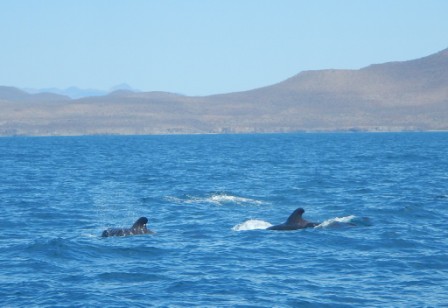
Both on the way in and on the way out we passed close to a pod of pilot whales.  We hadn’t seen these guys before, and at first we thought they were just another (ho-hum) pod of dolphins.  But they behaved slightly differently, which puzzled us and kept our attention.  They were creating white waves, visible from quite a ways away, but there was no leaping or frolicking.  Their dorsal fins were cutting through the surface in slightly more of an arc, and the fins were much larger than a dolphin’s, somewhat like an orca but completely dark. 

Pilot Whales

We stopped in Santa Rosalia for three or four days, to get some errands done before heading north into the more remote areas that we would be calling home for the summer.  We had dinner one night with folks from half a dozen boats, all of whom will be up in the BLA area with us this summer.  We’re just starting to form the relationships that will color our summer.  There are fewer people in our life when we are away from cities and towns, and the relationships formed tend to be deeper.  We’re all feeling around for who will be significant, perhaps forming friendships that will be with us for years to come. 

We were anchored near the commercial pier, and noticed that a particular boat came and went daily, carrying a distinctive load.  We’re pretty convinced that it’s gypsum from a nearby island where they have a big operation removing gypsum to supply the world market.  This boat carried about 20 big sacks, perhaps 8 feet in diameter.  It has a crane arm built in which can lift one bag at a time onto a waiting semi truck.  They load one bag at a time, 10 or 12 per truckload, then the truck carefully backs to the end of the dock and maneuvers slowly up the ramp.  The second load is pulled out of the hold while the truck makes its delivery, and then they do it all again.  One day we also saw them deliver a pickup truck.

Off-Loading Gypsum

We provisioned, did a few small projects around the boat, and picked up a Couchsurfing guest.  Aleeza had hitchhiked down the Baja peninsula, and was working her way back north again.  Although she initially only pictured a couple of days with us in Santa Rosalia, we suggested that she come with us up to BLA and continue her land journey from there.  She happily accepted!  She’s a 24-year-old from New Jersey, who has been living in San Diego for 5 months (but says that’s already WAY too long!)  She’s light-hearted and enthusiastic about learning new things.  She’s never been sailing before, and had fun finding her sea-legs.  She’s learned to tie a bowline, taken a short ride partway up the mast, and has now been snorkeling for the first time.  She’s been thrilled at every pod of dolphins we’ve seen, and curious about the instrumentation, the weather, and the life in general.

The first hop north from Santa Rosalia was an overnight trip to Bahia San Francisquito.  We saw some whales for the first time that Dan thinks might have been fin whales.  They didn’t show much above the surface when they spouted, but they had the right general shape and proportions – they were BIG!  We spotted perhaps 8 of them, although at different times so it’s impossible to know how many individuals that actually was.  Hard to say for sure, but this might have been more exciting for us than for Aleeza. 

Sunset

We agreed to split the night into three shifts of 3 hours each, but this was one of those situations where the plans don’t end up suiting the reality.  Somewhere around 4am the winds and waves picked up to uncomfortable levels and it didn’t make sense for our new crew to man the helm.  We had winds around 20 knots for 4 or 5 hours, which stirred up short choppy waves of 3-4 feet.  Not terrible, but quite unexpected.  When we mentioned it on the morning radio net conversation several people told us that this is a common weather pattern for this particular stretch of coastline.  Hmmph – we never got the memo!  Although Aleeza got her first taste of seasickness, it was pretty mild, and things worked out fine.  We caught a 36″ dorado late that night, and were pleased at how smooth our fishing process has become.

San Francisquito is a very large bay with a small cove off to the side that has a narrow and shallow entrance.  There were four boats in the small cove and one outside near a large sandy beach.  We arrived late the next night, and joined the one boat near the beach.  When we got up the next morning, our neighbor had already moved into the small cove with the others!  We enjoyed a hike that day, following a ridge of smooth yellow sandstone riddled with numerous caves and dens.  There was no sign of habitation, either human or otherwise, but we did spot a few animals along the way, including a jackrabbit, a coyote and innumerable lizards.  When we were here last year, we were chased away by mosquitos, causing Kathy to dub this place “San Fran-mosquito”.  This time the insects were much less voracious, although the name was still apropos.  That night we heard coyotes yipping on shore, and we had fun howling a bit to get them going.  We had a nice snorkel the next day, introducing Aleeza to the use of a mask, snorkel and fins.  Although the water was not crystal clear, we did see a good variety of sea creatures including rays, angel fish, and sponges.  We crossed paths here with our friend Dave on Free Spirit, who is heading south to Puerto Escondido.  He bakes bread frequently and in fact shared his techniques with us the last time we saw him a year ago.  We had dinner with him, and he made cinnamon rolls and a tasty loaf of bread for us to take when we left the next morning.  What a nice guy!

San-Squito Vista San-Squito Towers San-Squito Portrait

One evening while underway north from San Franciquito, we enjoyed watching a lightning display from 3 or 4 weather cells 100 miles away on the mainland.  We considered the likelihood of their coming our way, and concluded that it was low.  These storms are often sucked out to sea by warm water, but the water where we were was a cool 81 degrees.  Later that same night we had a different sort of light show when we watched a few dolphins swimming in and out of our bow wave, highlighted all over by bioluminescence.  They were leaving a glowing trail as they criss-crossed in front of the boat.  A beautiful sight to behold! 

The following day as we approached BLA we went through a patch of light winds and decided to play with our newly acquiredspinnaker.  We figured out a temporary way to secure the front corner and played with a couple of placements for the sheet, the line that controls the loose corner.  The winds were very light, but steady, so we could see the effects of our changes.  We didn’t go very fast, perhaps not even as fast as if we had all of our normal sails up, which has us wondering why not!  But we did move directly downwind, which is a direction that is difficult for us to do normally.  The sail is BIG, about 50% of the total area of the five other sails, and the bold colors are striking (even though there was some bleeding between panels, which is why we got it for a great price!).  We need to make a sock to make deploying and retrieving it easier and safer, and there’s still plenty for us to learn about using this sail, but we are pleased with our successful first try.

Spinnaker

Bahia de los Angeles is a large, partially protected bay over 10 miles long and 6 miles wide.  There are dozens of small islands and coves to explore here.  The winds are squirrely and sometimes intense, but the fetch is limited so the waves never get very big. Our first stop inside of BLA was the La Mona anchorage, a big beautiful cove with a sandy beach fronting a lagoon to the south, some impressive cliff walls on the east side, and the twinkling lights of the town (also called BLA) to the north.  This seems to be the favorite place for the region’s whale sharks to come out to feed.  Almost every day one boater or another reports having seen anywhere from one to a dozen whale sharks in this area, and it’s not unusual for the report to include a very close encounter.  This group of whale sharks are fairly young and apparently pretty curious.  They are smallish, mostly between 15 and 25 feet long, and slender.  When fully grown they will reach 40′ or more.  When we saw a couple of whale sharks circling a half mile away from the boat, we took our dinghy out to see if we could get even closer.  We slowly approached them, and then cut the motor and slipped into the water with them, wearing our snorkeling gear.  From the surface it was easy to see their fins cutting through the water, but it was hard to see them through the water unless we were very close to them because the water was a bit murky.  It was filled with the plankton that the whale sharks were feeding on.  Although we’ve heard tales of people touching these gentle beasts, we did not want to scare them away.  We were all awed at just being near these huge creatures!  A couple of whale (shark)-watching boats came out to see them too, snapping away at their cameras but no one got in the water with us.  When the  sharks moved on, as did all of their human observers.  We headed over to the beach, and walked up and over the berm separating the lagoon from the sea.  The lagoon must be several square miles in area, and generally quite shallow, which means that the water inside heats up quite a bit over the course of a few hours.  The tide was just turning, and the warm water was beginning to flush out the narrow mouth further down the beach.  We floated around for 30 minutes or so, scooping at the sandy bottom to see what we could dig up.  We were surprised though that there wasn’t a lot in there.  We found a few clams and a lot of live sea biscuits, which were difficult to identify at first.  They are fuzzy, almost prickly little globes that easily fit in the palm of your hand, and they have some faint markings on them that remind us they are closely related to sand dollars.  Sorry, no photos of these guys.

Whale Shark

The final stop on Aleeza’s journey with us was the village of BLA.  We stayed there two nights, because we wanted to visit the little museum in town.  Unfortunately the day we arrived was one of the days when its regularly closed – sometimes it does pay to stay aware of the day of the week!  We met a guy while trying to get an internet “fix” at a local restaurant hot-spot, who joined us later that evening for a lazy swim near the point at the outside of the anchorage.  Brad is a college photography and graphic arts instructor in Yuma, AZ who spends much of his summertime exploring the Baja peninsula.  It’s got a large collection of interesting objects, ranging from sea shells and whale skeletons to manmade artifacts from several periods throughout history.  Unfortunately there is not a lot of interpretive text to go along with the collection (yet), although there are short labels on almost everything.  It’s just a step up from poking through someone’s ancestral attic, wondering what’s in the next corner and what its significance was.  The schedules worked out well for Brad to be the next hop in Aleeza’s journey north, so we bid her a fond adieu after visiting the museum.

After waving goodbye to Aleeza & Brad, we headed 5 miles north to the La Gringa anchorage.  Here we got to work for a few days.  Dan spent his time sanding and painting the rubrail on the hull, and Kathy worked on re-covering our large and mismatched collection of throw-pillows and then re-upholstering the galley just for the heck of it!  The fabric that we had used just two years ago to cover the galley cushions had faded badly in the sun, and we were pleased to discover that we had just enough fabric left over from the recent pilothouse upholstery project to fit the galley as well.  Dan also spent an hour or three polishing up the brass poles, and we can’t remember when the galley looked so nice!

New Galley New Rub-Rail

La Gringa is another large sandy-beach ringed anchorage, north of the village, which has a smallish lagoon chock-full of clams.  We spent 15 minutes one evening harvesting some of these lovelies for dinner the next day.  Now we’re working on a hearty pot of chowder – yum!  While at the lagoon, we saw a couple of coyotes combing the low-tide beach for other tasty morsels.  We had a nice evening with Ron on IntimaSea, who had caught a yellow-tail tuna and had plenty of meat to share.  When we returned to our boat, the winds had picked up a bit.  We decided to sleep inside instead of on the air mattress on the front deck where we had been planning to spend the night.  Although Dan had put a small anchor on the air mattress to keep it in place for the day, somehow it had gotten out from underneath the anchor and blown away during the evening.  We grabbed a super-powerful flashlight and hopped in the dinghy in the dead of night, for a trip to the beaches downwind of Lungta.  We saw some local guys fishing from a panga with nets, and we saw some largish crabs swimming around in surprisingly deep waters, but we didn’t see our air mattress anywhere on the beach.  Finally we went home to bed, sad that our nights of sleeping on deck might be over for the summer, or at least would be far less comfortable.  🙁  But Dan woke up VERY early the next morning with a renewed energy to go on the search.  So we launched the dinghy again and retraced our steps from the previous night.  We still didn’t see anything on the beach, but wondered whether it was possible for the 15-20 knot winds to blow a queen-sized air mattress up and over a sand-dune ridge into the lagoon.  So we beached the dinghy and walked around the lagoon a while.  Finally we spotted something in the distance that “could” have been our air mattress.  Dan went back to get the dinghy while Kathy went on to check out the possible recovery.  There wasn’t a single moment which struck Kathy as “aha – that’s it!”, but the likelihood just slowly grew larger as she walked.   Dan had a happy moment when he saw Kathy deflating the object though – hooray, we found it!  There was a fire-ring nearby, containing ashes that were still warm.  We’re curious whether someone else enjoyed our mattress for a few hours on the night it went on walk-about.

Life is settling into our summertime rhythm now, spending a few days to a couple of weeks in a beautiful anchorage somewhere within a couple of day’s travel to Puerto Don Juan, our hurricane hole, followed by a quick trip into the village to catch up on email and reprovision our refrigerator.  We’re looking forward to reconnecting with some friends we met last year and making new friends this year.  We’re anticipating more wildlife sightings, more spectacular sunsets and shooting stars, and many projects to check off of our to-do list.  🙂  Hope your summer is as delightful as ours is shaping up to be!

Posted in Uncategorized | Comments Off on 7-29-2014 – Bahia de Los Angeles, Baja California, Mexico

7-12-2014 – Santa Rosalia, Baja California, Mexico

Summer has begun, and we’re excited to be heading up into the Sea of Cortez! We ended our passage across the Sea in La Paz, because we wanted to say goodbye to our friend Bernard. His boat was still out of the water while he finished up a few last minute projects, so we hung out in La Paz for a day while he wrapped up. We ran into some now “old friends” who we first met in San Diego when we were coming down the coast – two and a half years ago. Tommy and Susie on Ariel’ hosted us for dinner one evening, and we all really enjoyed each other’s company once again. We’re hoping that they’ll come up to the Sea this summer too.

The next day, with Bernard’s boat back in the water and ready to go, we both left the anchorage early in the morning and sailed up the La Paz channel. We spent nearly a week together, traveling the first half and staying put in Nautilus Cove the second half. We had several great days of sailing together. Bernard has many years of sailing under his belt, from racing in San Francisco Bay to cruising in Mexico, and we often learn quite a bit from him. This time he gave us some pointers about trimming our sails which was very helpful, and Lungta’s performance has unquestionably improved since. We began talking about ways to get better performance in light winds, and how we might go about adding a spinnaker to our sail inventory. We went dinghy fishing a few days, and he showed us some things he’d learned recently about catching rock fish. We went for a walk along the beach and spotted a roadrunner, the first we’ve seen in Mexico – and the first we’ve even heard of here! It was running along a path a ways up the slope, and its distinctive run is what clued us in. We expected Wiley Coyote to come trotting along right behind. 🙂 We had a dinghy raft-up one evening with all 5 boats that were in the anchorage. We started out in the shade of Lungta, but after the sun went down we drifted around the cove for a while, meandering where the current carried us (with an occasional push from one or more outboards). Because this anchorage has high cliffs on both sides, the sun was out of sight long before sunset, and the moon didn’t come up until quite a bit later. But we all waited until the full moon presented itself before we made our various ways home for the night. What is it about a full moon that moves the heart?

Dan & Bernard  Nautilus Cove

It was wonderful to spend this time with Bernard – and to make some new friends, especially Carol and Sigmund on Mary T, who have already traveled around the world, have many tales to tell, and are moving towards the next chapter of their lives back in the States. It was with mixed feelings that we left Nautilus Cove, wondering if/when we would see any of them again. Bernard has expressed interest in joining us on Lungta at some point down the road, perhaps even this summer while we’re up in the far northern Sea of Cortez. He’s been our closest friend since arriving in Mexico, and we look forward to that day.

We left that Monday because we had a schedule to keep. 🙂 We prefer life without schedules, but find that they creep into our lives when we decide that we want to travel off of Lungta: planes, ferries, or car rentals are the usual culprits. This time it was because we had reserved a car for a “quick trip” up to San Diego, primarily to pick up the new anchor chain that we had ordered. We have done this trip once before, and loved the drive up the Baja peninsula, so we were looking forward to doing it once again. We got some good winds to bring us to Loreto, so the trip we anticipated would take two days only took one. That meant that we had time to run an experiment: to verify that our solar system was up to the task of supporting the batteries for a full week without assistance from the generator. We tried to spend a full 24 hours without using an appreciable amount of power, checking the battery level at either end of that period to see that the level was the same. We went into town in the morning, and spent most of the day running errands, including a visit to the car rental place to confirm that they could deliver our car to Puerto Escondido, 15 miles away, where we would be leaving Lungta while we were gone. Although the power levels weren’t exactly equal, the difference was less than we calculated our usage to be, so we tentatively declared it a success. Then we popped down to Puerto Escondido, paid for 10 days of moorage time, and packed our bags.

We got off to a slow start, though, because they are doing some construction on Mexico Highway 1, the one road between Loreto and Puerto Escondido (actually, it’s the only road that runs the 800 mile length of the Baja Peninsula). We had heard that sometimes the wait could be 45 minutes, because traffic can only pass one direction at a time. The project is a big one, and they are making remarkable progress, but it does impact the lives of people in the area. And as a matter of fact, they were completely done with that stretch of highway when we returned less than a week later. Once we passed the construction zone(s), it was smooth going – except that we very nearly ran out of gas! The car arrived with a little less than half a tank, and we should have filled up at the first station we passed, but we waited until the second town, which turned out to be quite a ways up the road. Although we were both nervously spinning fantasies about walking through the desert in the heat of the day to get fuel, we were able to coast downhill into a gas station while there were still some fumes left in the tank. Our little rental car kept trying to catch our attention with alarms and blinking lights and for the last 5 miles it had a clear display telling us that there were 0 miles left to travel on this tank. After that we were much more diligent about topping the tank off whenever it got below half-full.

We spent the night in a wonderful little hotel in the town of El Rosario, perhaps the best $25 we spent all week. As before, we both marvelled at the scenery, the interesting rock formations, the quirky plant-life. We always enjoy joking about signage and other marks of human foibles. Just past Ensenada we turned off onto Mexican Highway 3, which goes to Tecate where there is another border crossing. People have told us that this crossing typically has much shorter waits and that it ends up being worth the 50 additional miles of driving off the direct route into town. Unfortunately our experience did not confirm those hopes, and we ended up sitting an hour and a half in a very slow line to meet up with a border agent that was not as friendly as we have met elsewhere. Much of the wait was on the downward slope of a hill along the border fence, so we were entertained by watching lots of street vendors selling various items, mostly food, to the dozens of cars in line ahead of us. One odd observation was that a significant number of these people were on crutches or in wheelchairs; we even saw a blind man with a cane holding onto a younger man’s elbow as they walked from one vehicle to the next – is this a dangerous job, or does having a handicap make one more successful at selling snacks and trinkets?

Back in the States, we were overwhelmed at the contrasts between the two sides of the arbitrary line we call The Border: the difference in road and building maintenance, the landscaping, the variety of products available, the cost of those products. We searched diligently for an inexpensive hotel, but found (again) that San Diego has a dearth of hotel rooms and is completely booked up on weekends when conventions come to town. This week the convention was for the nation’s Jehovah’s Witnesses, some 80,000 of whom descended upon the town. A hotelier told us of the Comicon convention in July which brings in 1.6 million attendees, causing hotels up to 150 miles away to fill up. Yikes! Fortunately we were able to find a room in a suburb that was not too far away. We originally planned to spend 4 days in Southern California, and actually ended up spending 5. Sounds like quite a bit, but it turned out to be just barely enough. Our list was rather long to begin with, and seemed to get longer as time went on, yet we still managed to get almost everything we came for. In addition to the chain, we also ended up purchasing a used spinnaker, a backup inverter/charger, a new wind generator, a replacement motor for our dive compressor, a new speargun, numerous items for smaller projects, and a few delicacies for our future dining pleasure.

On the last full day of our stay, we went up to Hollywood to have lunch with Dan’s son Jesse. It was good to see him again, and see the changes that he has made to his life. A number of years ago he threatened to run away and join the circus, and has since really thrown himself into the training it will take. He’s been bartending for years now, but his heart is in acrobatic performance. He was just beginning his training when we passed through the area on our way down the coast three years ago, and it’s amazing how far he’s come in just a few years. His body, his confidence level, and his life style have all changed, and he seems happier for it. He’s now putting together an act of his own, and beginning to make the contacts that will be needed to find a great job. It’s an exciting time in his life and a testament to the power of dreams!

The last stop on our itinerary was the primary goal: the chain. We got 300′ of 1/2″ high-test chain, which weighs over 750 lbs. We had specifically looked for a rental car that had a high payload capacity over 1000 lbs, nonetheless we ended up exceeding it (as we knew we would 🙂 ). Although the suspension felt a bit softer than before, and the rate of acceleration and deceleration were detectably decreased, the car still handled just fine; if it wasn’t for the comparison with its handling before we loaded it up, we wouldn’t have known that it was working at capacity. Hooray for Volkswagen! As we crossed the border heading south, though, something caught the eye of the border guard – perhaps we were sitting too low to the ground, perhaps it was the sail in its bag coming almost to the ceiling in the back seat. At any rate, we got singled out for special attention, and then told that our understanding of the import policies was not quite accurate. 🙂 We had thought that replacement parts for the boat were exempted from import duties, because of the import process we went through when we brought the boat into Mexico. Unfortunately, the border guards had a different interpretation of what was exempt and what was not (we think that they would only count items that are being repaired and not those being replaced), and we ended up paying an additional $500 in import duties. The border agents (we talked with half a dozen over the course of the process) were all polite and friendly, and spoke varying amounts of English, almost all of them better than we speak Spanish – although our skills have increased to the point where most of the conversation took place in Spanish. Eventually we got cash from the ATM on site, paid our duties and were on our way again.

Vado Sign  Baja Cliff

When learning a new language, you may originally assume that words will just translate one-to-one, but in fact you’re actually interacting with a different culture as well. The people have a different history, a different environment, and it’s not always easy to know what a word really means if you don’t have a deeper knowledge of the context. When we were driving up the Baja, we saw two signs over and over that were confusing to us for quite a while. They were both telling us that a “vado” was coming up.  This one made us think of a mustache or a worm crossing the road. As it turns out, a vado is a low spot in the road where a stream or river might cross if there have been recent rains. There are lots and lots of these, and since it’s usually dry it is prohibitive for them to build bridges or put in culverts for all of them, so they just put a dip in the road and repair it when it gets washed out.

Although we had another late start, we were able to make it to the same hotel that we had stayed in on the way up – and the woman at the counter recognized us and gave us the same room. We arrived back in Puerto Escondido in the early evening, and bummed a dinghy ride out to the boat. We were delighted to find when we got back to Lungta that the batteries were completely full, proving that our solar panels are up to the task – at least under these specific conditions (if the water temperature was hotter, causing the refrigeration to run longer, or if there had been cloudy days, there might still have been a deficit). What a relief! The new wind generator that we came back with is intended to give us a little more leeway in that balancing game. We stopped in at the marina office, and got permission to use the fuel dock for an hour in the morning to transfer our load of chain to the boat, avoiding the necessity of overloading our dinghy. After ferrying a couple of loads of “stuff” from the car to the boat, we relaxed on the back deck and called it a successful day. The next morning we got up early and moved Lungta over to the fuel dock so that we could drive the rental car up close and load the chain with far less handling. It was a breeze, and within half an hour we had all 750 lbs of chain stretched out on deck. We also offloaded the rest of the stuff that we’d bought, including the huge bag with our new spinnaker. We went back to the mooring ball and spent a few hours marking our chain, removing the old one and loading the new one into the chain-locker. The old chain had rusted away to where the links were no longer sized properly for the windlass, causing it to skip and jam frequently. What a relief to have new chain: the ground tackle system is such an important safety system for the boat, and now we can sleep better. Before leaving Puerto Escondido, we also took advantage of the fact that we were attached to a mooring ball instead of at anchor to paint our anchor with some of the new zinc paint we brought back with us. This will help keep it from rusting away, until we get it regalvanized next. More sweet dreams!

Punta Pulpito  Punta Pulpito Cliff

We had a few wonderful days of sailing north from Puerto Escondido. We went up to Conception Bay in time to join in the annual 4th of July party thrown by Geary, our local ham radio weather guru. Geary rented tents and provided beer, hot dogs and fireworks for everyone, and the cruisers brought lots of tasty things to keep us munching all afternoon. This year “only” about 25 boats showed up, and we were surprised at how few of them we had already known. We met a few new friends, including some cool campers that happened to be staying in the area, who expressed some interest in crewing with us some time in the near future. We also made a connection with a couple of young men who were bicycling down the peninsula, using an internet tool called Couchsurfing. This is an interesting social experiment made possible by the recent proliferation of internet access. It’s a free service that lets people find others who are in the same area, one side is in need of a place to spend a night or two and the other happens to have just that. Because there is a profile page and a feedback loop, both sides have an opportunity to do a little research about the other before agreeing to give it a try. We just signed up for it when we were in San Diego, and this was our first meeting. Although we’re a moving target, we think it might be fun to host other travelers, and also to stay in someone’s home rather than a hotel when we are on the road.

We arrived in Bahia Conception at the beginning of an unusual weather period, where we had lightning and strong winds at night and even half an inch of rain one night, according to our official weather bucket. Some of this was caused by the remnants of Tropical Storm Douglas, and more of it was caused by huge convection clouds that build up in the heat of the day on the mainland, then blow across the Sea towards the peninsula. This is a daily phenomenon in the summer, but the storms rarely make it all the way across the Sea, especially this early in the season. We were in this area for almost a week, and almost every afternoon these clouds blew up on shore and then drifted out over the water, often bringing thunder and lightning with them, and sometimes a big burst of wind for an hour or two. Then they dissipated in time to produce great sunsets.

Heavy Clouds

We took advantage of this time to work on the projects that we had brought back for ourselves from Southern California. We installed the inverter/charger (but discovered that the manufacturer had included the installation guide for the wrong model, so we haven’t completed the wiring yet) and the wind generator (and are so pleased with this addition that we’re already planning to add a second one). Dan spent half of 4 days on the heavy framework to support these – cutting, welding and grinding the 1 1/2″ pipes into shape. Now we have a wind generator helping to top off our batteries whenever the wind gets over 7 knots. While it won’t cover a huge part of our power need, it does help to bring some power in during conditions when the solar panels aren’t enough: cloudy days or when we are underway and the panels are shadowed by the sails. We also installed some of the rope that we purchased, to replace a few worn lines and install a new halyard for our spinnaker (which we haven’t tried out yet). We’ll need to make (or purchase) a sleeve to bundle it up to help make it easier to deploy and retrieve, the most difficult part about using a spinnaker. Kathy has a few sewing projects starting up. She’s replaced the screen cover for the main companionway entrance, making it much easier to use, and hence more likely to be used. Dan’s thrilled with the improvement, declaring it 1000% better than the old rigid frame that we had before. (That’s a pretty big improvement, don’t you think?) She’s also recovering the throw pillows for the pilothouse and galley, both to update the color scheme and because a few of the old ones were showing serious signs of wear. And there’s a quilt that was begun a few years ago which is still calling for attention. Not to mention all of the minor repair jobs that always need to be done around the house: missing buttons, tears in various fabric items, replacing sail ties with more sun-resistant webbing. (Oops, now we’ve gone and mentioned them!)

Wind Generator Installation

We’re posting this from Santa Rosalia, about halfway between Puerto Escondido and the Bahia de Los Angeles (which is where we plan to spend the bulk of our summer, for those who haven’t been keeping up). The best hurricane hole in the entire sea is near Bahia de Los Angeles (‘BLA’ for those in the know). We’re making frequent stops and enjoying ourselves along the way. Summer is here and the water is warm and clear!

Posted in Uncategorized | Comments Off on 7-12-2014 – Santa Rosalia, Baja California, Mexico

6-4-2014 – La Paz, Baja California Sur, Mexico

We’re very pleased to be on our way to the start of our next, and likely last, summer in the Sea (of Cortez).  We took a little longer than expected to get going, but now that we are finally moving it’s lovely.  Today we’re moving along smoothly anywhere from 3 knots to 6, almost exactly in the intended direction (only off by a few degrees, which will be easily made up the next time the wind changes).  We were delayed by all of the usual suspects: boat work, fun and weather.

The biggest item was a repair project that we’ve put off for several months now, repairing our bowthruster which was damaged when it got flooded with salt water caused by a leak in the generator’s cooling system.  The generator has long been repaired, but the bowthruster, which is installed in a hole in the floor of the hold that the generator is in, turned out to be a much more difficult project to accomplish.  The bowthruster is a device intended to help turn the bow of the boat when we are in tight conditions, usually marinas.  We don’t need it often, but when we do it’s immensely useful given the mass of our cement boat.  It’s essentially a pair of smallish propellers, pointing right and left, installed in a horizontal tunnel at the very front of the boat just below the water’s surface, and driven by a large electric motor.  You may be surprised to learn, however, that large electric motors don’t take well to being splashed and even partially submerged in salt water.  At one point it just stopped running – one of the terminals on the motor, where the cables to the battery connect, had just corroded away.  This repair was more than we could do ourselves: we needed to remove the bowthruster and have it rebuilt by a shop that specializes in electric motors.  Having installed the motor ourselves (and also having done this very same repair before), though, we knew that there were just four bolts holding the motor in place.  Getting to those bolts is no easy feat, but Kathy can squeeze into the small space to reach them – with the right set of tools, of course.  Unfortunately, those bolts were frozen hard, and it took a lot of effort to get them free.  We ended up hiring two different people to try their hand, and eventually got the motor out by breaking the heads off the bolts (not usually the recommended technique, but this allowed us to remove the motor, and get the motor into the shop while we continue to work on the bolts in parallel).  Dan welded nuts onto the remaining ends of each of the bolts, and we bought a heavy-duty impact wrench (like a power drill on steroids).  This ultimately managed to get 3 of the 4 bolts out; the 4th we gave up on, deciding to leave it as a nubbin which will prevent the motor from spinning but not helping to hold the motor onto the prop-assembly.  After that decision it was a piece of cake: the motor was rebuilt in 3 days, we “popped” it back in and it all tested just fine.  While the space was empty, we painted the hold and improved our system to pump water out of the area.  Hopefully we can avoid going through such gyrations again!

DSCN0507

The bowthruster repair was by far the biggest item on our list.  We did a number of other smaller projects while we waited for a weather window.  Also, since the water warmed up and was beautifully clear, we jumped in and did a thorough job of cleaning the bottom.  We realized that the bottom paint isn’t in as bad shape as we were worried, so we’ve decided not to repaint right away.  If we’re diligent about cleaning (Dan is proposing spending an hour every day!), perhaps we can get by for another year before it’s necessary.  Time will tell… 

But our life is not all about work, as you well know!  We also played a good bit during this time.  Our friend Jeff on Final Escape has an old windsurfer that Dan has been interested in for quite a while.  Although Jeff is not yet certain he is ready to sell it, he does admit that he hasn’t been using it, and he suggested loaning it to us for the summer.  Score!  But we only spent one afternoon playing with this new toy, because we got drawn by the lure of our kitesurfer which we bought last summer but never learned how to use.  This month we took a couple of lessons, one doing kitehandling from the beach and one actually in the water learning how to steer the kite while dragging behind it through the water.  What a blast!  But the lessons are expensive, so we decided we would spend some time practicing on our own before taking more next year.  It turns out that once the rig is set up, it’s fairly straightforward and safe to play with it in the water.  The controls are subtle, though, and it will be useful to practice before we try to add the board to the mix.  But it’s a lot of fun, zipping through the water with the kite at your beck and call.

After the bowthruster was installed, we began watching the weather for a good window to depart.  We waited through a week of northerly winds, while a hurricane brewed up south of Banderas Bay.  Hurricane Amanda went on the record books as the largest hurricane in May, but it didn’t last long.  It petered out after only a couple of days, and then its remnants promised rain to Banderas Bay.  The winds turned southerly in front of this cloudy weather and we decided to go for it, but we took a course first up the coast towards Mazatlan before crossing over, being cautious of the unsettled weather.  It took three days to get to Mazatlan, a little slow for most, but not unusual for us.  We had periods of beautiful sailing interspersed with little to no wind, which sometimes drove us to motor for a few hours.  At night we saw lightening and heard occasional thunder, sometimes uncomfortably close, but had no real problems. 

We had two strange events happen in this period.  The first was a deluge of mosquitos, dozens or perhaps hundreds over the course of a couple of days.  So many that we concluded we must have had a hatching somewhere on board.  We never found a particular area where they were congregating (except on our ankles 🙂 ), and when we checked all of the likely places for standing water we didn’t find any smoking guns.  We added a bit of bleach to the three bilge areas on the boat, just in case.  After 3 or 4 days they dwindled away, and we are hoping that they don’t resurge.  The other odd thing happened at night, as mysteries often do.  We were traveling 5-10 miles off-shore in a relatively uninhabited region, as far as we know.  There were no boats around, as far as radar, radio and visual scanning could tell, but we heard an unfamiliar motor sound.  We searched all over the boat for the source of the sound, perhaps a pump that had gotten triggered but wouldn’t turn off.  We couldn’t isolate the sound to any particular location, and over 30 minutes or so it increased in volume so we could hear it everywhere: in the boat and on deck.  Because of the way that the sound seemed to come from all directions, we concluded that it was traveling through the water instead of the air.  Sounds that come through the hull are typically impossible to pinpoint.  The sound lasted for a few hours before fading away.  We’ve never heard anything like this, nor talk about this phenomenon.  Perhaps it will turn out to be similar to the snapping shrimp that we first encountered during our trip down the California coast, but we think it’s more likely to have a human source that we will never identify.

The day we turned away from shore towards the Baja, an unexpected kink was thrown into our plans.  The jib halyard (the rope holding the top corner of the foreward-most and second largest sail) broke, causing it to flutter and flap and lose its effectiveness.  We made a quick turn back to Mazatlan for the night.  We were able to sail on the remaining 4 sails, although not as efficiently, and anyone who didn’t know us would be hard pressed to recognize that we were “limping” in on reduced sail!  In the quiet winds of the following morning, Kathy took a ride to the top of the mast and tied the line back in place.  It had worn through only a foot from the end, so we were able to reuse the line.  We’ll replace it with a stronger material later this season.

As we passed through Mazatlan, we saw the ferry that we had taken to La Paz last year.  It arrived just before us, and departed again before evening.  We reflected back to meeting the captain of the ship, and wondered if he remembered meeting us and had any notion that the sailboat in front of him belonged to folks he had met…

DSCN0517

Back on our way the next morning Dan noticed that there was a small tear in the same sail.  It’s unlikely that we damaged it during our work earlier in the day, but it is an unfortunate coincidence.  We decided not to go back again, but rather to watch it for a day and see what happens.  The next morning the tear was twice as long, nearly a foot, and we were concerned that if it got too much longer then it would rip catastrophically.  So, while we still had lighter morning winds, we lowered the sail and pulled out the sewing machine for a “field repair”.  The process went exactly as one would hope, and within 30 minutes we were putting the sail back in its track.

We’ve been sailing in superb conditions ever since, with moderate winds from the south or southwest, slowly rolling seas, and temperatures averaging 80.  Our new barometer keeps showing the graphic that rain is due, which raises our eyebrows a bit, but we think it must not be calibrated for near-desert climes.  Every now and again one of us says “pinch me”.  Life is good.  We’re enjoying being on the water again, with the slower pace that it brings.

Night time is a particular treat when we’re underway.  Sunsets are always a significant moment, marking the transition from the heat and activity of the day to the quieter more personal time when we keep a separate watch schedule.  When we get away from the lights of the city, the stars come out in droves.  We all know that there are a lot of stars, but it’s always a moving experience to be reminded by just the sight of the Milky Way.  There are familiar constellations and more to be learned, there are planets and satellites and the occasional shooting star.  The sea also lights up with bioluminescense, sometimes lighting up in bright flashes and sometimes in patches of softer glows, or outlining a fish or dolphin moving through the water.  Right now we have a delicate crescent moon getting a little bigger each night.  We are enjoying having big clear skies again after a couple of weeks of cloudy tropical weather in Banderas Bay and afterwards through the Hurricane Amanda fallout.

During passages, life moves into a slower mode.  Unless we’ve penned ourselves in by a schedule (usually airline tickets), we move at whatever pace the winds support.  We read, play the guitar, meditate, or nap.  Lately a few computer games have found their way onto our tablets (2048, Lexathon, and Doptrix).  We write emails to send later – or a blog!  We putter around the house, making meals and cleaning the dishes.  We occasionally do small projects like splicing a line or reorganizing a portion of the pantry or the workshop.  We enjoy reminiscing about the people we’ve met or the places we’ve seen, and making plans for where we’d like to go next.  These moments don’t make for exciting stories, but they are a special part of the richness of this life.

DSCN0508

Our good friend Bernard from Simple Pleasures is leaving Mexico after 7 years; he’s heading back to California for a while.  He may be back, but we’ll be gone by then.  We’re going to spend a few days with him in the islands north of La Paz before heading north into the Sea of Cortez, and he’ll head south around the tip of the Baja peninsula to begin the “bash” up the Pacific coast. He is one of our longest and deepest friendships here, and it will be sad to see him go. 

We’re scheming lots of plans, some of which I am confident will come to pass.  🙂  We’re now thinking of renting a car and taking a “quick” drive up the peninsula to San Diego, to make some last big purchases.  Our anchor chain is rusting faster than we are comfortable, and we’d like to replace it before heading into Central America where major purchases like this will be harder to organize.  There are also a few heavy electronic items we’re thinking about, and always the special foods that we just can’t find in Mexico.  We’re becoming conscious that our time in Mexico is getting short, that each time we visit a place may be the last time, and that we’re going to be moving further from the States.  It’s exciting, and we’re having fun thumbing through guidebooks and travel guides.  We’ve stepped up our Spanish learning, and we’re thinking about what changes we’ll need to make to the boat and our habits to fit our new locale.  A big one for this summer is to focus on some carpentry projects, in order to consume the “wood-pile” that we’ve had on deck since we left Portland.  We still have three boxes of tongue-and-groove flooring left from our purchase of 8!  Although we won’t resurface the entire interior as we’d originally planned, we’ve found that this jatoba (or Brazilian cherry) is beautiful for many trim projects around the boat.  The biggest project in this category is to replace the main door.  When we remodeled the forward stateroom, combining two small rooms into one larger one, we ended up with an extra door.  The doors of this boat are fabulous, and we had to find a place to reuse it.  It turns out that the sliding door to the pilothouse is not a good choice for heavy weather, and so we’ve decided to replace it with the “extra” one.  But it’s not a minor project.  The new one has an arched top and different dimensions, we’ll need to reframe the entry and make changes for where the door swings.  We want to replace the top panel with glass, and we’ll need to find hinges and a locking mechanism – in materials that can deal with the harsh environment of a globe-traveling sailboat.  But you’ll hear all about that later this summer, assuming all goes well.  🙂 

Not many pictures this time, but I just realized that we forgot to mention last month – or was it the one before? – that Kathy completed a set of chaps for our new dinghy.  So here’s a photo of that.  The “om” symbol on the front is coming to be a bit of a theme on the boat, so we decided to put it on the dinghy as well.  This set of chaps was more challenging because of the curved shape of the pontoons, but the chaps seem to be doing OK.  The off-white color is really nice to keep the heat down, but does get dirty in the blink of an eye!

DSCN0519

Enjoy the beginning of summer, and we’ll be back in a few weeks.

Posted in Uncategorized | Comments Off on 6-4-2014 – La Paz, Baja California Sur, Mexico