4-27-2015 – Bahia del Sol, El Salvador

After running back to Bahia Santa Cruz when the weather got rough, we spent four days hanging out in that bay and the small but bustling towns nearby. There is a historical tale that galvanizes the area, about a huge cross that was planted in the sand by a pale-skinned figure that arrived from the sea nearly two thousand years ago. Many people tried unsuccessfully to remove the cross, including a pirate using a big ship. Some believe that this was the cross that Jesus died on. Eventually it was broken into several pieces which were sent to different centers within the structure of the Catholic Church, one of them Rome. Many years later a church was built on the site, incorporating a small piece of the original cross. It is a beautiful open-air building overlooking the harbor, with the story lettered on a board in the back and no doors to keep people out. This story is the origin of the names of the local towns, Santa Cruz and La Crucecita. We enjoyed several visits to the town squares, sometimes for catching up via internet (including posting the last blog!), sometimes for listening to music, sometimes just for people-watching. One night we listened to a local band that was fronted by a 11-year-old (mas or menos) boy with an amazing talent and stage presence.

We noticed that the area has lots of birds, especially grackles which congregate at dusk and offer up a huge chorus of squawks and calls. We also saw a very striking bird with a long tail and a headpiece that curved up and over. Although our bird identification book did not seem to include it, Wayne remarkably tracked it down via Wikipedia. It’s called a
white-throated magpie-jay. We did not get a good photo of it, so you’ll have to do a little internet research as well. 🙂 The second day we were in the bay, a huge U.S. Coast Guard cutter pulled in and tied up alongside the municipal pier, where cruise ships occasionally visit. We spent quite a bit of time cumulatively watching them and speculating about what
they could be doing so far from home. Our best guess turned out to be related to drug interdiction. USCG Cutter Boutwell

The primary reason we hung out in this area was to find the best weather window we could for crossing the Gulf of Tehuantepec. We’ve been hearing about this significant passage for years, and were a little nervous about actually attempting it. But we also know real everyday people who have done it and have read numerous descriptions about techniques to use to increase the likelihood of an uneventful crossing. The first one is to gather good weather forecast data. Historically, of course, there was no NOAA to collect and disseminate global weather information, so gales could spring up without warning. Nowadays it is relatively easy to understand what causes the dramatic winds through this area, and even to predict when they are likely. The passage is about 250 miles, from Huatulco to Chiapas at the very southern end of Mexico. We typically travel a passage of that length in about 4 days, and usually allow for 5 – so we built in an extra buffer here by waiting for a clean weather window of 7 days, the full forecast period. (Clean weather in this case means winds coming from the south, rather than northerly winds which are driven by the systems in the Gulf of Mexico.)

We left early Thursday morning, and had a lovely sail to the last of the bays in the Huatulco region, Bahia Conejo – which we delightedly called Bunny Bay. We hadn’t gotten enough beach time in the area, and felt that we had enough buffer available to us that we could spend a night at anchor. We had our choice of anchoring locations: there was no one else around. We anchored off of the prettiest beach and dinghied ashore to explore. We walked the beach, scrambled on some rocks along the shore, splashed in the waves: generally enjoyed the beautiful afternoon. When we finally went back home, we were all refreshed and decided that we were enthusiastic about being underway again, so we pulled anchor and continued on our way around the curve towards the Tehuantepec.

Playing in Bahia Conejo

The consensus for the safest strategy to sail the Gulf of Tehuantepec is to keep “one foot on the beach”, which means to follow the 250 miles of coastline around an arc, staying close to the beach and in relatively shallow water, rather than cutting straight across the center (which might save 30 miles). If a wind event comes up, this strategy will assure that the waves will remain fairly small because there is not much distance for them to have been whipped up. One can anchor anywhere along the coast and ride out some temporary weather. If one is caught out in the middle when the winds pick up, the waves can get dangerously high and steep, and boats have been pushed out to sea up to a couple of hundred miles. We have to admit that we smirked a bit at one guide book’s description of how capriciously the winds can pick up, saying that “the window can slam shut at a moment’s notice”.  (Notice the deft use of foreshadowing here?)

The first 90 miles head north, right towards the shallow gap through which the winds can come. We had a lovely day of sailing, and came to the top of that stretch late on Friday night. Right at the focal point of the gap is Salina Cruz, a town with a number of oil refineries which services quite a bit of freighter traffic. We were fortunate to reach Salina
Cruz in the middle of the night on Friday, and passed across the traffic lanes without encountering any freighters, although we saw a dozen or so at anchor nearby. Moments after we passed out of those lanes the nice southerly wind we’d been enjoying petered out, and coincidentally the night shift change from Kathy to Dan. Within 30 minutes of that change, Dan woke Kathy up again with an Alexander Bell-like cry of “I need you!” The wind had suddenly started to climb again – and from the north! We quickly doused the mainsail, and then decided that the jib should also be stowed as the wind continued to rise. All the ruckus woke up Keith and Wayne, who helped us put away the other three sails while Kathy started the motor. It was a wild night, not particularly dangerous but flavored with the adrenaline of unforeseen circumstances. We found an anchorage on the chart, and read in our guide book that we should receive permission from the port captain before staying there. We tried to raise them on the radio, but no one responded – at 1am, can you believe that?! So we anchored anyway, scoundrels that we are, and went to bed snug, as one often feels with a storm blowing outside. In the morning, we saw the town was much bigger than we’d expected, but a petroleum stench permeated the air. We talked with the port captain, got a weather forecast that made us decide to stay another day, and spent a lazy day reading and cooking a canneloni dinner. That afternoon the Mexican Navy paid us a visit, and 3 men boarded Lungta for a drug inspection. This was the most thorough inspection we’ve undergone so far; they toured every room, took photos, opened cabinets and peered inside with a lighted fiberoptic camera, presumably looking for bales of drugs or other contraband. We got a clean bill and they were quickly on their way. After a good night’s sleep and a final check of the forecast (and finding a 5-day clear window), we put up our sails and resumed our journey. We were a bit nervous to poke our noses around the corner of the bluff that marked Bahia Ventosa, the Windy Bay, but the winds were once again southerly and there were no more surprises.

The first few days (before our mini-Tehuantepecker) we had a number of wildlife sightings, which seemed to group themselves by type. One day we saw lots of turtles, another day we had numerous dolphin pods come to visit, and a third day we saw and heard lots of mobula rays jumping. The day we left Salina Cruz we had some good fishing, catching 3 fish but only keeping one bonito. After that: nothing. It was a rather sudden change, and a surprising one. We did see some big flocks of birds, looking something like gulls or perhaps terns and squawking as they flew in loose formation like geese. Most of this stretch of 190 miles was long sand beaches backed by scrubby vegetation, with lots of crashing breakers with huge white tops constantly astounding and delighting us – because we were never so close that they terrified us! There were two openings to big inland lagoons in the region of the Tehuantepec’s “maw” where the vegetation stopped and the breakers increased. After that we could see mountain peaks once again through the hazy skies. Periodically there were rough buildings or groups of palapas, and the further we traveled the more signs of civilization we saw, including road traffic and even beachside towns, a couple of which had power lines and cell towers. Each day we saw a few fishing pangas, most of whom were excited to see us, waving and whistling over the noise of their big outboard motors (but not one came closer to talk).

Big Crashing Waves

Our next stop was Puerto Chiapas, in the far south of Mexico. This is a fairly small harbor which doesn’t get a lot of cruising sailboats. We called the port captain to alert them of our arrival and get permission to anchor in a corner of the harbor. He had a difficult time understanding our request, so Guillermo from the marina joined in and helped facilitate the conversation. We got permission to anchor there but were told that it would be easier for the port captain to inspect the boat if we were at a dock in the marina. The marina is only a couple of years old, dug from a plot of land neighboring the harbor and then flooded. It was recently dredged to 15 feet deep, so we agreed to head over there for the inspection and planned to return to the other section of the harbor to anchor. The folks at the marina are keen observers of humanity, though, and realized that if they got us in the door then we’d be likely to stay a little longer. Turns out we followed their prediction. 🙂 It took the port captain an hour to get around to driving all the way around the harbor, and by that time we’d settled in. We decided to stay one night, but ultimately stayed 5! It’s a nice marina, with reasonable rates, clean facilities, helpful and friendly staff, and decent wifi access. We seriously considered hauling the boat out here in order to paint the bottom, and were very disappointed when we learned that their new equipment was “only” rated for 60 tons (we weigh close to 64 tons) – not something we want to take a chance with! If they’d been able to haul us out, we might have stayed for a few weeks.

The first day there, we dropped the dinghy in the water and took a tour of the harbor, scouting out the anchoring area. We explored down a narrow channel that runs a few miles to connect to a huge lake that is part of a natural reserve. Although we didn’t go as far as the reserve, we were excited at the wildlife that we saw. A large school of small rays fluttered underneath our boat and were gone before we could figure out what they were, but some boys on a nearby bluff saw us and motioned us in the direction that the rays had gone. We were able to catch up to the school and had a second chance to see them swoop around before they disappeared again. We also sighted a number of beautiful birds. It seems that we are changing to a new ecosystem and we are encountering quite a few new bird species, many of them quite “glamorous”. After the short nature tour, we pulled the dinghy up on the beach in (what we thought was the) town and walked around a little bit. What we saw was a row of perhaps 30 restaurants that faced a road on one side and the harbor on the other. Most of them had swimming pools built in on the harbor side,
so that you didn’t have to swim in the (dirty?) salty harbor water. We were there on a weekday, and the place was very sleepy, but we could imagine what it must be like on a weekend, because it was clearly built for a large tourist crowd! We saw a few “tricycles” driving around town, built from a motorcycle or bicycle with the front wheel replaced by a
trailer where cargo or a bench were built in. We were intrigued to ride one, but didn’t really have anywhere to go. 🙂 Except that it was getting dark and time to head back home for the day. Perhaps another time…

Puerto Madera's Palapas  Tricycle Cab

Another day we had a fun experience when the marina manager Enrique asked a favor (and made us a deal in return). His youngest son was graduating from primary school, and the class was going to have a photo shoot that Saturday at the marina. He was wondering if they could stage their group shot on the boat. Dan upped the ante and suggested that we could take them for a short cruise around the harbor. It turned out to be a long day for the kids and their parents, as the photographer took individual portraits of each of the 21 students in addition to the group shots. The whole process probably took 4 hours! However they did eventually finish up in time to take us up on the offer. We only spent an hour or so motoring the boat out to the harbor and circling around before returning to the marina, but it appeared that the families were excited by their experience.

Class Photo

Our last full day there we rented a car and did a little tour of some of the region’s sights. We visited a Mayan ruin which was discovered less than 20 years ago, when they were putting in a highway around the nearest big city. It turns out that there are a number of archaeological finds in the area associated with this settlement (named Izapa), and
we stopped at one of them that was on some private property. It looked like the neighbors on the other side of a wire fence probably also had more to uncover but had not chosen to do so. The place we stopped had uncovered and at least partially restored 8 or 10 different buildings. We had fun trying to figure out what the different structures might have
been, but since we did not have a guide we did not really come up with anything conclusive. 🙂 They also had a few stones displayed underneath some rickety covered structures, uninterpreted, some of which had carvings on them or were shaped into huge bowls or funnels. After this stop, we headed up towards a local volcano on the border with Guatemala. We stopped in two villages along the way, one for lunch and the other at the closest point of approach for us. Both towns were charming, but in different ways. The first, Tuxtla Chico, had a produce market underway in the streets and we saw a trio of men playing a marimba together. The second, Union Juarez, had very steep roads – most of which had recently been paved with “hydraulic cement”, whatever that means! We stopped at a little restaurant/coffee house and sampled some of the locally produced coffee and chocolate.

Mayan Ruins of Izapa  Marimba Players in Tuxtla Chico

While we were in the area the rainy season began – several weeks earlier than the locals expected! We experienced a couple of gully-washers, and were quite nervous about all of the thunder and lightning we experienced a couple of nights. The local mango farmers were worried that their crop might be spoiled – and we were concerned that the last leg of our trip down to El Salvador might be more challenging. So we kept our stay relatively short and got underway again. We checked out of Puerto Chiapas and Mexico on the same day as two other boats: Isleña and Irie. The marina staff made this process quite easy by preparing all of the paperwork for us and driving us from one office to another to follow the various steps in the process. First we had to visit the immigration office and get our passports stamped (and pay $30MXN per person), then we stopped at the customs office and paid the departure tax for the boat (for Lungta it was $385MXN) and picked up our international zarpe, the document telling who is on board, and finally we visited the port captain and arranged for a final inspection. We had previously heard that this inspection would involve the Mexican navy and a dog or two, but for us it just consisted of another visit from the port captain’s office. Once that visit was complete we were expected to leave pretty quickly. We delayed just a bit while we ran up to the marina office and purchased some ice cream treats with (most of) the rest of our pesos, and then we threw off our dock lines and were on our way.

Fortunately, the weather did not follow us and we had a very nice passage south. We took three days to go the 200 miles down to El Salvador. Although there were huge waves crashing along the shore, out where we were the swell was hardly noticeable and we had a nearly constant moderate breeze pushing us along. We leap-frogged with the other two boats, sometimes being ahead of one or both, but most of the time somewhat behind. We would check in with one another periodically, often at night when looking for company. 🙂 The last evening underway Isleña called us to mention that they were going through a lot of fish and bird activity – and to be sure that our fishing lines were in the water. Half
an hour later we went through the area they were talking about, where there were several big patches of water where lots of fish were breaking the surface (which we have come to call a “fish boil”) and some small flocks of tiny birds gathering above. It wasn’t clear that the birds were actually eating anything, but they were definitely excited! The patches would grow and shrink and shift around, and the whole experience was full of energy. It was very cool! Earlier that same day we had all enjoyed watching the same small birds flying around in groups of up to a dozen. They would swoop in close to our boat and then veer off again, over and over again. Sometimes it would look as if they were about to land, or as if they were about to collide! Then they would recover, change course and come back for another try. We decided that perhaps they were doing the same thing as the dolphins that seem to have so much fun riding our bow wave, only in the air; perhaps there is something pleasurable about the change in pressure created by the boat pushing into the wind and deflecting it as we pass by. We haven’t seen this behavior before, but it sure was charming! After several minutes of flying in loops or figure-8’s around the boat, one would land on the water (for a break?) and the others would usually follow suit. We all thought of a kaffee-klatsch, gossipy women (ouch!) sitting around sharing their thoughts and
experiences. Capturing the energy in words, or even a still photo, is hard to do, but perhaps you can get a sense.

Birds at a Fish Boil  Terns Swooping near Lungta

We arrived in El Salvador three days later, but since this posting has gotten long I’ll save that for the next one. Suffice it to say we’re happy and healthy and excited to find ourselves exploring new territory in a new country!

Posted in Uncategorized | Comments Off on 4-27-2015 – Bahia del Sol, El Salvador

4-8-2015 – Huatulco, Oaxaca, Mexico

Keith and Wayne returned to Lungta after 4 weeks in the freezing Massachusetts weather, and it was good to see them again. Although Keith really wanted to take the local combi-van into town from the airport, they had enough luggage that it made more sense to take a taxi. We were all surprised that the taxi cost significantly more from the airport into town than the other way: something like $30US vs. $12! But there was no helping it; we’d loaded them down with too much necessary “stuff” to maintain our lifestyle. 🙂 Dan and Keith took the luggage to Lungta (since we weren’t sure the dinghy would gracefully handle 4 people plus more than 200lbs of luggage!) and then returned to the beach landing spot for a stroll into town and lunch at our new favorite restaurant. El Buen Sazon is a very inexpensive place that we stumbled on a few days earlier which seemed to be off the radar for gringos but well-frequented by the locals: always a good sign! They also have a diverse and more interesting menu than most places. After we returned home, we staged an unpacking event that rivaled many Christmas mornings throughout the States. Wayne and Keith spent nearly an hour pulling things out of every corner of half a dozen bags, some of them expected (because we’d ordered them ourselves, or at least requested them), and some of them thoughtful surprises (because they’re that kind of people). We may not be stocked for life, but we are certainly full for now.

We stayed in Zihuatanejo another week – longer than originally planned because the delivery of our mainsail was delayed. It was disappointing to watch several of our friends leave before us, but the new mainsail was worth the trouble. The old sail that was replaced is one of the original sails, made nearly 50 years ago. It is definitely not a “production” sail, and we wanted to be sure to have a quality job done by a well-respected sailmaker, so we ordered the sail before we left La Cruz from Tony Morelli who has recently set up shop there. We had originally ordered the sail to have two layers of UV-protection on the edge, one a white UV-resistant dacron and the other a burgundy Sunbrella to accent the rest of the boat. Unfortunately, at the last minute he found he was unable to get the Sunbrella fabric, so we will have to add that ourselves down the road. It was exciting to pull down the old sail for the last time and raise the new one. It’s clearly new: clean white fabric, crisp and flat when unfurled – as opposed to the old sail which was dingy and quite baggy after way too many years on the job. The new materials available meant that he could sew in a pre-tensioned Dyneema cord for the furling “backbone” instead of requiring the original steel cable. It packaged up much more compactly than the old sail, and was much easier to transport via dinghy. We’re talking about using that old one for a sun shade for the forward deck.

Brand New Sail  Flying the New Mainsail

After we cleaned our hull and installed our mainsail, we departed enthusiastically. We had a wonderful string of great days of sailing, with only a few stops along the way. This passage is the first multi-day sail that Wayne and Keith have had, and we were all curious to see how it worked out for them. We happened upon a delightful stretch of weather that allowed us to glide along hour after hour, aided by a favorable current of a knot or two. The wind would build up over the course of the day, gaining speed and also building waves, then glass off in the middle of the night. We left Zihuatanejo with a half-moon overhead, and arrived in Huatulco under a full moon.

We breezed past the first couple of anchoring possibilities when we realized that we could either stop at dusk but arrive in Acapulco in the middle of the night the following day or sail through the night and arrive in mid-afternoon. It’s almost always easier to set anchor in an unfamiliar location when the sun is out and you can see any obstacles. Since this is the first time Wayne and Keith have sailed through the night, it is way too early to ask them to alternate the nighttime watches with us. So to begin with we have been pairing up for the shifts so they can see what a night watch feels like. It’s been fun to have some company during those sometimes lonely hours – but we also look forward to splitting the night watch 4 ways instead of 2. Our current watch scheme is 12 hours total, from 7:30 in the evening, just after sunset, to 7:30 in the morning, shortly after sunrise. We do two shifts of 4 hours, then 2 shifts of 2 hours, but often the person doing the second 4 hour shift chooses to continue into the next 2 hour shift, allowing the first to sleep for 6 hours total. After a couple of nights of “shadowing” us, Keith and Wayne paired up for a 4 hour shift on a night when Kathy and Dan each did a solo watch. The next step will be to divide the night into 4 3-hour shifts, which means that everyone will get a full-night’s allotment of sleep, although not necessarily in one stretch.

We spent three days in Acapulco. Perhaps it shouldn’t come as a surprise, but Acapulco is a really big city perched on the cliffs around a nearly enclosed bay. The bay is well-used, and there were not many places available for small private sailboats to anchor. There was a big car carrier anchored off one beach and another at a cruise ship dock – they apparently move a lot of cars through Acapulco! Fortunately for us, the folks who left before us had already figured out the lay of the land, so we just needed to find out where they were anchored and join them. The water was surprisingly clear and sparkling, and the hills twinkled at night. There were about 8 cruiser boats in Acapulco at the time we were there, and one night a potluck was organized on the dock of a marina where a couple of the boats were staying. We all enjoyed getting to meet each other and exchange histories and plans. Most of these boats are heading to El Salvador like us, although a couple are continuing on to Ecuador this year.

Acapulco Hills  Acapulco Skyline

Our first day in town we visited a tall ship called the Cuauhtemoc – see if you can pronounce that name! It comes from a significant historical figure, I believe he was a ruler of one of the indigenous peoples. The ship is owned by the Mexican Navy, which apparently does a big tour every year. This year they are preparing for a trip through the Panama Canal and across the Atlantic to the Mediterranean Sea. The ship was docked at the cruise ship dock for a few days and open to the public. We talked with a couple of crew members, who universally seemed happy and willing to talk with curious members of the public – especially those who live on a big sailboat! 🙂 We were told that they had 250 crew, and we sure saw a lot of busy bees polishing all the stainless and brass fittings and working in the galley. We also were invited for cocktails one evening on a really fancy yacht, when the crew stopped by looking for some cruising guides. This 96′ sailboat had spectacular living quarters, marble countertops, artwork in lighted alcoves, a pristine engine room, and power everything, including winches. It was interesting to see how “the other half” lives. Oddly, though, they admitted to only sailing about 10% of the time.  Go figure…

Cuauhtemoc

We visited a few of the top tourist attractions, with a slight dose of self-consciousness. 🙂 We walked to the old Spanish fort, but then balked at the modest price of admission and settled for a chat with the guard at the door. That turned out to be fascinating! The star-shaped fort was built in the 1500’s (long before America’s Pentagon!), to help stave off the pirates that were raiding the local fleet. The building was destroyed by an earthquake in the mid-1700’s and rebuilt shortly afterwards, so although the fort we saw is quite old, it is not the one that actually defended the town when it was most in need! There are a number of these forts around the world, wherever Spain had colonized, and Wayne and Keith had visited a similar one in the Philippines. It turned out that there was a strong connection between Acapulco and the Philippines, which they discussed. The guard also told us about the founding legend of the city, which was a story of star-crossed lovers similar to Romeo and Juliet. The boy’s name was Acapetl, which means “reeds”, and the girl’s was (something like) Nahuatl, which means “snow”. When the families prevented them from getting together, the boy cried tears which brought up some reeds that were later destroyed by a snowstorm that resulted from her grief. Or something like that… The name Acapulco means “Place of the Reeds” or “Place of the Destroyed Reeds”, depending on who
you ask. 🙂

The most famous of Acapulco’s tourist attractions is the cliff diving show. 4 times a day half a dozen young men swim up to the base of a 60 or 80 foot cliff, climb to the top, and then one by one dive back into the churning waters below. The cliffs are fairly vertical, but not quite, so the divers must jump out several feet from their perch. Most of the shows are
at night, so the nearby restaurant has floodlights to make it visible – and the deep shadows make it even more dramatic. You can view the show either from a table at the restaurant (with an admission fee of $150MXN/$10US per person) or from a viewing platform lower down and a bit closer to the action (admission fee of $40MXN/$2.75US person). There are also lots of other “spending opportunities” at the lower platform, including tips to the divers who are still dripping as they come back out of the water, photo from previous shows and jewelry. Apparently the divers are largely from an extended family, and there were also some younger boys, around 8-10 years old, practicing lower down on the cliffs. The show has been going on for decades; Wayne remembered watching Wide World of Sports programs in the 70’s. Although highly touristic, we definitely had to admit that the feat was impressive. Who first decided that it was a good idea to jump from these cliffs? What were they thinking!?  Can you find the three swimmers, three climbers and two tacky shrines in the photo below?

Climbing Cliff Divers

In addition to the standard tourist activities, we enjoyed strolling around the huge market. We wandered into a building that had lots of lunch counters that were serving many hungry locals and very few gringos. This was just what we were seeking! We had a wonderful meal at a shop just big enough to hold a cookstove and the proprietress. As we meandered through this part of town, it was extremely clear to us that this city has a strong dividing line between the haves and have nots. There are luxurious homes built out on the hills around the bay, and hovels above the stands in the market with “for sale” signs and a fresh coat of paint – but no windows, and running water seems unlikely.

Markets Galore

Another day we found a beach-side palapa restaurant with wi-fi and watched a team of mostly young men hauling in on a fishing net which had been deployed by a panga. Two groups of 4-6 men pulled in on each end of the net, each one cycling to the front of the line when there was room at the water’s edge for another. Most of them had something like a small hammock slung around one shoulder that tied onto the rope, so that they could lean into it and exert more force more easily. After about 15 or 20 minutes of pulling in on the ropes, the actual net came to the shore, and then the part with fish in it finally came out. Then a crowd of women, older men, and even children swooped in and helped sort the fish for sale. There were probably in the neighborhood of 100 fish flopping around on the beach! Some of the sorters would grab 5 or 6 fish by the tail in each hand and walk them to the surf to rinse off the accumulated sand, then walk across the beach to their processing stations for sale. As this catch wrapped up, a second round began, capturing the fish that had escaped from the first net. We were fascinated!

Hauling in the Nets  Hauling out the Catch

Then we were ready to go. We pulled anchor mid-morning and sailed out of the harbor. But we didn’t go far. There’s another cove just a few miles south of Acapulco called Puerto Marquez. We’d heard that this was closer to the big provisioning places (CostCo, Sam’s Club, Walmart & Home Depot) – you can take the people out of the States, but you can’t
take the acquisitive urge out of the people. 🙂  We were surprised to see that it was more of a vibrant beach community than an overdeveloped shopping district. Instead of topping off our provisioning we ended up spending a day and a half people-watching and soaking in the culture. We spent some time sitting in the courtyard of a market, mostly watching the vendors tidy their shops while waiting for the occasional visitor and the vendors’ children playing underfoot with tops, balloons, and whatever else caught their eye. The children were gentle with one another, and there were lots of endearing smiles exchanged all around. After lunch in a beachside palapa we went for a swim, mostly just splashing in the waves amidst the Saturday afternoon crowd. Semana Santa, the Holy Week of Easter and the biggest holiday time in the Mexican calendar, was just beginning, and the beach was getting full. Although many Mexicans don’t know how to swim, they still love to roll around on the sand at the water’s edge or just sit under an umbrella while their children jump delightedly whenever a wave rolls in. We again left mid-day, this time prepared for a longer passage.

We spent 4 days – and nights – underway to Huatulco, mostly in lovely moderate winds and gentle seas albeit with a large but long swell. The last couple of days we had slower winds and dealt with the perennial issue of impatience. 🙂 Along the way we trolled a couple of fishing lines, and caught several fish. We enjoyed a sierra and a dorado on different days, and discarded a couple of jacks because we know that the meat is not the tastiest. Early one morning, Kathy woke to Dan’s voice calling from on deck. One of our lines had caught a turtle by the scruff of the neck and he needed help setting the big guy loose. Before long, all 4 of us were working at pulling it in, pausing occasionally when the turtle surfaced and needed to take a breath. Keith cut his finger when the swivel on the line came up, and we put gloves on afterwards. But not much later the line broke and the turtle swam away with our cedar plug on the back of his neck – I’ll bet there are no other turtles in the area with such “bling”! We saw *lots* of turtles during this stretch of our travels,
and Wayne was frequently heard calling “cowabunga!” as he tried to snap the perfect photo of a turtle making a sweeping turn. We also had a number of visits from pods of dolphins, the most dramatic of which occurred early one morning as Dan and Keith were on watch. These spinner dolphins hung around for more than half an hour and put on a dramatic show, swooping under the bowsprit and twirling quickly as they leapt 5 feet out of the water!

Turtle!

We arrived in Huatulco at the perfect time of day, mid-morning, giving us time to check out a couple of the small bays to choose one that suited us. We spent our first night in Bahia Cacaluta, nearly losing the dinghy when we left it on the beach but underestimated the size of the waves trying to pull it out to sea. Fortunately our small anchor dragged along the beach enough to keep it near shore, and the worst we had to deal with was a significant bailing job! We did, however, enjoy the stroll along the beach before that little vignette. 🙂 We were surprised at the number of boats visiting the bay, and also at how they all left as night approached. Later we remembered that it was still Semana Santa, and the Huatulco region was a major destination for Mexicans wanting to celebrate at the beach.

Wayne & Keith in Cacalute  Bahia Cacaluta

We visited another bay, Bahia Maguey, a couple of days later and saw the busiest scene yet – hundreds of tourists, possibly even thousands. There were dozens of party boats coming in and out of this bay, which is just a mile away from the central town. There were jet skis, banana floats being towed behind speed boats, and kids playing on giant blow-up toys depicting sharks, turtles, and gators – oh, my! In the late afternoon, the pangas and party boats started to carry passengers away from the beach. We watched load after load of tourists ferry out to the biggest boats and head back to Bahia Santa Cruz where the town is located. After most of the tourists had left and we were starting to think about heading back home, we noticed that Lungta was pitching badly and realized that it would be a very uncomfortable night. We decided to rush back to Bahia Santa Cruz ourselves, just before sunset, because this bay is aimed in a different direction than all the other bays and more protected from waves coming from the east. We prepared hastily and pulled the anchor quickly. We weren’t able to bring the dinghy on deck as we would have liked, so we nervously towed it along behind us, and kept glancing back every few minutes to make sure that the line was still intact. We took a few big waves over the bow, causing water to cascade all along the length of the decks. This was the first experience of even slightly rough conditions that Wayne and Keith had seen, and they did great. It took us close to an hour to get around the point, and during this time we heard numerous items down below come crashing to the floor. All of the counter tops cleared themselves, and a few cabinet doors opened up and disgorged their contents. It was pretty stressful hearing all of the noises and not really knowing what had happened. After we arrived in calm waters and dropped anchor again, we found that only a couple of items broke – although we had lots of things to return to their intended places (and continued work to eliminate clutter from our lives!).

We’ve determined that the cause of these turbulent conditions was probably a smallish gale in the Gulf of Tehuantepec, a region just east of here that is well known for strong winds and waves. The isthmus between the two American continents gets quite narrow in this area and also quite shallow, which means that it’s a natural gap for winds to funnel between the Gulf of Mexico and the Pacific Ocean. This time of year it is fairly common for there to be high pressure systems in the Caribbean while there are low pressure systems on the other side, and the winds howl through this pass, creating extreme conditions in a relatively small region. Nowadays boaters know to check the weather and watch for a window of time where the conditions are conducive to a safe passage. We are waiting in Huatulco for just that window. But Huatulco is close enough that it catches some of the fringes of those waves, and that is probably what we experienced on the evening of Easter Sunday. This experience makes us that much more determined to make sure we choose a good window for our Tehuantepec crossing!  It’s looking like tomorrow might be the day, so the next time we post we should be on the other side of that milestone…

Posted in Uncategorized | Comments Off on 4-8-2015 – Huatulco, Oaxaca, Mexico

3-13-2015 – Zihuatanejo, Guerrero, Mexico

Last month was a period full of social interactions and boat work. We left our guests, Wayne and Keith, at the taxi stand to get to the airport, where they caught a flight to Puerto Vallarta for a week’s resort visit with family. We all had such a good time together, that we suggested they return to Lungta afterwards for another week – and they did! They took a bus back to Barra, spent a fraction of the price for the previous week’s airline ticket, and enjoyed the journey every bit as much. In the meantime, we got another CouchSurfing request, from Alan, an older guy who was also visiting family at a resort in Manzanillo. He wanted to take a side trip, and go kayaking in the lagoon of Barra de Navidad. Since we haven’t ever seen anyone kayak there, we suggested that he spend a few days with us, sail back around to Tenacatita, and kayak there. He was thrilled at the opportunity and showed up at 8:00 the next morning. 🙂 We had a full house for a couple of days, but it was fun to see how everyone got along. The day Alan joined us, though, there was a big storm. The wind howled and it rained buckets. We decided to delay our journey to Tenacatita by a day. They learned about the fluidity of plans on a cruising boat, and that holes in a roof are not always water-tight. We had a number of leaks around the boat, and put out towels and containers to catch the drips. The worst location for this leakage was right over the bed in the forward stateroom – where Keith and Wayne were staying. We managed to keep the mattress minimally damp, but these energetic men decided to track down and eliminate that leak the next day. They disassembled the doors of the butterfly hatch, removed the bronze grates and the glass windows below. In removing the grates, they found some holes underneath that hadn’t been properly plugged, so we believe that the leak has been resolved. But they weren’t satisfied with just that. They all set in to refinishing the wood and polishing the bronze. Alan was a cabinet maker in a previous life, and he offered lots of good advice on how to do the plugging and refinishing. Wayne in particular was unstoppable on this project – not that we tried to stop him! It was amazing what a few days of intense focus and effort brought about! Alan did indeed spend an afternoon kayaking around the Tenacatita Bay before heading back to Manzanillo, but Wayne and Keith and Dan all continued to work on sanding and varnishing the trim work around the windows and polishing a few other exterior pieces of bronze. We’ve arranged for some lacquer to be brought down, and the plan now is to coat the bronze once it’s blindingly shiny, hopefully preventing the salt air and sea spray from doing its best to restore the celadon patina to these surfaces.

Varnishing Hatch Covers

Our relationship with Keith and Wayne has continued to flourish, so we invited them to spend another week with us, and then some more. They returned to Massachusetts in mid-February, to wrap up some loose ends at home. At first it looked like they were going to miss the latest winter storm, but then another queued up in the barrel so they got a deep appreciation of winter after all. 🙂 The current plan is that they will join up with us again in mid-March, and travel down to El Salvador. Things have become quite open-ended: as long as things continue to go well, we will continue to travel together. We expect to do some land travel together through Central America, perhaps we will spend some time trading off being on the boat while the others foray out, and then there are bigger passages after that: perhaps the islands of Panama, perhaps directly across to the South Pacific. Looks like we found ourselves some house-mates!

Wayne & Keith

The last week we were in Barra, we noticed a new sound that we have yet to figure out. It has a similar character to the snapping shrimp that we learned about in southern California, and which in fact are also present in the Barra lagoon. But this new sound is longer, almost like a frog croaking – except that it’s underwater. We hear the sounds through the hull, and they virtually disappear when we go up on deck to investigate. It sounds like there are several “voices”, perhaps responding to one another. There’s another sound, probably related, which Kathy has compared to woodpeckers, a series of sharper raps, not quite as fast as a real woodpecker however. The frog sound seems to happen in alternation with the woodpecker sound. We’ve spent perhaps 20 nights in Barra lagoon and never heard this before, but we’ve now heard it 4 or 5 nights running. Perhaps it’s related to the new moon? We would love to learn what this is, if anyone reading this blog has figured it out!

We spent a few days in Barra after Wayne and Keith left while we prepared for more guests.  One day while we were running errands during the week of Mardi Gras, we noticed a number of kids around town carrying baby chicks dyed some outrageous colors.  Later we saw the vendor who was selling them, along with some ducklings.  They were amazingly cute – and Dan offered the notion that they might grow up to lay Easter eggs!

Kids and Chicks

Candy Colored ChicksDuring this period we made several new friends, which is somewhat frustrating since it is likely that we will not see them again. The first was the crew of Bliss: Tod and Jolanda and their delightful and precocious 2.5 year old daughter Tessa. We spent an afternoon at the pool together, had them over for dinner, and had a couple other short encounters. We paid a visit together to Chacho, a spider monkey kept in a cage behind the restaurant at the Sands Hotel. Tessa was fascinated by Chacho (and we were too!), and excited to hand him a banana and watch him eat it hungrily while hanging on the wall from his tail. They are hoping to cross the Pacific in a couple of years, and perhaps we will meet up with them again there, but for the time being we are heading different directions. We also met the crew of Azul, a young couple that had gotten some bad advice when they entered the Barra channel. We first noticed them because they were aground, and we dinghied over to help pull them off the sandbar. Fortunately it was at low tide, so the rising waters also helped. We had dinner together that night with Nia and Mike along with their friend Richard on Sea Urchin, who came in the same day but did not get the same misdirection. We enjoyed papas rellenas (stuffed potatos) and vibrant conversation, swapped movie files, and when they came by to see us off the next morning we shared breakfast after a visit by the French baker. Alas, they are also starting to head north and we probably won’t see them any time soon either.
On Saturday our next friends arrived, and we made plans to leave Sunday mid-morning just before high tide. Two years ago, 11-year-old Noah and his father Adam spent a week with us in the Loreto area, just in time to experience the diminishing hurricane Paul. We first met them as we rounded the bottom of Baja for the first time in late 2011. We were pinned down in the Los Frailes anchorage by the first Norther we’d experienced, and they were traveling by car from Colorado, but equally stuck by the strong winds making beach time unpleasant. Now Noah is in high school, on spring break, and visiting with both of his parents while his sister is off at college. Once again we’ve shown him an unusual situation that is often stressful. Just after we pulled up our very muddy anchor and started to motor away from our shallow anchor spot, we ran aground. It was soft (so soft in fact that none of our guests were aware that anything unusual had happened), but distinctive, and the boat was firmly stuck in the soft muddy bottom of the lagoon. We tried putting the boat in reverse, and at first thought it might be moving, but then realized that we had only turned a bit but not really budged. So Dan hopped in the dinghy and pulled on a line tied off to a cleat. No dice. A few other dinghies from neighboring boats turned up to help the effort, nudging from the front, pulling from the back. The tide had peaked and was starting to fall. Tomorrow’s tide would be lower, and lower still the next day. If we didn’t get off the bottom now, the tightly made plans we were marching to would unravel. We attached the “lunch” anchor to a long line and dropped it in the direction that we wanted the boat to move, then tightened up the line using a winch. We continued to run the motor in reverse while our mini-fleet of dinghies continued to push and pull. In fairly short order, the boat began to inch backwards. Cries of celebration echoed from around us as it became clear we were back in the channel. We quickly straightened up the boat, pulled in all the gear, thanked all our helpers, raised the dinghy, and motored down the channel while the tidal current pushed us out the entrance. Whew! What a way to start the day!

Fortunately, the rest of the day offered up a beautiful sail. At one point we were sailing along with a few degrees of heel and when Noah opened the refrigerator all of its contents spilled out onto the floor! As we were picking things up, one of the fishing lines whirred with a big bite. Unfortunately, that bite turned out to be a booby bird – an unhappy bird indeed. While Adam and Noah cleaned up the rest of the berries that had spilled in the galley and Kathy reeled in the line, Valerie held a towel at the ready to cover the bird’s eyes as soon as he was within reach. Dan grabbed a pair of pliers and removed the hook, then we all stepped back while the stunned bird stood on deck and looked around himself dazedly for a short while before flying off. The Silverstein family had a full day of unusual events.

We stopped twice on the way, at two places that we’d seen before but wanted to share. We love Maruata because of the unusual rock features just off-shore, where the swell comes in and bounces around, and a huge breaking wave eventually emerges along with a big growl. After exploring these sights we wandered up the road a ways and disovered that there is more town here than we knew about previously. We hung out in the sleepy town square for a little while before buying some fresh tortillas and some frozen fruit bars from a small shop nearby. The second stop was Caleta de Campos, where we still remember arriving two years ago with our sails in tatters after a strong wind event caught us by surprise. This time the journey was uneventful, and we enjoyed a day of wandering the town’s streets, a lunch of pizza served by a British ex-pat, and a small shop with some nice produce.

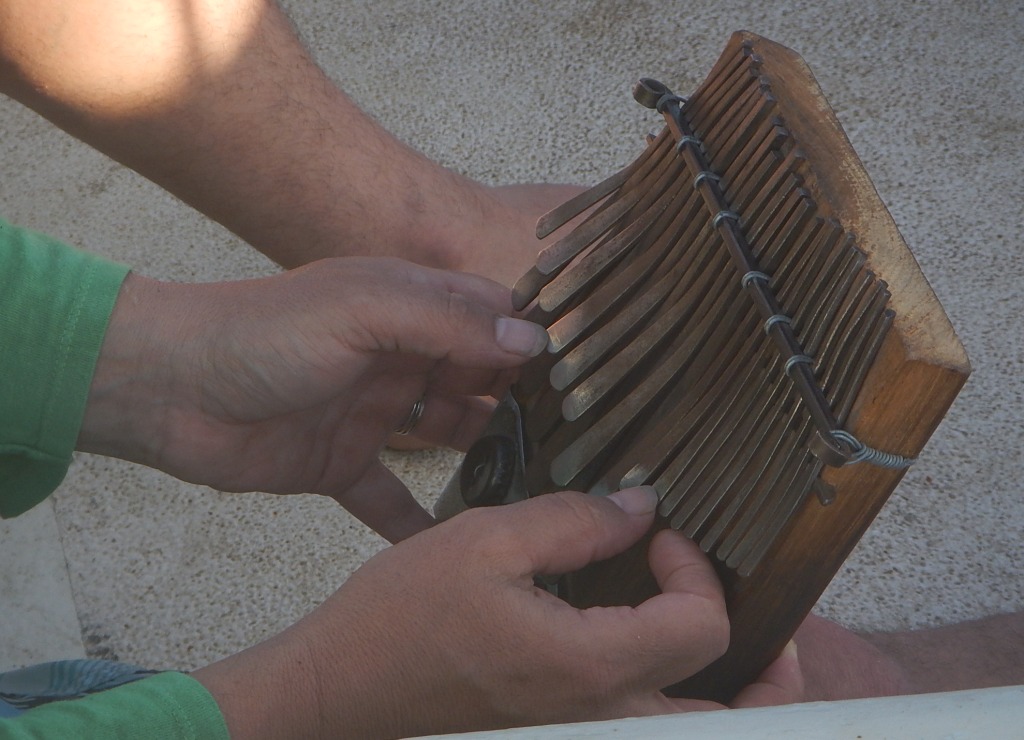
We enjoyed listening to Adam’s mbira music along the way. The mbira is a musical instrument from Zimbabwe that he learned to play many years ago. It has a pleasant sound similar to a marimba, but is extremely portable. He was teaching Valerie to play a song, and it was nice to hear their voices discussing the notes and occasionally singing the song that went along with the tune. Although Adam offered, neither of us ended up sitting down with him to learn how to play – an opportunity missed, that perhaps we will be able to redress the next time, whenever that may be. Valerie had found a recipe for an El Salvadoran meal in a magazine that she brought along. She made the side dish first, a pickled cabbage dish called curtido, but when we went to make the main dish, a fried corn patty stuffed with cheese, we were all disappointed to find that we were out of the masa flour required. Another missed opportunity! But we’re told the masa dumplings are an El Salvadoran standard, so we’ll probably get another chance to try them. It was hard to see the Silverstein family leave after we arrived in Zihuatanejo. Fortunately they stayed in town another few days, and we were able to have dinner together a couple of times.

Playing the Mbira

Kathy’s mother and sister Margie arrived 36 hours after the Silversteins left, and we spent most of that time doing laundry and other housekeeping activities in preparation. 🙂 We found a combi (a collectively owned and run van service) out to the airport and met them there. It cost us less than a dollar for the 20 minute ride! We had a fairly lazy week, wandering into town most days for errands or a restaurant meal. We found a sewing machine repair shop, and brought the broken machine in for repair, then picked it up the next day. The shop owner worked on a bench facing the sidewalk. He had a number of machines on the table next to him that it turned out were for sale. There were a few chairs out on the sidewalk, including a rocking chair. One evening we passed by the basketball court that doubles as a town gathering place. Sometimes there are musical events there, or movies, or lectures, but this night there was an actual basketball game going on! We watched the players for a bit, then were drawn to the crowd. There were small children happily running around and older kids flirting under tall palm trees. There were a few food vendors, including an ice cream cart powered by a flashy motorcycle. Their last evening with us we took a bus to Ixtapa. This town was built in the 80’s to nurture the tourism trade. It was a coconut plantation, but is now full of high-end resorts and restaurants. It stands in juxtaposition with Zihuatanejo, which is more traditionally Mexican in character, with a produce market and small streets lined with artisan shops. We went there to see a free concert on the beach which was a preview of a couple of the Guitar Fest performers. The view was spectacular, with a wide beach covered in clean white sand and a blood red sunset. The music was good and we all enjoyed ourselves. Another day we did an “arts and crafts” project; we weaved a doormat using an old rope.  Since it uses the other half of the rope that Kathy used a few years ago to make our first one, the two complement each other nicely!  It was good to see the family, which just doesn’t happen often. We’re lucky that Kathy’s mom is healthy enough and adventurous enough to come visit us periodically, about once a year. It was a little disconcerting to see her slightly less agile this time than on previous visits, though, and a reminder that we need to enjoy what today brings since tomorrow has no guarantees.

Family TiesArts & Crafts Day on Lungta

Now we have begun to focus on our preparations for our passage south. We have also attended a few of the Guitar Fest concerts and done a bit of socializing, but most of our days now include one or more of the boat projects that have been put off until needed parts were brought down by either the Silversteins or Kathy’s family. The first project on the list was to replace the landing wheels on our dinghy with some larger ones that allow us to come ashore without having to tilt the engine up. That was a great improvement!  We’ve already traded them to a friend on another boat who had no wheels at all.  We’ve done some more work on the exhaust system of our generator and the house main water pump.  We’ve brought our bowthruster motor into a shop for repair, and are expecting our new main sail to be delivered from La Cruz on Monday.  Keith and Wayne will arrive that same day, and we expect to leave either Tuesday or Wednesday. We’re getting excited about seeing new territory!

Posted in Uncategorized | Comments Off on 3-13-2015 – Zihuatanejo, Guerrero, Mexico

1-28-2015 – Barra de Navidad, Jalisco, Mexico

Due to some technical difficulties, this blog posting has been delayed a bit.  Fortunately, Dan was able to resolve them today, so here it is a little late but no worse for the wear. 🙂

My, how time flies! It seems like only yesterday we were in the middle of the holidays, and now somehow January is almost over! I guess it’s time to catch you up on where we’ve been and what we’ve been doing.

We stayed in La Cruz an extra week or so, partly because it was so hard to say goodbye to the dear friends we made there who weren’t going south. Whenever you say goodbye to a friend there is a chance that it is forever, but in this case it’s much more likely. We ended up hosting a “big” Christmas dinner with our friends Bo & Anna (on Aquarelle), Conor (on Moondance, but without Lanea), Wes (on Tumbleweed) and Rob, Kai & Etolin (on Vellela Vellela). Our galley was filled to capacity, and everyone except the turkey was in high spirits. We just managed to squeeze the 23lb bird into our small oven – and Dan’s apple pie a la mode was a hit! A week later Rob on Vellela Vellela organized a bonfire to celebrate the New Year. He circulated the news among many of his closest friends, but then later learned that the news was going “viral”, so he said he was going to boycott the event! 🙂 It actually turned out to be a wonderful evening for all. The local “Kid’s Club” gathered nearby a bit earlier and that party sort of morphed into the bonfire gathering. About 40 people turned out, though most of them were there for only part of the evening. There were dozens, or perhaps even hundreds, of other parties around the bay, and many of them were setting off fireworks and airborne candle lanterns throughout the evening. At midnight there were probably a dozen displays of fireworks, some of them quite spectacular. As you may recall, we had heard of an international fireworks competition and were excited to see some of the participants. We never really understood what went wrong, but the event fizzled. There was a nice show on the opening date, but none after that. Perhaps some of the teams shot off their arsenal after all, on New Year’s Eve. Whatever the story, we enjoyed the show!

On January 2nd, with the new year still in its infancy, we motored out of La Cruz and dropped the anchor 10 miles away in Punta de Mita for a couple days. We wanted to take advantage of the cleaner water near the mouth of the bay to run the watermaker and clean the bottom of the hull. While there, we picked up a couch-surfer, who stayed with us while we traveled south to Tenacatita Bay. Joey is a 20-something engineer from Alberta, Canada who is taking a year or so off from his regular life to travel around Mexico, Central America and perhaps further south. He is a bright, friendly guy and we enjoyed his company as we sailed across the bay and down the coast. While we were underway Kathy worked on making chaps for our “new” dinghy. Unfortunately, at one point we hit a largish wave (or, perhaps more accurately, it hit us) which knocked the sewing machine off of the table it was sitting on. We replaced a few bent parts with spares, but it still doesn’t sew consistently. We will need a repair shop to figure out whether it is salvageable, much to Kathy’s dismay. She’s had this machine since high school, and it’s been a real champ! That put a crimp in many of Kathy’s sewing plans for the foreseeable future, although she was able to finish this project using our sail-repair machine. The dinghy is now sporting our new signature color, burgundy, which will eventually be featured on all of our sail-covers. In order to match the big boat during its transition phase from navy blue to burgundy, and also to use up some of the old Sunbrella fabric that we stil have lying around, the chaps are trimmed in navy, “last year’s color”, with cooler white patches in the area where one might sit. Dan made some wooden benches for us, and Kathy has made some cushions for those as well. We now have the snazziest dinghy in the fleet… as long as the chaps stay on! (The first day we took the chaps out, an egret stood on them, using the dinghy as a vantage point while fishing. His feet were all muddy, and the prints looked a little like Chinese characters.)

New Dinghy Chaps Egret Prints - or a Calligrapher's Work?

Once we arrived in Tenacatita, we took Joey on a dinghy tour of the estuary and walked through a crocodile preserve in the town of La Manzanilla before sending him off on a bus to continue his travels.  Here are some photos from those outings:

Reflective Waters  Stealthy Egret  Crocodile Preserve

We briefly met a couple at the New Year’s Eve bonfire that we later connected with 150 miles south in the Tenacatita anchorage. Anna and Andrew on Jumble are taking 9 months to zip around from San Diego to New York via the Panama Canal. They are both in their late 20’s, living a thoughtful and adventurous life. Their boom had broken as they rounded Cabo Corrientes just south of Banderas Bay and they were stalled in Tenacatita for a few days while they repaired it. We had them over to dinner one night and enjoyed their company so much that we invited them again the next day (and the next and the next and the next). The conversation was vibrant and wide-ranging. We discussed dreams and boats and books and family. We convinced them to move to Barra de Navidad for a couple of days along with us for provisioning rather than leave immediately and we spent every available evening with them until we were forced to part ways. I don’t think that we will ever get used to the constant parting from every close friend we make – and I don’t think I want to.

While in Barra, we found some fraudulent charges on our credit card, so we contacted our bank and had the account closed and a new card sent. We are now without a credit card for a couple of weeks until we can arrange to get the new card brought down to us by someone traveling this way. At first we thought that this would mean waiting until March, when Kathy’s mom is coming for a visit, but then a friend on another boat told us that she was going to be popping up to Los Angeles for a few days, so she will be able to bring some mail down for us sooner. Coincidentally, we had just applied for a second credit card from a different bank, “just in case”. There are so many stories of identity fraud circulating these days (and it is so difficult for us to get a new card from the bank), that we had concluded that, much like heads, having two cards is better than one. The new card hasn’t yet arrived, so it didn’t actually make the situation seamless – but it did prove the concept! Oddly, another boater had had his debit card information stolen at roughly the same time and the thief was draining his checking account and the linked savings account. It sure can be frustrating to find that the services that are supposed to make our lives more convenient can dramatically complicate our lives when things go wrong!

We came to Barra in order to pick up some more couch-surfing guests, a couple from Massachusetts in their 50’s who are seriously considering buying a sailboat and cruising when they retire. Wayne and Keith are thinking about spending a year as crew on a sailboat that is circumnavigating the globe in 2016, and the week with us was a bit of a preview. We sailed with them from Barra back to Tenacatita and had an enjoyable, relaxed week, achieving a comfortable balance between recreation, socializing, and boat-work. I have to admit, though, that I’m a little concerned that a week on Lungta may have spoiled them for the reality of life on most other boats. 🙂 We took a dinghy tour in the mangroves, went snorkeling, and visited the crocodile reserve in La Manzanilla. We trounced them at a new card game they taught us; we probably have a huge store of beginner’s luck since we rarely play cards. They helped us clean the hull and repair a water pump, they participated in the daily kitchen work, and they even washed windows and swabbed the decks! It was a new experience for us as well because the people we’ve had join us previously have been guests, and these guys really wanted to participate as crew.

Setting a Stern Anchor  Pretty Fish  Sitting Pretty   Scenery while Snorkeling

One morning, Keith noticed that there was “a bit of water” in the bottom of the generator hold, which turned out to be almost two feet deep! Our bowthruster motor was once again flooded. We spent the better part of a day pumping out the hold, diagnosing the failure and putting a temporary fix in place. (The problem turned out to be a previous temporary fix that didn’t hold up well. 🙁 We’re still waiting for parts to arrive to get the job done “right”.) The last day they were with us, though, Dan found that the generator had a lot of diesel fuel in the oil and we worried about an even more serious problem with this equipment that we so depend on, such as a leaky head gasket or damaged injectors. As soon as we dropped our friends at the taxi to head off to the airport we sailed back to Barra, where we thought it would be easier to get parts and to do the work in the calmer conditions of the lagoon. We spent another day sorting through the symptoms and history, and realized that the problem was probably self-induced. A few days before Keith and Wayne joined us we had swapped the supply and return fuel lines to the generator because it was choking and stalling, as if it couldn’t get enough fuel. We thought there was a partial blockage in the supply line, that would be less of a problem in the return line. We planned to run a larger hose when we could find some hose. However, our assumption about the return line being less critical to the generator was wrong; it turned out that fuel was getting forced into the oil, probably around the rings, since it couldn’t get through the return line. We also remembered that we had shifted some items around in the storage areas that the fuel lines pass through and may have introduced a kink or pinch in the line. We opened up 8 of the floorboards in the forward half of the boat and emptied 4 holds looking for a smoking gun – which we indeed found! A few heavy items had piled up on one small section of the hose leaving a visible crimp. We re-routed the hose and secured it to joists along the way to try to keep it from getting pinched again in the future. We also changed the generator’s oil and filter so that it would be properly lubricated again. Now our generator is running merrily, though we are carefully monitoring it to make sure that it didn’t suffer any long-term damage. While this sort of story isn’t the most picturesque part of cruising, it is a “real” part of living life on the water, and can be rewarding if one maintains a healthy attitude.

Tomorrow we plan to do another major repair while we’re still in the quiet waters of the lagoon. As you may recall, a few months ago we made a repair to the cuffs that hold the shrouds (cables that support the masts from side-to-side). We noticed that these cuffs were sliding down the masts as the masts shrank in the hot climate and dry Baja desert air, and we hoisted them back into place and tightened them up. It turns out that one has continued to slip so we’re going to attach some wooden blocks underneath the cuff to support it. That will require a little woodworking to fabricate the blocks, a little aerial work to install them, and a little paint to make them blend in. Sounds like another full day! Thank goodness for the French baker, delivering breakfast each morning! 🙂

Posted in Uncategorized | Comments Off on 1-28-2015 – Barra de Navidad, Jalisco, Mexico

12-22-2014 – La Cruz, Nayarit, Mexico

It is said that variety is the spice of life.  If that’s true, then our life is very spicy – and we love it. 🙂  We experience many different environments, activities, people, etc.  These last few weeks have been a good example of that.  We’ve traveled from the desert environment of Baja to the hilly jungle of Banderas Bay to the winter climate of New York and back to the anchorage of La Cruz.  We’ve spent lazy hours sailing the Sea, cozy conversations in front of the fireplace in upstate New York, laborious hours working on our electrical system, and laughter-filled evenings reconnecting with friends.  What a joy!

When we last wrote, we were preparing to leave the Baja peninsula.  Our hearts were a little heavy to be saying goodbye, because we have really enjoyed the three summers we’ve spent in the area.  We left La Paz and moved around to the far southeastern edge of the peninsula to wait for a good weather window.  There was one last bit of tropical weather threatening further south, and we didn’t want to begin our crossing until we could be sure that it would not pose a threat.  We stopped in the bay of Los Muertos, which we’ve never seen but many of our friends have used as a departure point.  It’s a beautiful bay with a couple of fancy resorts tucked in to the rocks.  We enjoyed a light lunch at a small palapa restaurant near where we anchored and later strolled the grounds of a very fancy resort at the other end of the beach.  We’d heard that this resort had a model train display that was not-to-be-missed, so we were on a mission.  It turned out that it was indeed an amazing display, with tracks ringing two floors of a very high-ceilinged restaurant.  The trains were of various sizes, so they weren’t all interconnected, but each section was nicely built out with small buildings and other features.  It was a whimsical sight in a resort with lots of mirror pools and dramatic views.

Lot of Trains!   DSCN1410

We left Muertos the next day for another anchorage 40 miles further south, Los Frailes, where we intended to wait a little bit longer for the storm that would be named “Winnie” if it got big enough.  We sailed through the night, and in the morning when we heard the weather report we learned that the storm was getting bigger and closer, so we turned around and sailed back to Los Muertos.  We arrived at 2am, dropped our anchor and went right to bed.  Just a few short hours later we were awakened by the calls of our neighbor who was worried that we were swinging around on the anchor and getting too close for comfort.  So we pulled up the anchor, motored away a few hundred yards and dropped it back down.  Lots of activity for virtually no gain!  The next day the storm blew itself out and was no longer a threat, so we departed again, this time headed directly towards the mainland.

DSCN1446  Sunrise UnderwayCloud Masquerading as a Powerboat

We had a relatively uneventful crossing, which is a good thing to experience, but not very interesting to read about.  🙂  We spent just over a week traveling, starting the motor from time to time when the wind took a siesta.  Much of the time, though, we had delightful breezes helping us on our way.  We spotted a fair bit of wildlife on the way, including myriads of small yellow butterflies.  One day we had a number of tiny birds flitting around the rigging, poking their heads into many corners, and balancing on the lifelines.  They were very cute!  But they didn’t stay for long.  They were replaced by the usual suspects: boobies and frigates.  The next day we were thrilled to see a humpback whale breaching over and over again.  It seemed to us that he was celebrating the end of his long jouney down the coastline and the fact that he was finally in the Sea of Cortez: we could certainly empathize with that feeling!  We saw dolphins a few times, and it was especially exciting to see them criss-crossing underneath the bowsprit at night with the bioluminescence glowing all around.  The last encounter that was noteworthy was late in the afternoon, when we were about 3/4 of the way across.  We saw a swordfish leaping over and over again.  We didn’t see any prey to make it clear that a chase was on, so it could have been for other reasons.  This was the first time we’ve ever seen a swordfish in the wild, and it was exciting to watch it repeatedly emerge from the water.  As typically happens in this sort of situation, it stopped jumping as soon as we got a camera ready to capture the sight.  Oh, well, the memories will have to be enough!

Butterflies!  Tired Booby on Deck  Turtle on the Hook :-(

When we arrived in La Cruz, it was with a sigh of pleasure.  The place is so familiar to us after more than three years of traveling in Mexico.  But we only had a couple of days before it was time to move into the marina in preparation for our now-regular trip to New York.  We spent an afternoon with our dear friends Bo & Anna on Aquarelle, we did some work on the boat (largely around the generator which has been acting up lately), and we packed our bags for winter weather!

Back in La Cruz - Sunset

Kathy’s passport was due to expire in February, and she was worried that she might have trouble crossing the border at the end of our New York visit.  She did some internet research, and found several avenues to pursue to get a replacement.  The first was to try a local embassy/consulate.  We tried to visit the American consulate in Nuevo Vallarta, but they were unexpectedly closed.  After spending about 20 or 30 minutes outside the office, wondering what went wrong, we figured out that we had not changed the time on our iPhone when we changed time-zones coming across the Sea.  Oops!  We returned on Monday and talked with the consul.  She allayed a few of Kathy’s concerns, told us that it’s not unusual for her to see people whose passports were beyond expiration, and suggested that the best option was to get an appointment in New York for an expedited renewal process.  Although expensive, this was a reasonable way to go.  The first hurdle was to get an appointment, since they only seem to do this via a 1-800 number, which is not supported from abroad.  Fortunately Kathy’s sister Jean was able to make an appointment for her, and after that it was smooth sailing (but Kathy steadfastly continued to worry until the passport was delivered the following week 🙂 ). After passing through the security on the entrance level to the New York Passport Agency, you go to a window where they make sure you’ve brought everything you need, give you a ticket and send you upstairs to the waiting room.  In the waiting room there are something like 300 chairs and 28 windows processing applications.  It’s an interesting place to people-watch, because everyone has a story, and some of them are unfolding before your eyes!  We saw women in chadors (not a common sight in coastal Mexico!), watched couriers bring in applications (getting a fast-track through the system, but paying up to $1000 or more), and heard perhaps 15 different languages being spoken.  When it was Kathy’s turn to be called, the guy behind the window turned out to be just a clerk (paper-processor), and not the bureaucrat (decision-maker) that she had expected.  He did have the slightly surly attitude that is fairly characteristic of New York, but became slightly friendlier after it turned out that this was one of the easier cases of his day.  We paid an extra $15 to have the passport delivered, once we realized that this cost would be less than the cost of the public transportation for the two of us to come back into the city to pick it up the next week – not to mention the time that would be involved!  Getting around New York is not an insignificant factor in any undertaking!

We had a very easy trip getting to New York.  We had a non-stop flight which left mid-afternoon but arrived after dark.  Could it get any easier?  We caught a taxi to Hackensack.  He did a great job of avoiding heavy traffic near the sports stadium, but then got frustrated when he missed the exit off of the turnpike – how does anyone ever know all the twists and turns of a region as densely populated as the greater New York metroplex?  We got there soon enough, and enjoyed a warm welcome and a late night.  It was nice to be back in New York/New Jersey again, with the constant bustle, the abundance and variety of foods and goods, and the exuberant Finkelstein/Cooper/Samstein family.  Dan’s son Jesse came to town two days after we did, and the following day we drove 6 hours in a snowstorm upstate to Aunt Nancy’s 18th century farmhouse.  Dan did a great job of driving, but his mom found the whole experience to be stressful.  We were all relieved when we arrived and could relax for a few days.  The Thanksgiving feast was typically tasty and full of easy conversation.  The only downside to the whole weekend was that Dan’s sister Eve was unable to attend because of finals in her college courses.  The costs of education can be unexpectedly high!  Also his neice Nora was frantically studying upstairs for her law school exams, but at least she was able to periodically wander downstairs for a hug or a drink when she hit a wall.  There are three kids in the extended family now, one of which is perilously close to being an adult, but the other two are delightfully small.  Emma, the eldest of these cousins, is going through the stressful process of selecting a high school in New York City for the coming year.  The process appears to be as grueling as most college admissions processes!  Emma and her dog Ginger enjoyed playing in the snow for hours at a time, and occasionally managed to entice an adult or two to join her for a trip down the hill on a toboggan or a snowball fight!  It was a snowy wonderland, but it considerately stopped precipitating in time for everyone to return home again at the end of the weekend. 🙂

We spent almost another week in New Jersey with Dan’s mom Helene (although Jesse was only with us for a couple of those days).  We went into the city a few times: for dinner at a favorite pizza place with several of the cousings, to hear Dan’s sister Beth do a reading along with several members of her writer’s workshop, to visit the Metropolitan Museum of Art, and for a wonderful afternoon where Kathy reconnected with her high-school friend Beth who bused in from Delaware.  Don’t know how time can pass so quickly (and at the same time slowly!) – but it’s surprising to see a 15-year-old friend’s eyes looking out from the face of a 50-year-old woman, and realize that she is having the same experience. 🙂  Fortunately, FaceBook helps to ease the shock.  We also spent an afternoon with Aleeza, the young woman that we hosted from CouchSurfing when she was hitching north up the Baja peninsula.  We last saw her in Bahia de los Angeles, but in the meantime she has driven cross-country and set up a new home in New York City.  She’s found a nice little niche, tending the “front desk” of a 4-bedroom apartment being used as an AirBnB location.  In return for checking guests in and out and keeping the place clean, she gets a room to stay in – rent-free!  She’s also working part-time bartending and waiting tables in a nearby bar.  Perhaps the coolest thing she showed us, though, was how to play a musical saw!  She has a standard carpenter’s saw and a bow for a stringed instrument, both of which fit into a violin case – with extra room for her toiletries when she’s traveling!  She is proficient enough to play Amazing Grace, which is pretty amazing because there’s no way to mark where a given note will be found; in addition to the location one bows along the saw’s edge, the notes are intricately tied to the tension of the bend in the saw.  We each took a shot at it, but didn’t get much further than making a few squawks. 🙂

Our flight back to Mexico was less of a breeze.  We once again over-purchased, and this time near-fatally!  (Don’t worry, that’s just artistic license!)  Our luggage was overloaded on the way back – and so were we.  Kathy had nearly 50 pounds of fabric in one pack, and Dan was shlepping much of the rest, which consisted largely of kitchen goodies and boat parts, both for spares and repairs.  We managed to make it across the airport fine, but once we arrived in the warmer Mexican climate and had to navigate through the immigration and customs courses the load started to get overwhelming.  We had to take numerous breaks on the way, and by the time we got to the taxi we were shuttling the bags in short hops.  Each time we vow that we’ll be more level-headed the next time, but each time it seems we get worse!  Fortunately, it really does feel like we’ve got a larger share of discretionary stuff, and less stuff that’s absolutely critical.  It feels like we’re getting closer to a fully functional boat that just needs maintenance rather than one that’s still evolving to support the change in lifestyle that we embarked on nearly 4 years ago.  It was very nice to arrive home midday, and settle in gently rather than just fall into bed.

Especially since we once again came back to a dark house.  The batteries were completely dead, even though we were plugged into the marina’s power.  Modern chargers refuse to charge extremely dead batteries, in order to protect themselves.  It took a few minutes to find a way to bypass these checks and get power coming back into the batteries (done by using a smaller functional bank of batteries as an intermediary).  Both our refrigerator and freezer were at near room temperature, so the failure must have happened quite early in our trip.  Although we were able to get power restored back to the boat from the dock, the batteries had lost most of their life and needed to be replaced.  Perhaps we could limp along for a few more months, but we could never rely on them the way that we need, especially since we’ll be traveling through new territory in the next year and beyond.  Also, a marina in Puerto Vallarta is just about the most convenient place we could imagine to undertake the arduous process of removing and replacing the 12 batteries that comprise our main house bank.  We bit the bullet and laid the plans to do just that in the next couple of days.  Our friends Rob & Kai on Vellela Vellela had a similar situation, although their house bank only has two batteries.  So, we enjoyed the day’s outing together.  The Sam’s Club just a few miles from the marina had the best prices that we found, but they didn’t take back the old batteries.  We borrowed a truck from one of the marina’s dock-workers and ran around town looking for a place that would accept the old batteries.  We found a recyling shop that gave us a little over $10 apiece and were thrilled!  Then we went back to Sam’s Club, purchased a membership, picked up the new batteries (literally) and did a quick circuit of the grocery side of the store.  The rest of the afternoon was spent carrying the batteries down the dock to the boat (still sore from carrying 100 pounds of luggage apiece just two days earlier) and reinstalling them, but we went to bed feeling much better about the state of the boat.  The next day we left the marina and sailed back into the anchorage, because the highest tides of the day were getting lower (as we moved away from the full moon), and we were concerned that we might have trouble getting out if we didn’t move quickly.

Back in the anchorage, our generator continued to act out, and we spent a frustrating four days replacing the exhaust hose and the water pump for the cooling system.  It was another round of tough work, with a couple of false starts, but now our electrical system is back to running smoothly, and in some ways better than it ever has.  We’ve also installed a new stop switch, a new inline fuse and a couple of relays to help the system start and stop reliably.  The next most important item on the to-do list was to attend to our dinghy, which had developed some persistent leaks.  Due to a design flaw, some cracks had formed in the floor at the back of the dinghy, due to stresses from the heavy motor mounted to the transom.  Unfortunately, the hull is made from a material that seems impervious to every adhesive or sealant that we can find.  Previous attempts to repair these cracks have been successful only temporarily.  In addition, the dinghy has been losing air, getting soft overnight and needing to be pumped up every other day.  So it really wasn’t managing to do either of the two things that one expects of a dinghy: to keep the water out and the air in!  When a nearby boat announced on the morning radio net that they were selling an old dinghy, Dan’s ears perked right up.  We took it for a test drive and didn’t bring it back! 🙂  The people on yet another boat in the anchorage, Fantasia, were also interested in it, but it was too big for them.  As it turned out, they took our old dinghy, thinking that they had some ideas for how to repair the cracks.  (Coincidentally, they had been interested in this same dinghy last year before we even purchased it, but the timing didn’t work between them and the previous owners, and they had to leave town before it was ready to go.  So they feel like they just got it a year later than they’d originally thought, and for free!)  Our new dinghy is bigger and rides smoother than any dinghy we’ve had before.  It’s a real step up.  So now Kathy is working on another set of chaps – the third in 3.5 years!  And Dan is working on building some benches, because the last dinghy spoiled us. 🙂

We have been vacillating on whether to hang out in La Cruz for the holidays or move down the coast to Barra de Navidad.  We’ve changed our minds three times, depending on who we last talked with. 🙂  But now we’ve finally decided to stay in La Cruz through New Year’s – due to a combination of the stress of getting all of these projects (and more!) done before departing, a spate of poor weather, and recently learning that there’s going to be an International Fireworks Competition in the bay between Christmas and New Year’s.  And who doesn’t love fireworks!?

P.S.  When we first posted this, we had misplaced the cable for our camera and had no way to get the photos off of the camera.  We’ve now found the cable, and have updated the posting to include some of the photos taken during this time.  Enjoy!

Posted in Uncategorized | Comments Off on 12-22-2014 – La Cruz, Nayarit, Mexico

11-6-2014 – La Paz, Baja California Sur, Mexico

We’ve moved south another 200 miles in the last month through some really spectacular countryside, and spent time with lots of good friends and family too. We’re no leaving La Paz, where we stopped for a few days to reprovision, reconnect with the internet, and say goodbye to a few more friends before continuing across to the other side of the Sea of Cortez. This is what the cruising lifestyle is all about!

We spent five days getting from Santa Rosalia to Loreto. It was fairly slow traveling, and our guest Mary was surprised (and perhaps disappointed) to find that even big boats like ours have periods of slow travel. We need more wind to fill our sails than a smaller, lighter boat – but we like to think that our advantage is that we’re more comfortable during these times. The American mindset keeps us always moving, searching for whatever is around the next corner, rarely being comfortable with just where we are at the present moment. But sailing can test the patience of that perspective. Mother Nature doesn’t work against a schedule (although there are certainly weather patterns that sometimes require us to set a schedule, such as getting out of the hurricane zone during the most active parts of the season!) When there is no pressing circumstance, life is much more enjoyable if one just works with what is there. We had light winds, generally allowing us to make progress in the right direction. We arrived at our first anchorage well after dark, maneuvering into place using several types of instrumentation to show us what our eyes could not. We use GPS all the time, along with an electronic chart system, to continually show us where we are. We have a depth gauge that helps alert us to dangers below the surface, and radar to help us identify those above, especially land and other boats (but we’re occasionally tickled to see that birds can show up when conditions are calm, and we’ve been fooled once or twice by a low-flying airplane). It was an anchorage we’d visited before, wide open with no obstacles to cause trouble, so we were comfortable with the situation while Mary was shocked that we would approach shore in the dark. Needless to say, it all went smoothly. We had a calm peaceful night at anchor and moved on the next morning.

We hopped across the bay to visit our friends Sonia and Geary in El Burro Cove one last time as we leave Mexico. Geary is a local celebrity, being the main weather guru for the region. Sonia is a (Mexican) Jewish attorney from Mexico City; her Yiddish accent makes Dan feel right at home. There were a few other boats in the area, and a group of us went out to dinner in a nearby palapa restaurant. The specialty of the house was a clam meal cooked and served in the shells, which were wrapped in aluminum foil. Yum! A good time was had by all, and in the morning we departed again. We enjoyed a couple of days of nice weather as we sailed down to the Loreto area. We were somewhat surprised that we had no large animal sightings, whether whale, dolphin, turtle or sea lion. Perhaps it was simply that we were more inwardly focussed, chatting with Mary rather than looking out at the water as much as usual. We spent our last night with Mary anchored outside Loreto (not really an anchorage, but just a shallow enough spot that was close in).

After losing her boat to Hurricane Odile, she was understandably pretty stressed during the time she was with us. A friend in Puerto Escondido, Connie, had told her to come on down and they’d work things out together, so our role was to get her that step of the way. But as we approached Puerto Escondido, the uncertainty started to loom and Mary was fretting about what the next chapter of her life would look like and just how she would overcome all of the obstacles currently facing her. Several people had sent her leads on boats that were for sale in Mexico that might fit her needs, and she was actively engaged in email conversations with at least one of them. But communication with Connie was difficult in the aftermath of the hurricane, while repairs were made to the washed out highway and downed cell tower. Mary finally focussed on getting her things packed up, and this seemed to help diminish her stress level. We loaded everything onto the dinghy and drove her to a beach location that she was familiar with, and she arranged for a taxi to take her the last few miles to Puerto Escondido. There was time for a hug and one last goodbye. Two days later we heard on the morning radio conversation that a cruiser who was in Puerto Escondido sold Mary their gray van, along with a bunch of camping equipment. She was last seen heading north. 🙂

Meanwhile we spent a couple of days cleaning up from one guest to prepare for another. We managed to get the place back in reasonable enough shape by the time Kathy’s sister Jean was due early Saturday afternoon. We checked that her flight had departed on time and grabbed a taxi out to the airport. We waited and waited and waited, but the plane never showed up. So we asked an airport employee if it had been delayed, and were told that the flight had been canceled. Hunh?!? A visit to the Alaska airlines desk confirmed that the flight had been turned around in mid-flight and was rescheduled for the next day. (It turned out that the plane’s radio had failed, and halfway there they turned around. Go figure!) When we got to the airport on Sunday, Jean’s rescheduled flight arrived at nearly the same time as the usual daily flight. So the airport was full and lively. We met some folks from a boat in Puerto Escondido who had been cruising the Sea of Cortez since the 80’s. It was really fun to hear how much things had changed! When Jean finally emerged from the customs zone, we whisked her off to a taxi.

We went straight to Lungta and put up the sails to begin our week-long adventure. We sailed the whole way to San Juanico, about 26 miles, stopping overnight at one of our favorite anchorages, Islas Coronados. The scenery along this route is gorgeous, highlighted by the tall, striated cliffs of the Sierra de la Gigantes. The size and colors of this range have fascinated us for years now, and it’s cool to share the sights with people that we love. The entrance to the cove of San Juanico has some beautiful pillars that reflect warm golden hues at sunrise and sunset. We usually manage to see the sunset show. 🙂 There were three other boats in the anchorage when we arrived, and several people later commented about the beautiful sight that Lungta made as we sailed in.

Sierra de la Gigantes

We spent four days in San Juanico, and packed them full of fun and socializing. One night the folks on the power boat Maitairoa hosted a potluck dinner, and it was fun to have Jean meet some of the diverse people that we’ve been calling friends for the last few years. We spent a good bit of time snorkeling in the wonderfully warm and clear waters. We introduced Jean to the art of finding scallops. They are tricky to spot, but she got the hang of it. We combed the beach for some pretty shells and enjoyed a fancy meal by using the shells as serving bowls and stuffing them with scallops, portabello mushrooms and parmesan cheese. Yum!

Before

After

One afternoon Jean and Kathy swam halfway across the bay to the pinnacle rocks and back again. Another morning Dan and Jean took the dinghy out fishing. We all went for a dinghy explore along the shoreline, stopping a few times to walk the beach and clamber over some rocks. We saw some prints in the sand and made up a silly story about a rancher named Jose who was searching on horseback for some of his lost cattle that had clearly wandered this way. Although we never saw any roses, we took time to smell the flowers that day. Jean found a beautiful egg-shaped rock of red and white swirled sandstone which she decided to put on her porch step to remind her of the trip. (Unfortunately it was confiscated by customs officials on her way home!)

Jean on Beach

We all loved our time in San Juanico, but decided to spend our last full day together at a new location, so on Wednesday we had a full day of sailing back south towards Isla Carmen, across the channel from Loreto. Caleta Ballandra is cozier and greener than San Juanico. That night we were surprised to see a 4′ green moray eel swimming among the myriad of night fish that typically gather around our hull in the halo of our lights. The next morning Dan pulled out the wind-surfer that was loaned to us at the beginning of the season, and we all learned a bit about wind-surfing. The conditions were perfect, with moderate winds coming ashore and calm waters. We all spent more time *in* the water than *on* it, but it was loads of fun! An important observation is that it’s not about using strength to overcome anything, but rather being part of the system and steering the various forces, using our bodies to produce movement in the intended direction.

Hunting Moray

Jean Windsurfing

Back in Loreto, we were surprised to see a cruise ship anchored just outside of town, along with at least 6 tender boats ferrying passengers ashore. We haven’t ever previously seen a cruise ship north of Cabo San Lucas. The town was *alive*, with every vendor in town open for business. Lots of people were strolling the streets, clearly tourists in a new place. Many were carrying bags advertising the cruise line, some had ship’s towels draped over their swimsuits. Every restaurant was full. There was a live band in the town square and a few tourist information booths set up around town. The taxi stands were well attended, so we had no trouble getting to the airport. It was sad to see Jean go, but oh-so-sweet to have had her with us for a week of warm conversation and fun. We know that she will come back again, and look forward to that day. After we took her to the airport we went back to Lungta and immedately set to putting up the sails to continue our travels south. We waved as her plane passed overhead, hoping that she was watching out the window and catching the good wishes coming off of our prayer-flag (lungta) sails!

That evening we stopped in Pyramid Cove on Isla Danzante, about 18 miles south of Loreto. It’s a pretty nook in a fairly small but beautiful rocky island. The water was spectacularly clear and once again we felt torn about leaving such a beautiful corner of the world. The next morning, we popped over to visit our friends on Ariel, in the next cove to the north. We met Tommy and Susie in San Diego as we began our journey in 2011. Although our cruising paths have looked quite different, we still feel a strong connection with them. They have not moved from place to place as much as us; instead they have traveled in bursts and then stayed (gotten stuck) in one location for months at a time. We’ve stayed in touch though, and enjoyed it when our paths have crossed each year (for much the same reason that a broken clock is correct twice each day).

As we continued south, we saw a power boat heading our way extremely quickly, throwing up a huge plume of spray. We joked about whether he could see us with all our sails up. He turned off just moments before a collision, and circled our boat, revealing that it was the Mexican navy. Kathy went below to retrieve our documentation while Dan established radio communications with them. Typically they want to board the boat, visually verifying the hull number with the documentation, but this time they simply asked us questions over the VHF radio. There was a little confusion when they asked where we were going (south towards La Paz, then Puerto Vallarta and Zihuatanejo), and then where the boat would be while we were there. When we said it would be in the same place as us, they seemed to get the idea. They took our photo as they turned around and zipped back north. We have been stopped several times by the navy, but it has been a couple of years. I guess we were “due”. 🙂

We stopped that night in Nautilus Cove, just outside of Agua Verde, where we had heard that dengue fever was becoming a problem. On the way we tossed out a stale box of bread crumbs, hoping that the bread crumbs would show us the way back someday. The next day we had a short sail down to Los Gatos, which is marked by dramatic red sandstone cliffs. There was an eco-tour of kayakers setting up camp on the beach. They set up seven identical tents, and we watched as the kayaks trickled in from around the point over the next hour or two. We dinghied the other direction and went for an interesting hike. The rock was composed of lots of fist- to head-sized smooth river rocks held together with a sandy mortar. The whole cliff face was crumbly and formed lots of indents and caves and pinnacles. A couple of times we were startled when a flurry of the large dark moths that we call “vampire moths” flew out from a dark hole or crevice. The nearby desert was hardly recognizable as such, because of all the greenery that had sprouted up in the month since the big rains that came with the hurricane. After tiring of our rambles, we returned to Lungta – but at Kathy’s instigation we squeezed in a snorkel before sunset! 🙂 It was a good place to snorkel, there was large variety of fish and invertebrate life, although the bottom surface was not very interesting: mostly blocky rocks piled on a plain sand bottom. We did see some small-ish colonies of coral, though, which were beautiful.

DSCN1344

DSCN1337

The next couple of days of sailing we were accompanied by huge numbers of yellow butterflies, all traveling solo. At times we would pass lots of them floating dead on the water. We woke up in the morning to find dozens perched on the lines and sails of the boat. Some of them were solid yellow, while others had bold black lines outlining their wings. Occasionally we also sighted a monarch crossing the Sea of Cortez. At the next couple of places we stopped we were plagued by biting no-see-ums (locally called jejenes) and mosquitos, so we didn’t stay long even though we’d hoped to enjoy a little more hiking or snorkeling.

Butterfly!

Our last stop before La Paz was a very popular anchorage called Caleta Partida, which we’d somehow managed to avoid to date. It turned out to be a magical place. The water was very blue, and the rocky cliffs were populated by osprey, soaring overhead or perching on the arm of a cactus. We were glad to catch up with our friends, Bob and Sherry on Nirvana. The morning before we left we took an amazing jaunt in the dinghy. The anchorage is in what was originally a large caldera. Although it’s hard to tell from any distance away, it is actually nestled in between two islands (rather than a cove in one) which were originally one. There is a 100 foot wide, 4 foot deep passage snaking between them, though, with a couple of fishing camps built on the banks. We saw perhaps a dozen pangas in various stages of morning preparations for a day’s fishing efforts. The cliffs on the back side are steep and colorful. There are a few sea caves and arches as well that were fun to poke our dinghy into. There aren’t any good anchorages on this side of the islands, though, so it’s got less boat traffic. We really enjoyed our morning’s putt, but it was time to get going. So we turned around and retraced our tracks through the passage between the islands.

Caleta Partida Passage

Backside of Isla Partida

We had a great sail all the way to La Paz, and even sailed all the way up the narrow 7 mile channel into town. Just as we approached the channel, our fishing rod made the sound that makes our mouths begin to water. So we slowed the boat down to begin reeling it in, but quickly discovered that what we had caught was not dinner, but rather a blue-footed booby. 🙁 His foot was snagged on the hook and we had to bring him on-board to free it. He did not enjoy the upside-down maneuver! We wrapped his head and wings in a towel to help calm him down, and then removed the hook. It was lodged pretty firmly, and it was heartbreaking to hear him squawk a few times as we tried to twist it free. Finally it came loose and we could set our small charge free. It’s been a couple of years since we’ve caught a booby – an apparently lucky streak, and not because they are growing any smarter. 🙂 We resumed our journey up the channel. Along the way we noticed a boatyard that had a number of boats up on stands which had toppled over during the hurricane. We were once again reminded of how lucky we were and how many lives were touched by this event.

Toppled Boats

When we arrived at the end of the channel we easily found a place to anchor and settled in for the evening. We enjoyed almost a week in La Paz, mostly just visiting with friends. In particular, we were there to hook up with Janet and Phil on Cantem Para Mi. They are in the middle of having their boat painted, so they couldn’t go anywhere, but we really wanted to see them before we left the area. We had a very nice visit with them, over 3 or 4 days, and although we’ve now said our goodbyes we hope that our paths will come together again soon. We also spent some time with a new friend, Jerrid on Salvation. We just met him in June on our way north, but he couldn’t come with us because he was just beginning a major boat repair project. We had dinner with him our last night in town, along with a few other new friends, one from Spain and two from Italy. It was a wonderful, international evening full of intense conversations! The other big event in our week involved another opportunity to help someone out who had been caught in hurricane Odile. Seamentress is a big cement boat (sound familiar?) that was at anchor in La Paz before the hurricane. During that fateful night a derelict trimaran came loose from its anchor and plowed into her, breaking Seamentress’ anchor chain and setting her adrift into the turbulent night. Paul and Philly were aboard but were unable to keep their boat from being blown up the channel and beaching nearly 10 miles away. They incurred some damage, but not enough to be a problem in and of itself. The big problem is that they are high and dry on an extremely shallow grade – and inconveniently far from town to just think of it as a condo on the water(front). We joined a work party that was formed to try to dig a trench to allow the boat to float out at high tide. Unfortunately the high tides are getting progressively lower for the next few months, meaning that the longer the task is delayed the harder it will be. They need to move the boat about 400 yards until they are in 6 feet of water, and this will require removing sand and shells to form a trench about 4 feet wide and 2 feet deep. Paul rented some super-sized pumps to help remove sand from around his boat, and a local marina owner loaned him a dock-sized float to help move them around and position them. The good news is we had more than a dozen people out there for most of a day, and we moved a lot of sand; the bad news is that there’s still a *lot* more sand to move (and the boat hasn’t really moved at all yet). It’s time for us to move on, though, and we wish them all the best in this monumental undertaking!

Pumping a Trench

DSCN1402

Now we’re resuming our southward passage one more step, 300 miles southeast across the Sea of Cortez to La Cruz. We have several good friends there to whom we have to say goodbye. We will also spend two weeks around Thanksgiving with Dan’s family in New York. Should be another great month!

Posted in Uncategorized | Comments Off on 11-6-2014 – La Paz, Baja California Sur, Mexico