7-21-2012 – Puerto Escondido, Mexico

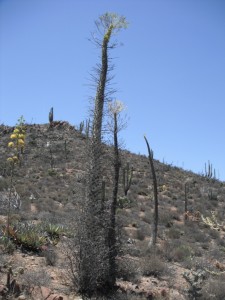
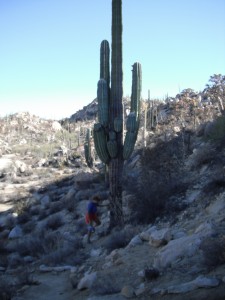
So we’re just back from another of our “excursions”, this time on a driving trip to Southern California.  As we told you in our last posting, we had some errands to do that needed us to be in the States, so we rented a car in Loreto and spent two weeks on the road.  We only took two days to drive the 800 miles, but we thoroughly enjoyed the journey and would love to do it again, taking a bit more time to stop and smell the, um, cactus.  Although all of the terrain was desert, there was a surprising amount of variety.  There is a mountainous backbone running the length of the peninsula, but it meanders from the Pacific side to the Sea of Cortez side.  The road also meanders, and uses its own drummer.  Sometimes it runs along the coastline, sometimes it winds through the mountains, and it crosses from one side to the other halfway down the peninsula.  The mountains are the same beautiful Sierra de los Gigantes that we saw when we were sailing up to Puerto Escondido.  They are layered with many different colors and textures of rock, and as we drove up the peninsula the face we saw changed from hour to hour.  We enjoyed the immense variety of cactus, from 30′ tall cardon cactus to bushy cholla’s, tree yuccas with their spiky curvy arms and barrel cactus with their radially symmetric bright red needles.  There were a few tree-like plants that didn’t have leaves, or if they did then they were *really* tiny!  One of these was tall and skinny and often leaned over or did a full U-turn to the ground.  They had a little tuft of yellow at the very top, like a crown.  We took to calling these “Dr. Seuss trees”.
 

Near the end of the first day, we were in a stretch of road that was between towns too small to have gas stations, and we were running low.  We came across a tiny town that had no Pemex station, but did have an enterprising family who offered gas for sale from a number of jerry cans that they must have gotten filled 50 miles away.  We were happy to support their ingenuity, and breathed a sigh of relief that we would safely make it to the next large town without incident.  Nearby we saw some signs for an anthropological attraction just off the highway, and decided to see what it was about.  We pulled off the road into a dirt parking area, and followed the marked path a mile or so to a low cave with a lot of paintings inside.  There were several interpretive signs along the way describing what is known of the Cochimi, the indiginous tribe that inhabited this area until the 18th century.  There is very little known sbout them.  The paintings were done using mineral pigments, so it is difficult or impossible to date them.  There were a LOT of small paintings, some of animals or people, some of geometric shapes, and some are abstract.  It was very cool to see them, and to imagine what it must have been like to live in this remote place.  The cave was located fairly high up a hill, and had a wonderful view of the valley from between the boulders.

The road at the northern end of Baja went by the beautiful beaches of the upper Baja peninsula.  We made it to Tijuana quickly, but needed to make a stop to get insurance to cover the car while we were in the U.S. Although the car rental company did authorize us to cross the border, they didn’t offer this coverage!  They had suggested that we stop at a Bancomer branch, a major national bank.  So we drove around the city center of Tijuana a bit looking for a branch (and a parking place).  When we did find one, the teller told us to go to Oxxo, a convenience store much like 7-11, that happened to be right next door.  The clerk at Oxxo pulled out a small cellophane packet containing a glossy how-to brochure and a form with all the fine print.  The insurance was available in increments of a week, and was underwritten by Bancomer.  The store couldn’t take a credit card for insurance, so we had to pay the $25 bill in cash.  We found a little hole-in-the-wall restaurant to get a bite to eat, and used our iPhone to register on-line – even with our limited Spanish it only took us 10 minutes to get the insurance lined up.  This is a service that we could never find in the U.S!

Then we hopped back in the car and joined the line to cross the border.  It took us two hours of slow stop-and-go traffic to get to the front of a line, It turns out that Friday evening was the worst possible time to cross – the border agent told us that it’s usually *four* hours at that time.  Yuk!  We were sure to cross mid-week on the way back, and made it through much more easily.

Our first stop was to Minnie’s Chandlery in Newport Beach.  We found this place on our way south, and the second time through it’s still incredible!  One of the items on our to-do list was to get our new (to us) liferaft serviced, because it was 10 years out of date.  The first thing we saw when we entered Minnie’s was another 8-person liferaft, recently serviced, for a few hundred $$$ less than we were expecting to pay just to have our new one serviced.  We bought that one, and “traded in” our old one.  Somehow we managed to spend another $500 – and three hours! – without really working at it.  🙂  Wow, that was easy!

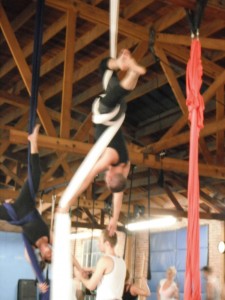
We had a looong list of tasks to do (I think the count was 45 seperate items), but managed to have a little fun as well.  We visited Kathy’s college buddies Beth & Mark, who shared an amazing Thai restaurant with us.  We didn’t realize how much we missed Thai food!  Later in the week we also enjoyed a fabulous meal at a sushi restaurant.  We also visited Dan’s oldest son Jesse, who took us to watch him as he took a class in circus acrobatics.  He was working on trapeze and the fabric apparatus.  It looked like so much fun that both of us were inwardly scheming how we could take classes too!  The school’s motto was that it was for “anybody with any body”, and we were convinced that we’d qualify.  We also went for a marvelous hike in Pasadena’s Eaton Canyon, gaining 1300 feet in 2.5 miles.  We enjoyed the close-up look at a different eco-system, including finding tufts of black bear fur along the trail and pine trees at the top.  Unfortunately we couldn’t help but notice the cloud of pollution as we gazed back over the city and reflect on the contrasts of population density between Southern California and Baja Mexico.
The primary goal of this trip was to finalize the requirements and apply for Captain’s licenses with the Coast Guard.  There are *lots* of requirements, including a security screening, a drug screening, a physical, a first aid/CPR class, 3 letters of character reference, a “killer” written exam, logging a huge amount of time on the water, and swearing an oath of loyalty to the U.S.  We took a class last September to secure the written exam part, and we’ve spent the last year or so acquiring the sea-time, so it was time to wrap up the rest.  We spent a lot of time running around town jumping through all of the hoops, but were finally able to submit our applications the last day.  What a relief!  In a few weeks we expect (hope) to receive notice of our new credentials and you’ll have to start calling me ‘Captain Kathy’!

Our last stop was to a little business in San Diego that does mail-forwarding for cruisers.  People rent a mail-box there and whenever someone is heading down to Baja they stop by to pick up everyone’s packages.  Although we aren’t renting a box, we did volunteer to bring back some mail.  Cruisers have generally formed a real “pay it forward” sort of community.  There was a LOT more mail waiting than we’d expected, so we only took enough so that our drive back retained a limited view out the back window… 

The drive back was just as nice as the drive up.  The first night we stopped at a hotel that quoted prices in dollars (usually not a good sign!), but we stayed anyhow after the woman at the reception desk offered to show us a room and listed the *names* of all the rooms.  This was one of those places that has a decorated theme for each room.  We stayed in the “Medieval Room”, which was very cute, and the most comfortable bed we had the whole time we were gone.  We made up for this with the last night, where we paid the equivalent of $18.  🙂  The restaurant at the motel the second night had a nice menu, but unfortunately they were out of everything but quesadillas.  So we had the quesadillas, which were very good.  Dan joked that you could have either the menu or the quesadillas, but that he recommended the quesadillas.

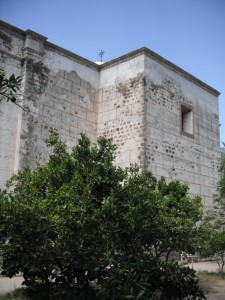
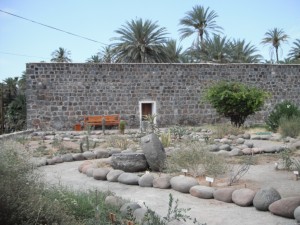
On the second day of our drive back, we stopped in a town called San Ignacio.  It’s just off the main highway, and is a little jewel.  It’s set in an oasis, with lots of palm trees nestled in a canyon in the middle of the desert.  Apparently there are springs here, keeping things wet and green.  The town has a wonderful square, which is quite reminiscent of the town squares we saw on the mainland.  We looked at the church, which was founded as part of a Spanish mission in the mid-18th century.  They had some interpretive signs in the yard, and a labeled cactus garden that we appreciated.  We were very saddened at the historical information about how 1200 native people were decimated by disease brought by the Westerners.  200 years later there were virtually no indigenous people left.  The building of the church had also been challenged by natural disasters, including volcanic eruption, flood and drought – a difficult place to set up shop!
 

As we were nearing home, we noticed that there were lots of heavy cumulus clouds, some of which looked quite dark and threatening.  When we had left two weeks previous, the skies were perpetually clear.  Now that we’re back, we can definitely tell that the weather has changed.  It’s hotter, more humid, and there are frequently clouds over the mountains.  From what we’re hearing, the summertime does sometimes include thunderstorms, but not consistently.  Everyone here prays for rain.  🙂

Now we’re heading off for some fun in the sun at one of the nearby islands.  We’ll be out of touch more than usual, but will hopefully check email at least once a week.  Please stay in touch!

>> Kathy & Dan
Posted in Uncategorized | Comments Off on 7-21-2012 – Puerto Escondido, Mexico

7-17-2012 – Puerto Escondido, Mexico

Our friend Sandy likes to remind me that “boating plans are written in sand at low tide”, always subject to change. We’ve certainly found that to be true of our plans! Last year in September we took a course to help us pass the written test to get our Captain’s licenses from the Coast Guard. The final requirement was to log up to 2 years of sea time – and neither of us had enough time officially “on the books” yet. The course completion certificate is good for up to a year, so we have to submit the application packet before early September. We’ve been planning to fly to Portland in August to take care of that. However, when we tried to figure out the logistics of traveling from the Sea of Cortez, it turned out that the easiest way to do this is on our way north, rather than after we’ve gotten further up. So we moved our plans up to July. Then weresearched flights from Loreto, the only airport north of La Paz, and realized that renting a car in Loreto and driving to San Diego would be less expensive and much more fun! So we’re on our way…

In the meantime, here’s how we got to this point: we left La Paz on a Saturday and thoroughly enjoyed 10 days sailing up the Baja coast, passing some really beatiful terrain. We sailed virtually the whole way, starting the engine only to pull in and out of the anchorages. We spent one or two nights in each place, since we’re enthusiastic about getting north. We are looking forward to spending a few weeks in one place, but I guess we’re not yet ready to do that.

We retraced our steps out of La Paz, and then headed north along the western coast of the islands Espiritu Santo and Isla Partida. We started to see a lot of wildlife along there. We saw several turtles popping their heads up to take a breath of air, only to quickly disappear again. It took us a little while to figure out what we were seeing. Seeing them is sort of like seeing a shooting star, because as soon as you can point it out to someone else, it’s already gone. One popped up in front of our dinghy as we were moving, looked very startled and dove back down barely in time to avoid being hit. Whew! One night just at sunset we were eating dinner and heard a continuous sound sort of like a train moving down the tracks. We came up on deck to find that the sound was a large pod of dolphins moving up the channel. We have a short video of them – but unfortunately you can’t hear the sounds.

   DolphinTrain_0001

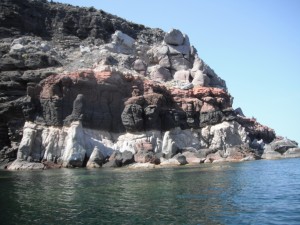
Our guidebook described the cliffs of Ensenada Grande as being “lacy”, which seemed a little silly or strange, until we got there and saw it. One layer of rock looks like it was poured over another, extending towards the water in sheets. It seems to be softer than the lower layer, because it’s eroding away, forming lots of holes like swiss cheese – or lace! There are many layers of rock throughout the whole area, and this is where we really began to enjoy rock-watching. Each anchorage has its own unique character, partially because the geology is so varied.


The water clarity is much better out in “the islands”, and we’ve been enjoying a swim or a snorkel most days. This anchorage is where we first got a taste of the small tropical reef fish. Kathy is working to remember all of the names of the fish she once knew so well, and Dan is enjoying making these new acquaintances. We took the dinghy out of the bay and around the point a couple of miles to some nearby rocky islets that provide a well-established nursery for sea lions. The park service had installed some mooring balls so it was easy to tie off while we went for a snorkel. We were interested in seeing them, but also a bit nervous because the bulls can get to be 800 pounds and territorial. For better or worse, although we saw – and heard – quite a few sea lions of various sizes, we didn’t have any close encounters in the water. We didn’t stay out long, though, because we got chilly, and while we were taking a break we noticed that the wind had picked up quite a bit and we decided that we’d better get back to the protection of our anchorage. On the way back, we passed by a huge archway in the cliffside that we hadn’t seen at all on our way out. It was fun to pass underneath it and feel like we were exploring new territory!

We met some folks in this anchorage who had chartered a sailboat from La Paz for a week. We had dinner together and decided to run back out to Los Islotes to swim with the sea lions in the morning before sailing further north to the next island up the coast (Isla San Francisco). There were quite a few sea lions in the water, but in ones and twos, and away from the rocks. We’d heard stories about them playfully interacting with divers, including swiping gear, especially fins, and we’d heard warnings to stay away from the big bulls because they are territorial and could be aggressive. As we got in the water we all had some excitement and a little apprehension, but of course it all turned out fine. We each spotted one or two sea lions in the water, but none of them came closer than about 15 feet. For such odd-looking creatures, they are amazingly graceful in the water – and fast!

After our visit to the sea lions of Los Islotes, we returned to Lungta and set sail. We had a lovely sail up to Isla San Francisco, keeping our new friends in sight the whole way. The bay we stopped at has a looong crescent-shaped white sandy beach and we couldn’t resist going for a walk almost immediately. Our new dinghy is MUCH faster and so much easier to land than the old one; we’re really enjoying it! We hiked inland from the beach, and crossed a fairly narrow section of the island to another beach which faces the open Sea of Cortez. This second beach had pebbles instead of sand, and was much rougher. Our guidebook promised agates here, which kept us looking, and then wondering just exactly what agates were. 🙂 We saw a sea eagle’s nest on a cliff overhead, and watched one of the parents feed the babies and then fly off for more. We found a few areas where people had arranged rocks, shells, driftwood and even bits of bone, into artistic arrangements.

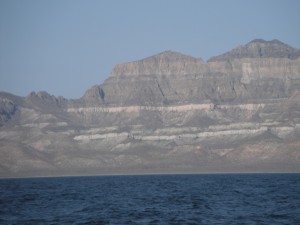
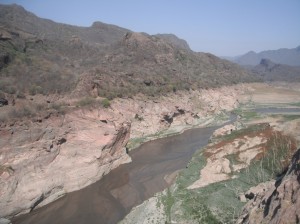
The next few days we sailed up a channel in between the peninsula and a series of islands. This portion of the Baja peninsula is perhaps the most visually stunning terrain we’ve seen (yet). The coastline is right up against the backbone of the Sierra de las Gigantes mountain range, which is dramatically striped with layers of rock of varying colors and textures. There are tall cliffs against the water, and cactus on those cliffs.


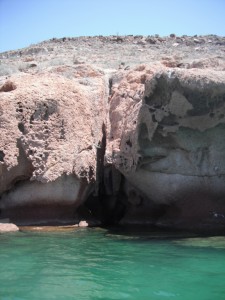
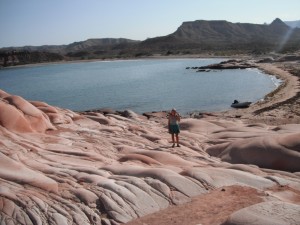
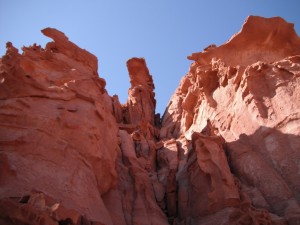
 A few of the anchorages are nestled amid a section of red sandstone. Sandstone weathers into beautiful smooth curves and interesting shapes that just dare the imagination to see faces, buildings and creatures.


We enjoyed a nice hike one evening among these features, and then back amongst the cactus. There are so many types of cactus which we don’t know the names of! Tall cactus like telephone poles, tree-like cactus with many branches but no leaves, bushy cactus with flat-bread leaves or segments that look like grenades, barrel cactus with long bright red thorns… And every hill rises to another incredible view of the world around us. We frequently wonder why there aren’t more people doing what we’re doing, and how is it that we’re so lucky to be the only ones in a given anchorage or sailing a given stretch of water.

One night we saw a distant lightning storm, with flashes coming every second or two. There’s a weather phenomenon here in the Sea of Cortez called a chubasco which has us a bit apprehensive. It’s basically a squall that comes up at night, forming over the mainland in the hot summer months that gets pulled out over the Sea because of the warmer water. They’re hard to predict more than a few hours ahead of time, and by then most sailors have gone to bed. Because they’re small and nocturnal, they often go unnoticed until they’re upon you. The winds can get quite dramatic, and lots of boats have been ripped off of their anchors or had their awnings or sails torn up. We buttoned things down as best we could and went nervously to sleep. We each woke up a couple of times during the night and went up to monitor the progress of this storm, and fortunately it never got anywhere near to us. Hopefully that’s all we’ll ever need to report on that subject. 🙂

There’s a small town in the bay of (Bahia) Agua Verde, where some local fishermen make their base. While we were in this bay, we purchased a fish from a panga returning from a day of fishing. We enjoyed some amazing fish tacos! We’re still trying to perfect our fishing skills. It was so easy in Alaska that we got over-confident, and now we find that we really don’t know what we’re doing. We change our technique or equipment every day or two, but have only caught a few small fish since we rounded the corner of Baja last December. But we’re still hopeful: the fishing in the Sea of Cortez is supposed to be quite good! We enjoyed some nice snorkeling in this bay, and saw all kinds of tropical fish. Dan spotted an eel swimming free during the day, which is unusual; usually they stay in holes until they are ready to hunt at night. We saw a group of young men hunting octopus who offered to sell us some, but when we looked in their little rowboat and saw the tightly stuffed sack with writhing tentacles we decided that we weren’t ready cook calimari.

The end of this section of travel was in Puerto Escondido (Hidden Port), which is aptly named. It’s a large bay that’s almost completely enclosed, which would of course make it a lake. Instead there’s an opening just wide enough for boats to pass through, though they almost certainly have to keep dredging it to make sure that it stays deep enough. In our case it’s just barely deep enough; we had to make sure to pass through at high tide so that we wouldn’t get stuck in the sand at the bottom. Several years ago, the Mexican government’s Tourism Development agency had a grand scheme to build up the Sea of Cortez for foreigners, mostly American, to visit and leave their money. The scheme included perhaps a dozen marinas with lots of facilities, some of which also included housing projects. Most of them got mostly completed, but “phase two” never happened. Puerto Escondido is a marina almost in the middle of nowhere. There’s a town about 10 miles away which has shops, restaurants, etc, but here there’s nothing but the marina and an RV park just down the road. To get to the nearby town, Loreto, one must walk perhaps a mile and a half out to the highway and flag down a regional bus traveling from La Paz or Cabo San Lucas to points further north. There are about 4 a day, so it’s a real pain in the neck if you miss it! Fortunately it seems that lots of people around here are friendly to hitchhikers. Because it’s not a regular stop, you have to be sure to remind the driver on the way back to stop.

Once we got into the bay, we hooked up to a mooring ball. We spent a few days touching up the paint on the hull and painting the pilothouse the same shade. One evening we went to shore to try to get a better internet connection, and ended up having houseguests. A couple of hard-core cyclists had come into town and were talking with some friends of ours. We joined the conversation and learned that they needed a place to spend the night, so we invited them to stay on Lungta. We all had a wonderful time talking together, and they ended up staying a second night. James and Margit are cycling from Southern California all the way to Tierra del Fuego. Wow! We exchanged life-stories and compared notes about traveling the world, doing yoga, growing up in the 60’s, etc. We spent a lazy day together, going for a little tour of the bay in our dinghy and taking a dip off the side of the boat. It was a very pleasant interlude.

After they left, we packed up our bags and prepared to head north for a bit. Because we’ve never left the boat alone disconnected from shore power, we found someone to check in on it while we’re gone, making sure that the power-hungry refrigerator & freezer don’t bleed the batteries all the way down. After we’ve done this a few times, we’ll have more confidence in our systems, but this is a major test for us.   We’re posting this from on the road, and we’ll include another posting of our trip north soon.

>> Kathy & Dan

Posted in Uncategorized | Comments Off on 7-17-2012 – Puerto Escondido, Mexico

6-16-2012 – La Paz, Mexico

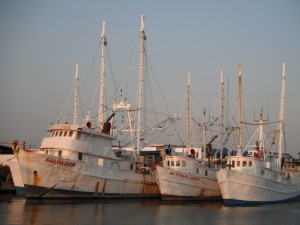
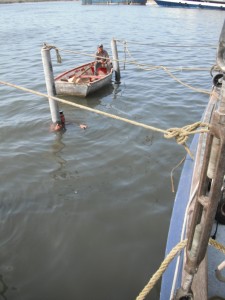
We stayed in Mazatlan for another week – a very busy one, because we had our boat hauled out and we worked on it. The boatyard we used is primarily geared towards the shrimping industry. They have two railways that run into the water, with two skeleton cars each that can hold one boat each. They lower a car into the water, using a massive winch, and the boat is driven so that it’s floating above the car. The cars have about a dozen tall posts at their perimeter, to which the boat is secured, and divers shove wooden blocks and wedges under the keel to support it against the bed of the car (which is really just a frame). Then the car is winched slowly up the shore. The first day we tried to haul out, the crew had difficulty and couldn’t make it work. They decided that they needed to reconfigure the car, making it narrower and shorter. So they pulled the car back on shore and told us to hang out until the next day. They helped us to tie onto a shrimper that was tied onto another which was tied onto a third that was secured to the dock. (This is called rafting. It’s not unusual, but not an arrangement that we’ve ever done before!) We clambered over the other three boats to get ashore that evening. The three boats were of different sizes and shapes, and one gap in particular had a significant height difference to overcome. We were introduced to the night watchman, who was told that we would be living aboard while we were there the next week. The second day, things went much smoother. They sent three men to be on deck with us, two divers in the water, and one man paddling around in a rowboat carrying the wooden blocks. As it turns out, the divers were the decision makers. They could see the whole situation and determine whether it looked secure enough to count on. This time they were able to position the blocks in a way that they were confident, and the boat was slowly eased up the track. We could barely see it moving, but the boat shuddered a bit as it did. Finally we were above land again, and they pulled over a scaffold for us all to clamber down.


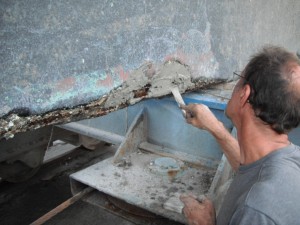
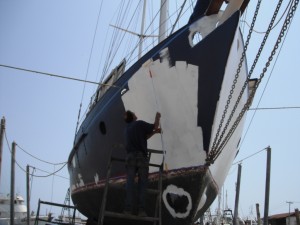
The next morning, we got right to work. We thoroughly cleaned and then patched a few spots on the bottom corners of the keel, where we’d had some less-than-satisfactory encounters with rocks: none of them serious, but the concrete had chipped off and exposed the steel structure inside. If left untreated, this could cause the boat to rust away. So we are now masons as well! We reached a “major decision”, and changed the primary color of the boat from dark blue to white. Although we both love the blue, it is not a practical color for the tropical waters we intend to inhabit for the next several years. White should be cooler, which is not only more comfortable but also somewhat less wear and tear on the boat itself. We used the rub-rail as a dividing line, retaining a strip of blue at the top, and left the entire transom blue. We taped off pleasing curves from the ends of the rub-rail to the bow and stern. As before, we bought house-paint for the top-sides, but the label calls it “vinyl-acrilico” instead of latex. This is quite a change, but we’re getting used to it (slowly). We had the boatyard’s crew powerwash the hull and repaint the bottom. Although we had just painted last year, the paint wasn’t really keeping up with the buildup of sea life, so we decided to put on a fresh coat. Also, the paint available in Mexico is much more effective (read “toxic”) than that which is available in the States. Hopefully, the higher copper content will be more successful at keeping our hull free of barnacles. We also had a few repairs to make that were related to some overzealous scraping done by a guy we hired to clean the hull the first time. He scraped the paint off a few spots of the rudder and chipped away at the fiberglass farings that we so lovingly crafted near our bowthruster. We had the boatyard sandblast and galvanize the rudder before painting. In doing so, they found that there were a few pinprick holes in the welded joints, and the rudder had partially filled with salt-water. Yikes! Fortunately we had put access holes with screw-in plugs when we built the rudder last year, so we were able to open it up from the top and flush it with fresh water. Before closing it up again, we poured in some antifreeze, to help prevent (more) corrosion. Dan rebuilt the farings around the bowthruster, this time mixing cement in with the epoxy to make it that much stronger than before. Finally we serviced all of the thru-hull fittings, testing to see that they worked smoothly and greasing the rubber sections to preserve their pliability.


We splashed back in the water (figuratively!) and spent one more night in Mazatlan before leaving for La Paz, on the other side of the Sea of Cortez. We had a lovely three-day sail across, with moderate winds most of the way although one night it picked up to about 20 knots. Although this is still at the upper end, we’re getting more comfortable with winds in this range.

La Paz is nestled at the bottom of a large bay, created by a “thumb” of a peninsula extending east off the Baja peninsula. There are several big islands near the tip of this thumb. The wind picked up quite a bit that evening and was close to 20 knots and the sun was setting as we rounded the corner of the thumb. Night had settled, but the wind hadn’t, as we dropped our anchor in the first small bay on the inside western face of the thumb. Our radar told us that there were 5 other boats in there with us, nestled as close to the shoreline as they could to minimize the wind. The wind howled all night, our first introduction to the “coromuel” effect that is very characteristic of La Paz. In the summertime, the ocean on the west coast of Baja is much cooler than the water in the Sea of Cortez. This creates a temperature differential in the air as well, becoming most dramatic after the sun sets. For most of the Baja peninsula there’s a mountain ridge down the center, which keeps the two air masses separate, but it dips near La Paz, providing a path for the wind to cross over. And cross over it does! Most evenings within 15 minutes of sunset the wind picks up from the west and typically gets up to 20 knots. Sometimes it blows out in a couple of hours and sometimes it goes all night. All of the other boats left the next morning, but we stayed another day. The bay we were in is called Balandra Bay, and it is beautiful! The water is very clear, and the beaches are white sand. There’s an estuary there that we kayaked into, observing the water color change into every shade of green from bottle-glass green to lime green to turquoise. We stopped and wandered down a beach for a bit until we came to some rocky cliffs. Kathy noticed some chalk on the walls, indicating that someone had been doing some rock-climbing (well actually just “bouldering”, because their trail didn’t go up more than 15 feet). In another corner of the bay, there was a dirt parking area, and we saw occasional traffic passing by all day. There was a business set up there which rented kayaks and beach umbrellas, and they seemed to be doing a good business: probably a dozen groups came by that day. We found an “oops” when we got up in the morning: the white paint that we had just put on was coming off in sheets, primarily at the waterline on the starboard side, where it had been “heeled” into the water for the past three days. 🙁 We hadn’t given it enough time to dry (not even close: the can suggests 7 days). So we peeled off the worst of it, retaped, and primed the area. We’ll find a quiet bay some time soon and stay for a week while the next coat goes on and dries.


The next day we went the remaining 10 or so miles to La Paz, half of it along a narrow channel, well-marked but not especially deep. La Paz is a smaller town than you might imagine, with roughly a quarter million people. It has a big presence in the cruising and sport-fishing communities and the tourist industry, though. There are lots of places to anchor in the La Paz bay, all along the main channel – but you have to be careful to stop far enough from the channel that you won’t swing around your chain and interfere with traffic! The conditions are similar to those we found in Canada & Alaska last year, in that the tides regularly cause a lot of water to change places from one side of a channel to another. There’s a constant current passing through La Paz, which is not common in this part of the world. Because there’s also often wind going one way or another, people talk about the “La Paz Waltz” causing boats to swing and dance, every one in their own way. We poked around a bit looking for a place where we would be clear of both the channel and our neighbors, and eventually found a nice place pretty close to a dock where we saw a couple row their dinghy. We settled ourselves in and took our little dinghy to the same dock, then we went for a walk to scout the town. We visited a few chandleries that our guidebook mentioned, and were amazed at the breadth of inventory that they had, far and away the best 3 shops we’ve seen in Mexico! We found a couple of items that we couldn’t live without. 🙂 As we were heading back, we ran into some friends from La Cruz that we’d been hoping we would catch up to again. It was real serendipity, because they were leaving the next day to go to a boatyard at the other end of the channel.

Our main goal for our stop in La Paz was to find a new dinghy, preferably with an outboard. We were amazingly successful in that endeavor, lucky that the one guy everyone pointed us towards happened to have a 10′ inflatable dinghy with a hard bottom and a 15hp outboard that was in good shape. It was a pretty basic setup, but the price was reasonable and we were able to get them the next day. La Paz has a morning radio “net” similar to the one in La Cruz, where we heard a guy say that he had a life-raft that he was interested in getting rid of. It was almost exactly what we have been keeping our eyes open for! It needs to be serviced (but they almost always will), and it’s rated for 8 people. Although we certainly could house more than 8 people, we think it’s unlikely that we’ll ever want to cross an ocean with that many, so we got it. We also got a swivel for our anchor chain, which is making it much easier (and safer!) to bring up the anchor after we’ve been swinging for a day or two. All in all it was a very successful visit – and we were only there 5 days!

One evening Dan was playing his guitar in the pilothouse, when an osprey landed on the end of the bowsprit. We watched it for a while – and realized that it was chirping and pausing as if it was listening for a response. As Dan’s hand slid from one chord to another, his fingers would brush the strings in a way that was causing a high-pitched chirp, and apparently the osprey heard it from a distance and came to investigate. The two interacted for 10 or 15 minutes before the osprey tired of the conversation and flew off again.

The day before we left we met an interesting young couple on a nearby boat, and invited them over for drinks and dessert. They brought another couple that was staying with them for a few days, and the six of us exchanged stories. Tom bought their boat 8 years ago when he was only 24 in Hong Kong for $1, and has been running Karaka, a 53′ steel ketch as a “shared-cost” effort ever since. This means that he takes on crew for extended stays, and they pitch in enough to feed themselves and to keep the boat running. He’s been from Hong Kong to Australia to the South Pacific to the Caribbean, and hosted dozens of fascinating characters. Because the crewmembers stay for months at a time, they come to live more like family than as paying passengers or even guests. The model is intriguing… But wow – they had some other stories to tell, of being held at gunpoint by Colombian pirates and being in Haiti last year when the earthquake struck (some local children were playing on board at the time, and at first he thought the kids were jumping on the decks!). They’ll be heading up into the Sea for the summer, and we hope to run into Tom & Kim again!

As we headed out of town, we stopped for one last visit with a friend whose boat is in a marina at the outer edge of the main channel. We anchored just outside the channel while we visited for a few hours. While Jeff takes a long-planned trip to visit family & friends in England & Europe, his partner Maru (who is new to boating) stayed on the boat with her cat in the marina. Her English is slightly better than our Spanish, and we enjoyed another opportunity to learn and practice conversational Spanish in delightful company. We were disappointed to learn that Jeff feels tied to the internet (because he’s still working – imagine that!), so they probably won’t wander far from La Paz this summer. This life is filled with ‘goodbyes’.

So goodbye for now – but not for long, we hope!

>> Kathy & Dan


Posted in Uncategorized | Comments Off on 6-16-2012 – La Paz, Mexico

5-28-2012 – Mazatlan, Mexico

Hi All,

Well, we’re finally working our way north towards the Sea of Cortez, but we’re taking our time.  We’re in Mazatlan now, having taken more than a week to get here.  We sailed almost the entire way, only starting the motor a few times to start or finish our day.  This is an accomplishment for us, and we’re determined to continue this progress.  There are a number of benefits to sailing over motoring: noise, smell and cost among them.  We have a loose budget, which is not completely realistic but provides a good target for our spending.  It includes $200/month in diesel.  We figured out on this trip, though, that after allowing for our generator usage it only leaves enough diesel for 10 hours of motoring a month.  Hopefully this will work out over an average, although we’re likely to over-shoot when we’re traveling like now.  However, it’s a good feeling to be traveling mostly by sail, possible because we don’t have a firm time-line: we’ll get there when we get there.  We had thought that the trip would only be 4-5 days, but we didn’t end up choosing an especially good weather window, so we ghosted along quite a bit of the time.

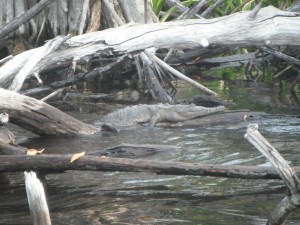
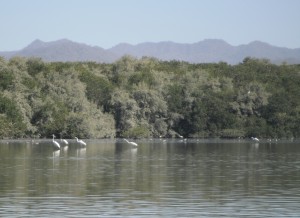
The first half of the way, the coastline had a number of well-known anchorages, divots that can offer some protection from winds and ocean swell, at least from one direction or another.  We stopped at three of them, the last of which was Matenchen Bay, which has a river running into it that widens out into a mangrove-edged estuary for quite a number of miles.  Our guidebook described a river tour by panga that sounded interesting, so we tracked it down.  We set it up for first thing in the morning, because that’s when the crocodiles are most likely to be out, and also because it would be more pleasant before the heat of the day.  We were not disappointed!  We saw lots of different kinds of birds, and were surprised at how different the list was from what we saw in Banderas Bay.  We didn’t see any iguanas in the trees like we had on our kayak trip near Paradise Village Marina.  We did spot a couple of crocodiles lounging along the shore, which was cool, but even better was a stop to a “cocodrilario”, a crocodile preserve on one arm of the estuary.  The boat stopped there for 20 minutes for us to take a look.  They had 8 or 10 large pools surrounded by heavy chicken-wire fences.  In each murky pool were 2 crocodiles, we were guessing a male and a female because it looked like there was generally a pretty big size difference.  We stopped and looked at the first pool for a few minutes, where the larger crocodile stayed completely motionless but the smaller one disappeared underwater.  She eased over to the edge near us and suddenly lunged out of the water with a hiss, then pulled back into the water as if nothing had happened.  She did this about 3 times before we wandered away, excited and puzzled at whether she was territorial, hungry, fearful, or ???  We saw similar behavior at two of the other pools, one in particular where she lunged at the fence (more specifically, at Dan, behind it) more than a dozen times.  The crocodiles we saw in the river/estuary were all about 3 or 4 feet long, rather small, but the ones in the cocodrilario were all large: 8 to 12 feet.  One would *not* want to see this behavior in the open river!  When we returned from the tour and were walking back to the beach, a huge “parade” of pre-teen kids rode by on bicycles.  There must have been 200 of them, organized roughly by school it appeared.  They congregated on the beach a mile or two further up the road.  Field trip?  We stopped for a swim before heading back to the boat.  The water has warmed up into the 80’s now, and with air temps in the 90’s a dip in the water is delicious!  Matenchen Bay is pretty long, but very shallow, so the waves that come in travel for a long ways.  The guidebook says that they can boast of having the world’s longest surfing wave.  But where we were, the waves were not tall, just enough to think about body-surfing.  The odd thing is that the waves were running nearly perpendicular to the beach.


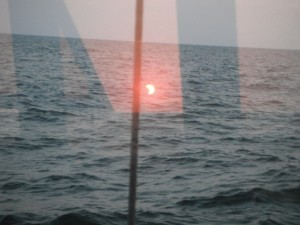
The second half of this trip the coastline was pretty straight, and doesn’t offer anywhere obvious to anchor.  Generally people just sail the whole way, but we chose to drop an anchor the first two nights when the winds died off and we started drifting backwards.  It turned out to be an uncomfortable way to do things, so we may not do it that way again!  The last two nights we sailed through, although we made virtually no progress after the daily winds died off.  One night about 1am we had another show of bioluminscent-covered dolphins leaping and twirling.  We were able to watch them for 15 or 20 minutes before our paths diverged.  Another day we saw a huge school of jellyfish drift by.  They had a little bit of color in them, and had long tentacles trailing behind, so we think they might have been stinging jellyfish.  We didn’t test to find out!  But they were beautiful: graceful and flowing.  We watched the sunset each night that we were underway, still hoping to witness a Green Flash.  Although that hasn’t happened for us yet, we were amazed to see a partial eclipse the last night that we were underway.  As the sun hit the water it was about half occluded.  At about noon the last day we were approached by the Mexican Navy.  They asked to board, in order to check our paperwork.  So they sent out a dinghy with 6 well-armed men carrying automatic weaponry, one of whom boarded Lungta.  We had a nice interaction, in mixed English and Spanish.  We were tickled when he asked why we had stopped the previous night.  The funny thing is that we hadn’t intentionally stopped that night, we had sailed through.  We told him we went with the wind, and the wind was very slow at night.  Later that day, as we approached Mazatlan, one of our fishing poles whirred that something had bitten.  We looked back  to see that a booby bird had grabbed the lure floating at the surface and got the hook through his beak.  Fortunately a friend had just told us about this situation the week before we left La Cruz.  Apparently it happens pretty often: he characterized boobies as pretty dumb animals, sometimes even coming back to a line that they’ve already been caught on.  He told us about his technique for removing hooks, so we already had an idea of how to approach the situation when it happened to us.  We pulled him in to the boat, and then wrapped a towel around his face before bringing him on-board.  The darkness soothed him somehow and he quit flailing around, making it easy to use a pair of pliers  to remove the hook from his beak.  Then we dropped him back into the water, and as soon as his eyes were free of the towel he took off flying.  He was a bit wobbly at first, but quickly regained his wits if he ever had any in the first place.  We pulled in the fishing lines at this point, so we didn’t see either him or any of his friends again.


We arrived in Mazatlan just at sunset, and dropped our anchor in the same place we visited in January.  It’s apparently a public anchorage, free except you can pay a nearby boatyard (Club Nautico) $4/day to use their dinghy-dock.  The place had been crowded when we were here before, but now it’s almost empty except for a dozen boats that seem to be abandoned, a dozen that look like they’re weekend fishing boats, and 4 or 5 commercial boats of various sorts (tour/ferry, sportfishing, dredging).  The first day we took the dinghy up into the harbor where the fishing fleet is situated, and found the boatyard that we had been told about that might be large enough to be able to haul our boat out of the water for us to work on the bottom.  We found the place, and although it’s *very* industrial, it looks like it will do the trick!  They won’t be able to take us, though, for the better part of a week, so we’ve had a few days to cool our heels, catch up on some small projects, and enjoy the town.

The second night we were here, though, something unfortunate happened.  We were awakened at 2am by the sound of voices and a splash just outside our windows, and by the time we popped our heads up and were able to take a clear look at what was happening, a couple of guys in a panga had made off with our dinghy, including the attached outboard motor.  🙁  They had cut four lines and towed it away all in about 10 seconds.  You can’t imagine what a helpless feeling we had as we stood on deck watching them motor away with our main form of transportation off the boat!  We called the port captain on the radio, but I don’t think he understood what we were saying (partly because his only questions were what our last port-of-call was and how many people we had aboard).  Then we called a neighbor boat who we’d met the previous day, and Rich graciously brought his dinghy over to see if we could chase them down.  Dan and Rich were gone about half an hour but saw nothing; the thieves had disappeared into the night (and probably the estuary, which goes inland for miles).  We didn’t sleep well after that, fretting over what had happened, what we “should” have done, and  where this was going to take us. 

One of the big advantages to having a large boat is that we have space for more “toys” than most cruisers, including another small boat that we intend for rowing and day-sailing, but which can serve as a backup dinghy in a pinch.  It won’t do beach landings and it won’t deal with choppy seas, but it will help us for the time being get to and from a dinghy dock while we’re in Mazatlan.  So the next morning we lowered the backup dinghy into the water and set it up with an outboard.  We’re also fortunate to have a pair of bicycles on-board, which we tuned up (it turns out bicycle chains & brakes don’t really like salt-water spray all that much) and then lowered onto the dinghy. We headed into town to report the theft.  The Port Captain told us that he first needed a copy of a theft report filed with the state, so we went to the location that he described all the way on the other side of town.  Once we found the building, we realized that there were numerous offices, each with a dozen or more people sitting in the hallway outside.  We must have been looking lost, because a man approached us and offered to help us find the right office and get started.  He was a lawyer, and probably spent an hour helping us get a place in the right line, but he never asked us for any money.  He just faded into the background after telling us that the wait would probably be a couple of hours.  So we sat in the hallway with the other dozen or so folks patiently waiting for their number to be called.  Kathy had a nice conversation with an 11-year-old girl named Janette, another delightful opportunity to learn a little Spanish.  Three hours or so later, one of the office’s workers called us in and told us that we should go to a different office several miles away, one that specialized in tourist affairs.  They have a translator on staff who would take our statement and file the proper papers.  However it was late in the day, and by the time we got there (did I mention the flat tire on my bike?) he had left for the day.  So our first day was spent learning what we needed to do to report the theft, but not much else.  The next day we went back to that office and things went just as they’d said, but by the time we got back to this side of town the Port Captain’s office was closed, so we filed the report with him the third day.  The final report here was three legal-size pages, of which they made five copies each, and they had Dan sign and affix a thumb-print to all 15 pages.  It’s amazing how many steps are in the process, any process, here in Mexico.  They love to make duplicate copies of forms, although they seem to have graduated away from the days of carbon paper.  There was a lot of confusion about which office we should have started with, rather than a clear delineation of responsibilities.  It really makes us appreciate how smoothly the American justice system operates, not that either of us had much experience with it!  What took the better part of two rather grueling days in Mexico, would, in the US, have taken a 10 minute phone call.

Mazatlan has a wonderful municipal market, loaded with fruits and veggies, a meat section, and lots of small odds-and-ends including clothing and souvenirs.  We’ve enjoyed poking around there several times.  On one trip we sought out a hand-grinder for grains.  We had to ask around a bit, but finally found a wonderful store a few blocks away which had one (and lots of other cool stuff too!).  We enjoy hot cereal for breakfast, but are having a hard time finding cornmeal, rolled barley, etc.  So we tried chopping some whole grains up in a food processor, but it came out very inconsistent.  Now we have another kitchen tool in our fleet and we love it!  We’re still enjoying the orange juicer that we got in Morelia and the lime squeezer that we got in La Cruz!  We get big bags of the fruit and enjoy the juice for days or weeks at a time.  Right now, with all of the heat, we’re going through 2 or sometimes 3 pitchers of limeade a day!

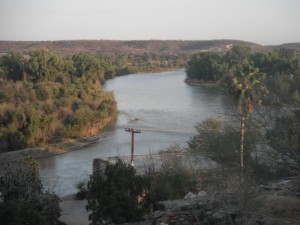
We’ve been getting more exercise recently than the last several months.  We’ve ridden our bikes to the far side of town a couple of times (see above 🙂 ), and we’ve hiked to the top of Cerro Creston, a 500 foot hill with a lighthouse on it.  The trailhead is located just across the street from the boatyard where we’ve been coming ashore.  (In the photo below, taken from the top of this hill, Lungta is just to the left of the center of the anchorage.)  It feels good to be active!  And we’re both looking forward to swimming a lot in the coming months…

We’ve heard that La Paz is the best town in the region for goods and services for the cruising boater, so that seems like the right place to go look for a replacement dinghy & outboard motor.  We had thought that perhaps we would make Mazatlan our last major city before hitting “The Islands”, but now it looks like we’ll also be stopping in La Paz.  That will give us another opportunity to post again (assuming that there’s anything interesting to share in the meantime 🙂 ).  Hope all is well with our friends and family out there in cyber-land.  We’d love to know how you’re all doing, so drop us a line occasionally.  Cheers!

>> Kathy & Dan
 

Posted in Uncategorized | Comments Off on 5-28-2012 – Mazatlan, Mexico

5-9-2012 – Copper Canyon, Chihuahua, Mexico

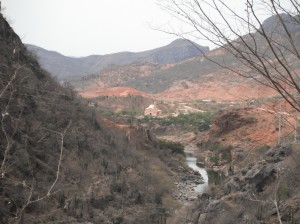
Barranca del Cobre (Copper Canyon) is a well-known natural wonder of Mexico, located in the mountains of the state of Chihuahua.  It’s deeper and covers an area larger than America’s Grand Canyon, which it’s often compared to.  In late April we took a week to visit Copper Canyon from Banderas Bay.  We took an overnight bus from Puerto Vallarta (actually a nearby town called Mezcales) to Los Mochis a few hundred miles north.  As the bus arrived, we began talking with the only other passenger still aboard, a French woman traveling alone.  We had a very nice connection, and the three of us decided to travel together.  Emmanuelle is a thoughtful traveler, fun and informed.  She speaks English far better than either of us speak French, and her Spanish is also better than ours.  She’s organized, but spontaneous and energetic.  It was a real treat to meet her and to spend the better part of a week with her!


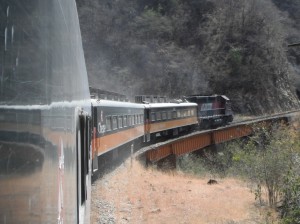
There’s an amazing railroad which goes from Los Mochis to the city of Chihuahua, roughly 400 miles through extremely remote territory.  El Chepe, as it’s known (short for Ferrocarril Chihuahua-Pacifico), has 86 tunnels and 37 bridges.  Someone told us that over 10,000 people died during its construction over more than 60 years.  We had heard that the first section of the train-ride was not as interesting as the later parts, so we grabbed a local bus to El Fuerte, El Chepe’s first stop.  Emmanuelle had a travel guide, so it was easy to find an affordable hotel for the night.  As the name promises, the Rio Vista hotel overlooks a river, and offers a spectacular view.  We went for a nice walk along the river, in search of some petroglyphs that we’d heard were nearby.  We had a bit of an adventure finding them ourselves, rather than hiring a tour guide, but it was worth the effort!  Other than the mosquitos (and something else – no-see-ums?), we had an enjoyable evening and caught the train station first thing in the morning. 


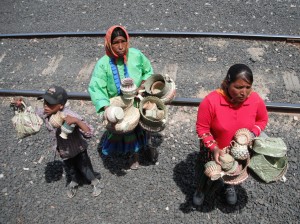
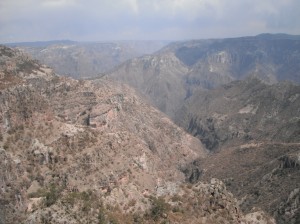
Wow!  From 8am to 5pm we rode the train to the town of Creel.  The countryside began flat and ended up quite vertical.  We  gained up to 8000 feet in elevation, and then came down about 2000.  Although the entire region is quite dry, we passed through several different ecosystems, with various types of cactus. pines and other high-desert plants.  The terrain also changed dramatically, including rocky hill-sides, steep canyons, spires of rock, sheer cliffs, with often a glimpse of a tiny river far below.  We traveled in the economy class, rather than first-class, because we were interested in seeing more of the local people (and fewer of the tourists).  There were half a dozen stops and we were pleased to see lots of people of all ages and apparently traveling for a variety of reasons.  It was interesting to see the large bags of produce that some people were transporting: they must travel to a bigger town a few times a year to stock up on potatos or onions.  We didn’t notice much agriculture once we got into the mountains, although many people raised animals, including cattle, pigs, goats, chickens, burros and horses.  The scenery was spectacular, and a train is a fun way to see it, with the big picture windows and the freedom to move around from one side to the other.  We each spent a good bit of time in between the cars, feeling the motion of the train on the tracks and the wind through the open windows.  At times these were the crowded points, while later in the journey we often had that space to ourselves.  There were children playing in the aisles, peeking out from around luggage or hurrying down the aisles in small posses.  There were indigenous women in their traditional dresses, wearing shoes that they’d made from tire treads and cloth ribbons.  There were rough-hewn men wearing cowboy hats and ostrich-skin boots with very pointy toes, on their way to whatever the next adventure would be.  And of course there were still we tourists, from France or Canada or the U.S.A. comparing notes on where we’d been and what we were still hoping to see.  At several of the stops, there was a small crowd of mostly-indigenous people trying to sell their wares, whether food or crafts, through the windows of the train.  At the town of Divisidero, the highest point on the track, the train stopped for 15 minutes to allow passengers to take some photos of the most impressive viewpoints, and to purchase a quick meal or a few souvenirs.


The next stop was Creel, which is the largest town on the route.  With a population of about 8000, it serves as the hub for most of the region’s tourism.  Dan had been here almost 20 years ago, and it had grown and changed quite a bit in the intervening years.  Where it had been a pretty sleepy village, now it is full of hotels, restaurants and gift shops – all modest, but primarily targeting the tourists.  We first went to the hostel that Dan remembered from his previous visit, but Margarita’s has become “the” place to stay and it wasn’t what we were looking for.  We visited 2 or 3 other places before finding the place for us: a little mom-and-pop place with about 10 rooms,  named Real de Chapultepec.  We paid about $20 a night for a huge suite for the 3 of us, which included a fireplace that we enjoyed each night. 

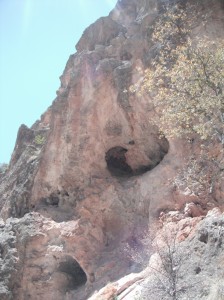
The first day in Creel we rented bicycles and visited several of the “must-see” places near the town.  There’s a valley nearby which is filled with huge pillars of rock.  Historically the place was called the Valley of the Gods, but it was renamed the Valley of the Monks (Valle de los Monjes) when the Spaniards came on the scene.  We stashed the bicycles and hiked in a little ways, but our itinerary was a loop so we didn’t stay long.  Although we were a bit uncertain about the route, the trail was always easy to spot and we never took a wrong turn.  We continued down to a local reservoir which offers fishing, camping, boating and a little bit of swimming.  We stopped for a picnic lunch, and actually dozed off for a short while before we started to hear some distant thunder.  We decided not to chance getting caught in a storm, so we headed on back.  By this time, we were all saddle-weary; the bicycle seats were quite hard and we were ready to be back.  Much to our relief, the last 5 km of our loop tour were on a paved road.  Just on the outskirts of the town, we passed a big cave, which was clearly still occupied by an indigenous family.  The Tarahumara people were the original inhabitants of this area, and they live very close to the land.  They traditionally lived in caves and walked very long distances regularly.  They do not seem to live in tight communities, but rather are quite independent and reserved people.  Many of them now have built houses from the sorts of materials we Westerners would assume.  It appears that many of them have built houses right near their cave, as sort of an extension to increase the size of their living quarters.  This particular cave seemed to have the kitchen still in the cave, with perhaps a bedroom in a nearby house.  The laundry was strung from somewhere in the cave to a tree outside.
 
The second day in Creel none of us felt like riding another bike!  We paid our host (the hotel owner offered up his cousin to be our tour guide) to take us to a nearby hot springs.  The first hour was by car and the last hour by foot down a cobblestone road which descended 1500 feet in about 3 miles.  The driver is Mestizo, of mixed Spanish and indigenous race, and he’s interested in the Tarahumara people. (Tarahumara is the name given them by outsiders.  They call themselves the Raramuri, which translates in their language to “people who run”.) He taught us to say “hello” and “what is your name?” in Raramuri (but it was difficult and we no longer remember either!).  The only other visitors were a young Mexican family, playing in one of the pools when we arrived.  Later we talked with them and tossed a ball with the 5-year-old son.  The walk to the top afterwards was challenging but the scenery was still spectacular as the shadows deepened into dusk.


We packed up the next day and took another bus to a town at the bottom of the canyon, named Batopilas.  Although this was a local bus, it was actually a four-wheel-drive van.  The 4 1/2 hour drive wound down the steep cliffs, and was impressively beautiful although Dan might use a word more like “terrifying”.  The first half of it was a smooth asphalt road with *lots* of twists and turns.  Emmanuelle was starting to feel car-sick when we turned off onto a much bumpier dirt road that Dan describes as “precipitously clinging” to the cliffs.  There were dozens, or probably hundreds of switchbacks as we slowly crawled, climbing and descending over dizzying heights through one canyon after another.  The rock changed color from gold to deep red and changed texture numerous times.  We stopped once to pick up a young man who was just walking along the road, and wondered how he had gotten out in the middle of nowhere.


Once we arrived in town, we found a hotel and explored the town a bit.  It felt good to stretch our legs!  Batopilas was founded in the heyday of the silver mining in the region a century ago.  Because of all the wealth, it was the second city in all of Mexico to have electricity.  Currently there is no mining going on (although exploration is starting up again, as the price of silver as risen in recent years), and the town is pretty sleepy.  Although it is no stranger to tourism, there are far fewer Western faces seen here than up in Creel.  We walked to the outskirts of town and wandered around an old hacienda which had been used during the mining boom.  Now it’s just a red-brick ruin with hints of the beautiful architecture here and there: arches that once formed doors and walls with a string of elegant but long empty windows overlooking the river.  There’s a swinging bridge across the river, a long foot-bridge linking the two sides of town.  Our hostess told us that there were two restaurants in town that she would recommend, that she liked equally well.  We had dinner at Dona Mita’s the first night and Casa Carolina the second.  Both were indeed charming, affordable and delicious.  Dona Mita recited the menu to us, of the 4 or 5 things she could cook for us today.  Carolina’s was a room of her house, and the first time we entered we ended up in her living room instead of the public eating room.  We found the food in Creel uninspired, but thoroughly enjoyed our dining experience in Batopilas.

The next day we took a hike 7 km to another town, even more remote than Batopilas, called Satevo.  Its claim to fame was a church called the “Lost Cathedral”, Catedral Perdida.  We asked around a few times to find the way, which turned out to basically be to follow the river down until you see the church.  It seems that few locals had actually been there, and weren’t exactly sure how to get there.  The hike was through pretty remote land, and there were a number of stunning views along the way.  We left early in the morning, to avoid the hottest time of the day.  When we arrived at the church, it was closed up so we sat in its shade and had some lunch.  While we were there, a youngish woman came by with a bag of embroidered cloths that she hoped to sell.  We wanted to contribute to the community, so we bought a kitchen hand towel (actually intended to wrap tortillas in a basket, but we don’t often serve tortillas with dinner like that).  She asked us if we had seen the church, and when we said no, she offered to get the key.  She led us to a house behind the church and we stood outside the fenced yard while she called through a window to some kids that were watching television.  They acknowledged her call, but didn’t move.  Apparently this is (similar to) the traditional way that the Tarahumara pay a call.  They do not demand entrance, but rather wait until their host is ready to receive them.  If the host does not wish to be disturbed, he is not obligated to receive a guest.  We’re postulating that this is a result of their living in caves and other places that don’t exactly offer a lot of privacy.  Perhaps the culture has developed techniques to allow people to experience privacy, even when the environment does not readily offer it.  After this happened 3 or 4 times, though, she looked slightly exasperated, and she went around to the front door to try a different approach.  An older brother answered, retrieved the key, and led us to the church’s main entrance.  We enjoyed 15 minutes in the cool silence of the church, admiring the architecture but marveling at the simplicity of the furnishings.  This is clearly a tiny community without a lot of wealth.

We wandered around a little bit more and then returned to Batopilas.  We spent the afternoon mostly people-watching from the porch of our hotel, which looked out over the river and had a nice view of a dozen or more homes on the steep bank on the other side.  The homes were small, so the families did much of their real living outside.  It appears that most families have 5 or 6 children.  We watched the children in a couple of families caring for their younger siblings  and doing other chores.  One little boy, perhaps 3 years old, spent most of the evening chasing a particular chicken in their yard, and when he caught it he picked it up, carried it around proudly for a few minutes, then set it down and started chasing it again.  We watched a few women washing their laundry in the river and setting it out to dry on rocks alongside.  We saw men working on building a new home with adobe bricks, and a few families moving around perhaps returning home from a visit to a relative or on their way to a friend’s home.  We enjoyed a little show when a calf ran down the river and a middle-aged man was chasing him.  Later the man returned with a lasso, but the calf crossed the river and the man was slowed down.  After the calf turned into town, we lost sight of them and never saw the resolution to this conflict.  As dusk set in, we left for dinner and an early bedtime – the bus back to Creel left at 5am!


The bus was a similar van to the one that we’d taken down the canyon, with a different driver.  Both drivers were very experienced and competent, so we knew we were safe even though Dan was extremely uncomfortable with the environment.  Fortunately (?) it was pitch dark when we left, so there wasn’t much to see for the first 2 hours.  By the time it was light enough to see, we were almost past the unpaved section and Dan’s worst fears.  At one point along this road, an old man and woman walked down onto the road, appearing from seemingly nowhere, somewhere up in the mountains.  Each of them was carrying a large sack, probably 40 or 50 pounds.  They hailed the bus, and we stopped to pick them up.  They put their big sacks on the roof and the man got in the bus – but not the woman.  She turned around and headed back up the mountain where she’d come from.  Although it was clear that they were a couple, there was no sign of affection between them: no good-bye kiss or hug, no gentle words.  Another demonstration of their reserved nature.  Both people were dressed in traditional attire, the woman in a very ruffled skirt and pleated blouse, and the man in a similar blouse with a characteristic skirt-like loin-cloth and a cap.  He had a friendly demeanor while he was on the bus, but only briefly talked with one other person on the ‘bus’, another indigenous man.

Once we returned to Creel, we continued our journey back home on one bus after another.  First we took a 4-hour local bus to the state’s capital city of Chihuahua.  Then we got a 15-hour regional bus to Guadalajara, where we said good-bye to Emmanuelle – with the customary Western demonstrations of affection!  Finally we took a 16-hour regional bus back to our Puerto Vallarta stop, where we caught a 15-minute local bus back to the marina.  Whew!  It was a wonderful adventure, but after all that travel we were glad to be home on Lungta!

Posted in Uncategorized | Comments Off on 5-9-2012 – Copper Canyon, Chihuahua, Mexico

5-6-2012 – Banderas Bay, Mexico

Yikes – it’s been almost two months since I last posted to our blog!  Sorry for the long silence.  Life has been pretty full, so here’s a taste:

In late March, we had our last scheduled visitor.  Dan’s cousin, Ben, came from New York with his 11-year-old daughter Emma and his newly-betrothed and utterly delightful fiancee Kathleen.  We enjoyed visiting with all three of them, individually and together.  The conversation was varied, thoughtful and fun.  Although they were only here 5 days, we packed a lot in.  We visited the beach a couple of times in La Cruz, and played on our surfboards for the first time.  Our surfing friend Rob had suggested that one milestone for him had been when he’d been able to say “I’m surfing” before falling.  Although it doesn’t take long to utter that short sentence, it’s a surprisingly long time to maintain balance on a tippy bit of flotsam.  Emma was the only one to achieve this feat, adding insult to injury by staying up long enough to sing Jingle Bells all the way through – twice.  We also took the boat out for a nice sail to Yelapa.  As on our last visit there, we took a day to walk up the river to the waterfall.  Again we were fortunate to come on a day when no one else was there, so we had the whole pool to ourselves.  The first night we spent there was pretty rolly, so we had a brilliant idea for the second night: grab a second mooring ball for our stern.  Seems pretty obvious, right?  This would keep us pointed into the swell, even when the wind died down in the middle of the night.  It worked well until about 7am, when Lungta swung 180 degrees.  We had pulled too hard, causing the weight on the bottom to lose its grip and slide down the precipitous slope until the 60 foot rope holding Lungta to the mooring now held the mooring to Lungta like a pendulum dangling off the stern in 195 feet of water. Uh-oh!  Someone worked to install this mooring ball, and now we’d just removed it in the blink of an eye!  We discussed various plans, and decided to wait until the winds picked up again to try to reposition the weight close to where we found it.  Although things turned into a bit of a three-ring circus before all was said and done, we did eventually accomplish our goal.  The owner of the mooring came by while we were working at it, and two other pangas joined in as well.  Just when we thought we were done, it was found that somehow the line had gotten twisted together with that of another mooring.  Kathy donned her dive gear and used the “hookah” to go down to straighten out the tangle, much to the surprise of the fishermen.  The sail back was great, but it was sad to see Ben and his girls go.


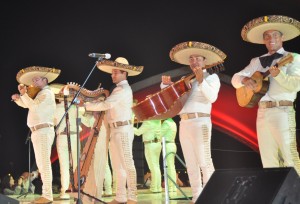
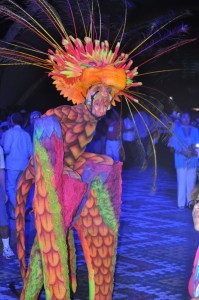
During this visit there were some major preparations taking place in the marina for an event that occured a couple of nights later.  A month earlier, they had poured 5 cement slabs near the main parking area, that could be used as helipads.  Now they erected huge awnings/tents over each of them and built a big sound-stage in the center with 30 foot television screens and an elaborate lighting infrastructure.  It turns out that there is an annual convention for the tourist industry, which was originally held in Acapulco but recently has been held in different places.  This year it was held in Puerto Vallarta, and they planned the bash for the final evening to be held in La Cruz.  Rumor had it that $1.5 million was spent on this event, which they expected 3000 people to attend.  Not the way I’d spend my money, but it was fun to watch the festivities.  One night they did a dress-rehearsal of many of the acts, including dancers, mariachi bands and performers in Cirque du Soleil-like costumes.  The sound system could be heard way out across the water, and we heard them working until 3 in the morning.  The following evening, the real show began.  After a few hours of hearing the various performers, we decided to get a closer look.  We hopped in our dinghy and stealthily snuck into the marina.  No one stopped us, and we ended up spending an hour or so on the premises watching the last two performances.  We met a few other boaters there, and later learned that some of them had also partaken of the appetizers that were being circulated by nattily dressed waiters, and even the open bar!  There was a hot-air balloon set up in the parking area, lit up with a warm glow, and small dirigibles circling overhead.  The finale was a round of fireworks that must have lasted for a solid 20 minutes!  It took roughly a week for the area to get cleaned up and deconstructed.

After Ben’s visit, we expected to leave La Cruz and make our way north into the Sea of Cortez, but things keep coming up that delay our departure.  One of the first was a short-notice visit by a friend from Portland who carved two days out of his visit to his mother in Guadalajara – and brought her with him.  Rod has recently moved his woodworking hobby up a notch and begun making mantel clocks that are beautiful enough to sell.  He’s figured out how to etch a copper plate to make a faceplate, using a Xerox printer as part of the process. 🙂  He brought us one of his first as a gift – and now we’re trying to figure out where to build a mantel to display it!  Rod and his family cruised down to Mexico several years ago, and are dreaming of doing it again.  We all had fun comparing notes about our journeys, the things that went wrong, and the amazing experiences along the way.  Rod’s mother Marian was also a fun person to have visit.  She’s quite independent and has done her share of traveling throughout Mexico and beyond.  Although the visit was all-too-short, it sounds like it just might be time for this family to begin planning another trip down this direction, and the first step might just be bringing the boat down to the Sea of Cortez next fall to prepare it for a longer journey.  We’ll certainly look forward to seeing them again!

We’re in a bittersweet period, since we’ve made a number of friends here in the last few months and many of them are moving on.  It’s not unexpected, one of the drawbacks of the lifestyle, but sad nonetheless.  Some people have headed across the Pacific towards Polynesia (as we expect to do in a few years); some headed south, and many put their boat in a marina or hauled out for the rest of the season and headed north to wherever home (or work) is.  Several of them had going-away parties, which were universally fun and we never failed to make new friends each time.  The last party we attended was for Christian, a 30-year-old who has been single-handing a 27 foot boat for the last 4 years.  He was an engineer at Boeing, and has made some amazing upgrades to his boat on a shoestring budget (most of it involving baling wire!).  He surfs and free-dives and takes his boat out sailing more than anyone else in the anchorage.  He has an “extreme sport” video camera, and he’s been making some wonderful videos for folks in the anchorage that he’s been out sailing with.  You can see the link to ours here. Lungta Sail Video He’s heading back to Seattle to resume the workforce or perhaps attend grad school.  He’s going via Hawaii, which will be the longest passage he’s done yet.  Our thoughts are with him on this big adventure!


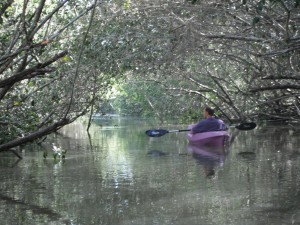
We had dinner with some new friends on their boat Aquarelle the night before they were going to move it into a nearby marina that’s part of a big resort called Paradise Village.  We decided to accompany them on the 1-hour trip, and to spend the afternoon playing in the pool.  Kathy enjoyed the water slides into the pool, and Dan enjoyed the ping-pong – we were hooked!  We decided to move in ourselves – OK, not for good, but for a few days of R&R before leaving the area.  We also changed our travel plans around again; we decided to do another “excursion” this time to Copper Canyon, but rather than finding a place to leave the boat further north as we’d been discussing we left from La Cruz.  Since this posting is a little long, I’ll do a second posting for that trip.  We’ve been back from Copper Canyon about a week, and have really enjoyed the luxury of having a dip in one of the four swimming pools followed by a soak in one of the jacuzzis every evening.  Paradise Village is a clean, well-run marina, situated at the mouth of a small river/estuary.  One morning we kayaked upriver a few miles.  There are lots of signs warning about crocodiles, but we didn’t see any – perhaps this was a good thing, as we’ve since learned that they get up to 10 feet long, and someone told us that they really like kayaks “cause they’re crunchy”.  🙂  We did however see lots of iguanas up in the mangroves and lots of water birds.  To our surprise, the river, which in some places narrowed to 20 feet completely engulfed by mangroves, led to a large lagoon over a half mile across, where we hung out for an hour or so watching the birds come and go.  Although Paradise Village costs roughly the same as the marina in La Cruz, the downside is that it’s full of tourists, (go figure!) so we’re missing the wonderful community that we’ve found in La Cruz.  We just moved the boat back to La Cruz for a couple of days, and then we’ll be leaving for The Sea – really, I mean it this time!  We’re hearing mixed reports about the internet availability in that area, so our posts for the next 6 months will be sporadic and likely without (many) pictures.

Until the next time, hope all is well with all our friends and family.

>> Kathy & Dan
Posted in Uncategorized | Comments Off on 5-6-2012 – Banderas Bay, Mexico