3-17-2012 – Corales & Michoacan, Mexico

Hola Amigos! It’s been a few weeks since we wrote, so it seems like about time to post something. 🙂 Life right now is pretty social, meeting new friends and enjoying time with others that we’ve known for, well it must be *weeks* now!
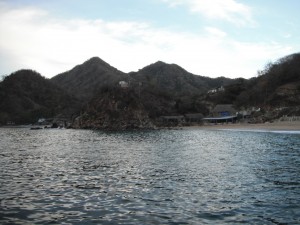
A couple of weeks ago, we took a short trip to the other side of Banderas Bay with our new friends Pete & Montse (the machinist and his Mexican girlfriend). We originally suggested Yelapa, since we’d recently had such a nice time there with Rich & Francine, but Pete suggested that we head further south to a place not in the cruising guidebooks. We ended up visiting a teeny-tiny town named Corales, in a cove that was ever-so-slightly more protected from the prevailing winds and ocean swell than the rest of the coastline in the area. We were nervous moving our big boat in between two rocky points without much information about whether there were any rocks to avoid. So Dan & Pete lowered the dinghy and went closer to shore with a depth sensor and talked with a local pangua driver. He told us where to anchor safely, and we dropped our anchor in 70 feet of water (pretty deep, but with a very steep slope into shore we were confident that we wouldn’t run aground in that direction). Then we set a second anchor from our stern, to keep us from swinging around. We used the dinghy to bring it out to a spot about 15 feet deep and outside the breakers. Although it was pretty rocky, we were secure. We hopped in the dinghy and went ashore for dinner at the one palapa restaurant in town. When they asked what we wanted to eat, there was a bit of a negotiation to decide what was possible. Some of us had breaded pan-fried fish and some had quesadillas – what a nice meal!

The next day we dinghied out to a beautiful beach one cove over from Corales. The restaurant owner had told us that there was a nice little fresh-water pond there that we were interested in finding. We didn’t have to look hard! A river ran out to the sea here, except that the sand had somehow formed a dam, forming a pond, but filtering out to sea level. The bottom of the pond was quite silty and got deep very quickly. We decided to explore up-river rather than hang out and go swimming at the pond. We found a trail that criss-crossed through the forest, but ended up circling around the pond. We encountered a few mellow Brahmin cattle along the way. The river was down to a trickle, but the river bed indicated that it gets quite large at times. There were lots of flowering trees and unfamiliar bird calls. We saw high cliffs along one side of the river, and mostly forest on the other. We never saw anyone else on this hike and except for the cattle, there was very little evidence that anyone had ever been here. We meandered up the river bed for a mile or two before turning around. We could have enjoyed hiking for a few more hours but didn’t want to anchor in the dark. We all got a little wet getting the dinghy off the beach, but we’re getting more comfortable with the process. We had a wonderful sail back to La Cruz, and arrived just as the sun was setting – perfect!

The next week we took our first “excursion”, where we left our boat for several days while we went inland to see the winter grounds of the monarch butterflies. We moved into the marina first, just to be sure that there would be plenty of people around if something happened. (Of course, nothing did.) We invited Crystal, a new friend to join us on this trip, and had a wonderful time getting to know her better. We left the marina very early in the morning to catch the 6:40 bus from the nearby town of Mezcales to Guadalajara and another from there to Morelia, spending roughly 10 hours seated, but in seats similar to an airline’s business class. There were movies playing on screens every couple of rows, and they even provided a sandwich meal on each leg of the trip. We arrived in the evening and found a cute little hotel within walking distance. No one there spoke English, so the three of us enjoyed the challenge of making our arrangements and finding out how to get a van-bus to the city center for dinner.
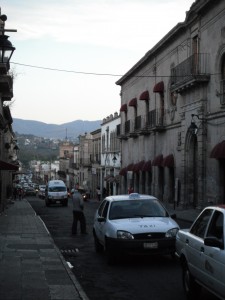
Morelia is an old city, with some beautiful historic buildings around the central park. We enjoyed a short walk and poking our noses into a few of them before searching out a restaurant for a leisurely meal on the square. Finding the correct van-bus to take us back to the hotel was a little bit of a challenge: first we were told bus #1, then bus #3, then back to bus #1. Eventually we found a #1 and the driver confirmed that it would take us to the right place. All of the local buses that we’ve ridden in Mexico seem to be personalized by the driver, leading us to wonder if they own the buses themselves and lease the routes. Many of them have religious images, decorative lighting, and unique signage indicating the destinations on the route. This one had a fancy lighted image on the back wall with moving parts, showing rolling dice and blinking words “Roll the Dice”. There were benches all around the perimeter rather than the usual parallel seating.

We found a flyer in the hotel’s lobby, for a local tour guide. We called Lorenzo and made arrangements to go see the butterflies the next morning. It was a full day, including about 2 hours drive from Morelia to from the reserve. The drive was beautiful, winding around and around through the forest and mountains. We had a beautiful sunny day, which Lorenzo explained was best for seeing the butterflies. He spoke some English, far more than our Spanish, but was appreciative that we wanted to speak as much Spanish as possible. We thoroughly enjoyed our time with Lorenzo, and both Dan and I felt like our ability to interact in Spanish improved notably. We’ve still got a long way to go, but it’s gratifying to see the progress from time to time.
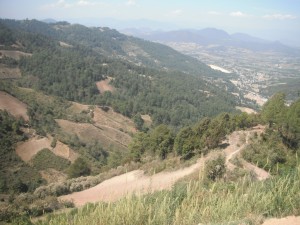
The town of Angangueo had many similarities to the town of San Sebastian. Both are nestled in the mountains, had a history of mining but more recently had come to depend on tourism. The architecture was quite similar, including the colors used to paint all of the buildings in town (brilliant white walls with red at the bottom and clay-tiled roofs). There were baskets of flowers decorating many of the windowsills in town. After passing through this town, it was just a short drive – up! We wound back and forth as we headed up the mountain where the butterflies congregate in winter. Lorenzo stopped halfway up for us to get a view of the town down in the valley and the butterflies overhead. Finally we arrived at the reserve’s parking lot, paid our admission and headed up the path. The park is well developed, with thousands of steps marking the way and many benches to the side of the path.
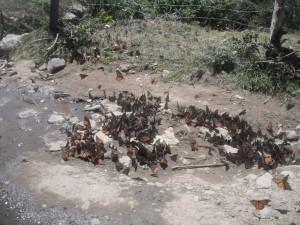
 

The monarch butterflies have an unusual life-cycle, migrating some 5000 miles from Canada to this one mountain in Mexico. The whole trip spans three generations of butterflies, so each butterfly has encoded in his genes the information for all three legs of the journey. The generation that we saw lives about 8 months, but the other two live only about 8 weeks each. This generation begins around California, heads south for 2 months, overwinters for about 4 months, and then travels north for another 2 months. While in Mexico, they mate (and mate and mate 🙂 ). Each copulation lasts 24-72 hours and depletes all of the resources of the male, who dies when he’s done. The female may mate with 8 or 10 different males. Only the last of these couplings results in the eggs being fertilized, while during the rest, the male is transferring fat to the female, to help her survive the journey ahead. While the pair is mating, the female is immobile and the male does whatever flying is done. It looked like hard work! The butterflies congregate in a particular type of pine tree, called an oyamel. When the sun heats up the day, they fly down to the valley and sip on any water they can find in the streams or wherever. The park had set up a slow-dripping hose at the bottom of the trail, to attract a cluster of butterflies. We arrived mid-day, and the butterflies were steadily pouring down the mountain, most above the treetops, but many coming down the trail straight into our faces! We had to walk carefully, so as not to step on any, especially couples that were in flagrante. LOrenzo told us that we could tell the males from the females because the males have a few dark spots on the back of their upper wings, which are sacs of pheromones to attract the females. We walked a large loop, up and then down, marveling at the beauty, quantity and fecundity of the monarch butterflies and their homeland. There were about 18 million of them, although I have to admit that we didn’t count them. They usually leave in early March, in colonies of a few hundred. We timed our visit perfectly! The local schools take a field trip to learn about the butterflies, and we were there on the day that they were visiting. The tour guides and teachers had their hands full, keeping the exuberant pre-teens from flattening too many hapless butterflies under their feet as they ran all around. After our tours, they played hackey-sack or soccer in the parking lot while we watched over a meal in a food-stand. Coincidentally, both our camera and that of our friend Crystal stopped working near the end of our day, so we decided that the universe was telling us to enjoy the rest of the day “in the moment”.
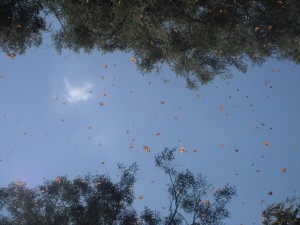
On our drive back to the hotel we decided that we were enjoying the trip so much we wanted to take another day. We selected a second tour from Lorenzo’s flyer, and he took us to some beautiful natural sites in the Patzcuaro region the next day. We visited a national park with lots of waterfalls right in the heart of the town of Uruapan and stopped for lunch at a resort on a large, very deep lake named Zirahuen. We bought some unusual sweet-treats, one of which was a whole orange which had been candied and another that was like marzipan only creamier, made from macadamia nuts – yum! We took an overnight bus back to Puerto Vallarta, and then back to La Cruz on the first local bus of the day, just as the sun was rising.

Other than those two trips, life has been fairly quiet. We’ve done some exterior work on the boat, and we now have freshly painted decks and the walls of the pilothouse. There’s still a little bit more touch-up to be done (including the roof!), but it looks so much nicer than before! We spent a few days cleaning the bottom of our boat. It was the first time that we had done this work, and there was a bit of a learning curve, especially since it should be done a lot more frequently! We’ve now been asking around, and it sounds like people typically do it about once a month, although one person recommended doing it weekly. We had lots of barnacles and some other stationary creatures that looked like a garden, especially on the coils that radiate the heat from our refrigeration. So even though we live on a boat, we’ve been doing some gardening. 🙂 Now that spring is on the way, many of you are probably also starting to garden…

Next week we have another guest coming, Dan’s cousin Ben, along with his girlfriend Kathleen and his daughter Emma. We’ll have a houseful, and we’re looking forward to it! Shortly after they leave, we will too. We’re looking forward to heading up into the Sea of Cortez and spending some more time out in some spectacular pristine nature. We don’t have much of an itinerary, so we can’t really tell you where we’ll be when, but if any of you wants to come for a visit let us know and we’ll see what we can do. Take care, all, and drop us a note with what’s up in *your* life! >> Kathy & Dan

Posted in Uncategorized | Comments Off on 3-17-2012 – Corales & Michoacan, Mexico

2-15-2012 – La Cruz, Nayarit, Mexico

Hi Everyone! Well we’ve moved into a new chapter of our journey. We’ve stopped moving for a while and settled into life in Banderas Bay, using the town of La Cruz as our home base. It’s a great place to stay while hosting guests: it’s 15 miles north of Puerto Vallarta, it’s an easy taxi ride and there’s good bus service. Up until just recently it was “just” a small fishing village – in a great location for anchoring. But a large marina was built here just a few years ago and it now hosts a large ex-pat cruising community, mostly during the “high season” (i.e. when it’s cold in the U.S. and it’s not hurricane season!). Lots of businesses have sprung up to support this community, and in turn be supported by its cash. There are tons of restaurants, many of which offer live music daily. There are also lots of events and services, such as Spanish classes and refilling of propane tanks. It’s a “sticky” town, in that lots of cruisers find themselves passing through La Cruz and getting “stuck” for much longer than they expected. 🙂

We’ve hosted two rounds of guests (so far) since our arrival in early January. Kathy’s mom came for a week in late January, and some friends from Portland came out in early February. Both visits were full and fun!

The first visit turned out to be quite different from what was originally envisioned. We’d invited the whole family out for what’s been an annual gathering, and were prepared for a group of 11. That’s a *lot* of people for this boat, but what the hell, they’re family! Unfortunately, for various reasons, everyone but Mom ended up unable to come on the week we’d chosen. The week before, when we still thought we’d have 3 guests, we were busily trying to make the forward stateroom habitable. (We tore up the two tiny rooms up front with two bunk beds each to make room for a chain locker and a single larger stateroom with a double bed. The framing has been complete for quite a while, but the finish-work is still a work in progress, slow progress!) We pulled off the portion of the ceiling that we’d paneled in oak plywood before leaving Oregon, because the material that we had on board to finish it had gotten wet and damaged while we were en route. We rented a car for a number of errands, including a trip to Home Depot to find a suitable alternative. After lots of hemming and hawing, we found some sheets of a fiberglass stuff that we thought would do the trick, and with a bit of ingenuity got them rolled up and somehow stuffed into an impossibly small back seat, then out of the back seat and down the dock onto the dinghy. We puttered across the anchorage and pulled up to Lungta’s side. As we struggled to heave the awkward roll over Lungta’s gunwales and onto the deck, though, the dinghy slid sideways away from Lungta and the whole roll of material fell into the gap between – just moments after Dan had pondered aloud “I wonder if this stuff floats”. It didn’t. We were unable to hold onto it and get it back in the dinghy. 🙁 Although Kathy tried to retrieve it by diving later in the afternoon (after the rental car was returned), she couldn’t find it. How frustrating! So the next day we took a bus back to Home Depot, returning in a taxi. Now it’s up and looks good, but sometimes the path to progress is frustratingly bumpy.

The week with Mom was far more laid-back and relaxed than it might have been with a crowd. We enjoyed flamenco music over brunch at a charming garden restaurant called “The Octopus’ Garden” and visited the Sunday market which has lots of high-quality crafts and delicious food! We took a tour up into the hill-country, visiting an old mining town called San Sebastian. Along the way we stopped at a coffee co-op and a B&B that was originally a facility for processing the silver ore that came out of the mines. John Huston and Elizabeth Taylor had visited this place “back in the day”. The last day Mom was with us, we went for a sail out & back into the bay. We couldn’t have asked for a prettier day! Although Banderas Bay is well-known for its whale sightings, we didn’t spot any that day. Fortunately, Mom got a little taste of the excitement of witnessing these giant creatures, because that night we heard whale song through the hull of the boat as we all fell to sleep. It was a lovely way to end the visit!

Rich and Francine are experienced eco-travelers, and we enjoyed a little bit of adventuring with them. We considered taking another tour, this time of a beautiful hike down the coast between cliffs and sea, but the timing wasn’t right. So we thought about renting a car or catching a bus and doing it ourselves. As it turned out, we just sailed directly to Quimixto, the town at the south end of the hike. We got lucky and spotted a number of whales on the way, including a group of 4 or 5 and a pair that dove less than 100 feet in front of the boat! We spent a very rolly night anchored in Quimixto and spent a leisurely day in town and hiking up to their pretty, but commercialized waterfall. You can rent horses here instead of hiking, so the trail was badly eroded: at times it felt like we were traveling through one of the Utah’s slot canyons. We spent a little bit of time on the beach watching pelicans and snowy egrets fishing, and got some tourist-photos holding a pair of iguanas that were some guy’s pet. 🙂

At the end of the day we decided to move on to Yelapa, but had some unexpected excitement when we tried to raise the anchor but the wheel wouldn’t turn. We had known that it was starting to have troubles, but this was a total failure. We ended up hoisting it using one of the manual winches that are used for the jib sheets. With a 230-lb anchor and probably the same amount in chain, it was a heavy load – hooray for self-tailing winches! We all worked up a sweat, taking turns cranking, but managed to raise it all up with enough time to make it to Yelapa just as thee sun was setting. Like Quimixto, but more so, Yelapa has a narrow shelf just off the shore and it drops off rapidly, rather like a wall actually, making anchoring a challenge. However unlike Quimixto, enterprising locals in Yelapa have set up mooring balls for traveling boats. They float a ball to a line attached to a big weight, such as a refrigerator filled with cement, and as you pull into the bay they come out to offer their mooring ball for rent. Easy! Fortunately, this worked out just as we’d hoped – otherwise we would have had to turn around and head back to La Cruz, since we wouldn’t have been able to anchor without our windlass. We spent three nights and two delightful days at Yelapa. We saw scores of butterflies, at least a dozen varieties of all colors including brilliant white, butter-yellow and neon blue. Rich documented about 20 different types of birds, taking beautiful photos of many of them. We visited the waterfall in town, but were much more excited at discovering that there was a more remote falls (una cascada) an hour’s hike from town. The hike to the Upper Cascada was pretty easy, but surprisingly off the beaten path. Fifteen minutes after we arrived, we had the place to ourselves, a beautiful waterfall into a large pool with a soft sandy bottom. It was heaven! When we got back to town, though, we were puzzled to see that the boat was in a different place than we’d started. Apparently some wind had kicked up and our heavy boat dragged the mooring ball to a new place in the bay, some 100 feet away. Although it appears that there were no ill effects, this is a good learning situation for us! The sail back from Yelapa to La Cruz was pleasant and uneventful. We lowered our anchor with a sense of finality, knowing that we weren’t going to lift it again until we’d repaired the windlass. Their last day and a half with us were spent kayaking near the anchorage and visiting the town of Sayulita, a 30 minute bus ride north of La Cruz. Sayulita is a big surfing town, but we enjoyed the sun and sand, wading out into the surf and watching a few people try their luck at riding a wave.

Both of our visitors were conscripted into being couriers, which was much appreciated! This turns out to be a wonderful way to get small parts that are hard to find in Mexico, so we’ll almost certainly continue to ask friends & family to help us out in this way.

Now we are in between guests for a little over a month. We’re hoping to strike a magical balance between socializing, working on the boat and playing (reading, playing music, etc). So far, so good. 🙂 We got the windlass repaired. It turned out to be a sheared piece of brass that’s a key between the motor and the chain-wheel. We tracked down a machine shop in the nearby town of Bucerias, and they made us 3 (just in case there’s a “next time”!) As we were talking with the machinist, we learned that he had quite a history with boats and was dreaming of traveling by sail some time in the near future. He offered to make another item that we’ve been looking for (a swivel for our anchor chain), so we invited him out to the boat to see the details of our situation. When Pete came that evening he brought his Mexican fiance, Montse, and the four of us talked late into the night. We’ve asked her to give us some Spanish lessons, so it looks like we’re going to be seeing more of them. We’ve also made some friends in the local music scene, and a budding author who’s down here working on a graphic novel because there are fewer distractions than back home in New York. 🙂 So, you know, life goes on much the same as it always has, except different. We expect to be in this region until early April, and then north into the largely deserted Sea of Cortez.

By the way, for those who don’t already know, we’ve created a Yahoo group called Lungta_Lives to use as a mailing list. Whenever we make a posting to the blog, we send an email to that list to alert interested people that there’s news. If you find yourself sometimes frustrated to find nothing new when you check for new blog entries, this might help. Feel free to join by going to http://groups.yahoo.com/group/lungta_lives/ and clicking the “join this group” link which is in the middle of the page, next to the “Home” title.

Sunny skies and fresh breezes to all of you, and please stay in touch.

>> Kathy & Dan

Posted in Uncategorized | 1 Comment

1-8-2012 – Isla Isabel, Mexico

After Los Frailes, we crossed the Sea of Cortez to Mazatlan, on the Pacific Coast of Mexico.  When we first left, the wind was still cooling off from a strong Norther, and it was on the brisk side for us.  However, it died off midafternoon and never recovered.  It might not have been too bad, except that the seas were still pretty steep from the previous week of intense wind, so we were wallowing around uncomfortably.  We broke our intention to sail “all the time” in favor of sailing whenever there’s enough wind to allow us to steer the boat instead of just bobbing along aimlessly.  Although we traveled for about 40 hours, there’s relatively little to report. 

The biggest event was that our starter failed on us *again*.  It’s been misbehaving sporadically, and in several different ways.  The worst is when it starts the engine, but doesn’t retract, causing a terrible growling noise as the main engine turns the starter’s pinion gear many times faster than it should.  This has happened 3 times to date, and the way we deal with it is to turn the engine off as quickly as possible, remove the starter, bang on the extended pinion gear with a hammer until it retracts, and then reinstall the starter.  🙂  We’ve gotten pretty good at removing and installing the starter, but it still takes a little less than an hour each way.  And it’s greasy work, not exactly what we had hoped to be doing with our day – any day!  The second time it happened, we tried adding grease in case it was sticking because it was dry.  This time we decided that we shouldn’t trust the starter any more until we had it fixed professionally.  So after we got it going again, we motored the rest of the way into Mazatlan, arriving just after dark (definitely not the ideal time of day to arrive in an unfamiliar anchorage!).  We found a nice spot to drop our anchor and fell into bed!

The next morning we hit the town.  With half a million residents, Mazatlan is the biggest city we’ve been in since San Diego.  We were confident that we could find some of the less typical items that had accumulated on our list.  The most important, of course, was a starter specialist.  We networked around a bit and found a shop that was recommended: Toloza’s in the northern part of Old Town.  Once again we had a challenging time communicating our situation, but we muddled through.  He poked at it a bit, trying to understand our complaint, then said to come back in a couple of hours.  So we strolled around the neighborhood and sat on a nearby beach, watching some gymnasts practice cartwheels and flip-flops on a gentle slope.  When we returned to the Auto Electric shop and asked what the problem had been, he said that he’d greased the shaft that wouldn’t retract.  Then he charged us $30 – what a deal!  We got it back to the boat and installed, and now we’re crossing our fingers that it’s really fixed this time!  While in Mazatlan, we also found a shop where we could purchase some belts for our engine, and some plumbing parts that we needed to repair a couple of small leaks, one under the bathroom sink and the other in the cooling system for the exhaust.  We stopped in the Municipal Market a few times – it’s a huge building divided into dozens of small shops/stands mostly selling fresh produce, but a few with meats, dry goods, and fast food.  We really enjoyed this market.  The mounds of fruits and vegetables were colorful and enticing, and the prices were great.  Also, the language skills required to ask the price and respond appropriately are now within our grasp, when we can get them to slow down a little.  🙂

We decided to move on, so that we can spend a week or so in the Puerto Vallarta area before hosting our first international visitors: Kathy’s mom Marilyn, brother Andy and his girlfriend Susan.  We left first thing Thursday morning, expecting to take about 40 hours on a straight shot to Puerto Vallarta.  We had a wonderful day of sailing, including an amazing night where dolphins appeared magically around 3am to play in our bow-wake.  They were larger than the ones we’ve seen before, probably bottle-nosed dolphins.  They were visible in the light of the nearly-full moon, but also because their owns wakes were illuminated by bioluminescent plankton, making them look like meteors streaking back and forth across our path.  We both came out on deck and went out to the tip of the pulpit to watch them under our feet.  There were four or maybe five, and their trajectories would entwine as they criss-crossed and took turns in the wake.  One of them was a lot smaller, perhaps a baby or juvenile.  Each one would cross in front of the boat, twirl around back and forth a couple of times, and then shoot out the side to make room for the next and to take a big breath.  They probably stayed with the boat for 45 minutes, but they will stay in our hearts for many years to come.


As we made our way south, we realized that Isla Isabela was directly on our path, and we couldn’t resist stopping for just one day.  This tiny volcanic island is sometimes called the Galapagos of Mexico, because it’s a nesting wonderland for several different species of birds which are not afraid of humans because there aren’t any predators here that they need to grow up fearful of.  There are also prehistoric looking iguanas lurking beside rocks and scurrying across grassy patches (they do seem to be more easily spooked).  We chose to anchor on the island’s east side, near some dramatic rocky islets known as Las Monas (which are apparently dress-making mannequins).  We noticed hundreds, or perhaps thousands, of birds circling over the island, looking somewhat like a swarm of gnats.  After a short nap we dinghied to the beach and went for a wonderful hike.  A biologist (student) came up to us and explained that the south beach would have been a better place to come ashore, but not to worry this time.  He and who-knows-how-many others are collecting data on the habits of the nesting birds.  They have set up blinds to hide in while watching the birds, and they have numbered many nests to help them identify them.  He pointed out a trail that went around the corner and then across the center of the island to the south end.  It was well-used and clearly marked with blue ribbons in the low trees.  Along the way we saw hundreds of blue-footed boobies with nests on the ground.  Some of the birds were sitting on nests, some were standing nearby.  They have long beaks and striking yellow eyes, but most notably they have robin’s egg blue feet!  Coincidentally the color was similar to Kathy’s Crocs – but we didn’t stop to compare notes on shops.  They would snap their beaks to indicate when we were getting too close, and make a sound like a cross between a kazoo and a breathy whine.  We tried not to upset too many of them, though.  They seemed to be comfortable until we got within about 6 feet.  Many of them were nesting directly on the trail so we often had to walk within a foot or two.  They acted a little pissed-off, but they never moved. Our guidebook tells us that there are also brown boobies here (which have lime green feet) of which we saw a few, and red-footed boobies but we didn’t see any of these.


The trail wound its way uphill, and into a low but open forest in which there were thousands of frigate birds nesting just overhead.  Many of them appeared to still be courting, but a few had nests with fuzzy fledgling chicks inside.  The males of this species have a fleshy sack on the front of their neck which they can inflate like a big red balloon.  They hold it on display for a minute or so with their wings outstretched.  We don’t know if this is territorial or to attract the girls, but it’s quite dramatic.  From the boat, we could see the hillside was dotted with red balloons.  These dark birds have a distinctive profile when they fly overhead; the leading edge of their wings has a pronounced convex curve to the point of their elbow and their tail is either spread out into a two-pronged fork or held tight into a very narrow point.  They soar way high overhead in all of the ports we’ve stopped in here in tropical Mexico.  Several times we’ve had one or more hitchhike on the spring-stay connecting the tops of our two masts.


We made our way up a set of crude concrete steps to the top of the ridge and back down into the caldera of the ancient volcano.  At the bottom is a large lake, named Lago Crater.  Many of you reading this will have already visited Oregon’s Crater Lake.  Like many natural features, they both leave you feeling small and privileged to live on this amazing planet!  The trail wound down to the island’s south point, where there are some derelict buildings intended for visitors to this World Heritage Site. Though derelict, the buildings were inhabited by numerous iguanas that were comfortable until we got within about 3 feet of them. As we headed back to our dinghy, we were conscious of all the sounds of the forest.  It was full of sounds, including screeching, quacking, chirping – it sounded almost like a Hollywood caricature of a jungle.  But it was light and airy, quite friendly seeming.


We got back to our dinghy *just* in time.  The tide had been going out, and we had to drag it back down to the water a couple of feet.  Then when we got it in the water, there were lots of rocks that it kept getting wedged between.  The rocks seemed to come in bands which were separated by just less than the length of the dinghy, so that just as we’d free ourselves from one set we’d become encumbered by the next.  There were probably 4 bands like this.  The waves were breaking over the rocks (and us) and we were scared that we’d never clear the last set because the water level was still going down.  We pushed and rowed and pried and shoved, and eventually made it past the last band of rocks – whew!  Dan got the wheels up and the engine started and away we went, back to the boat.  We were hot and tired, so we decided to take a quick dip in the water.  This was our first leisurely swim off the boat since we left Portland, and it was *delicious*.  We really only splashed around near the boat, but it qualifies as a swim to start with.  🙂

The next morning, bright and early, we left Isla Isabel towards Banderas Bay.  We had a truly wonderful sailing day, and we had a number of whale, dolphin and turtle sightings along the way.  We’ve anchored in La Cruz de Huanacaxtle (La Cruz, to those in the know), and we expect to be in this area for the next several weeks.  So that’s it for now.  Sunny skies to all of you, and please stay in touch.

>> Kathy & Dan

Posted in Uncategorized | 2 Comments

12-31-2011 – Mazatlan, Mexico

When last we left our intrepid adventurers, they were pulling into Bahia Ballenas, the Bay of Whales, excited at the prospects of seeing gray whales “up close and personal”.  🙂  Well, life has a way of changing plans.  After finding a nice spot to anchor, we lowered the dinghy and zipped into town.  We pulled up on the beach near a row of fishing pangas – probably thirty of them all neatly lined up.  We’d read that we wouldn’t be able to go up into the estuary on our own, but rather that we would need to hire a guide.  So we wanted to make those arrangements for the next day or two.  Perhaps some of the pangas were actually used to take tourist-cruisers up to the estuary?  We wandered down the main road, looking for some sort of shop or sign advertising whale-watching, but we saw “nada”.  Los Abreojos is a thriving town, but tourism doesn’t seem to be their game!  Eventually we stopped at a little convenience store and asked where we could go to see the whales.  Of course the question didn’t come across as clearly as all that, and the woman at the counter uncertainly pointed us towards the fish packing plant.  Hmmm, well there were a few guys standing around the doorway, so we went to ask them if they knew where we could go.  Our Spanish is still a work in progress, and it took a lot of repetition, hand-waving, and puzzled questions before someone finally went and retrieved a Chinese woman who apparently works in the kitchen but speaks a passable amount of English.  (“We want whales”, “Hunh?  You want a fish?”, “No, we want to travel to the whales.”, etc.)  She helped get enough information from the fishermen to realize that we were about two months too early.  Although our guidebook said mid-December through February, the peak calving season really is February.  No whales (here) in December.  So we moved on.

We took a couple of days to get down the coast to the next great anchorage, called Bahia Santa Maria.  Along the way we had a frigate bird sitting on our spring-stay, the wire running from the very top of one mast to the top of the other.  It didn’t look like a very comfortable perch, but she was there for the better part of the night.  For a while, there was a second one flying around also trying to get a perch – or was he looking for a date?  At any rate, he didn’t stick around very long.  We had a fishing line out as we passed over several likely places, and were successful at catching our first tuna.  It was about 15 pounds (Kathy pulled out the bathroom scale and weighed herself holding it and then without).  We cut steaks out of this one, and hope to smoke the next one (whenever that may be!).  As we rounded the last corner before the big bay, we saw a whale splashing and waving his tail up in the air.  We took that as a good sign.  As we neared the bay but were still in quite deep water (deeper than 600 feet, where our depth gauge stops telling us anything interesting), we kept seeing unidentified floating objects.  They looked like the sorts of floats that are used to mark lobster pots – but those are usually seen in about 150′ of water.  At one point, we dodged a string of them, and one of them waved.  What?  We took another look and found that the next one had a little head.  It turned out these things were actually sea turtles – *lots* of sea turtles! And perhaps it was no coincidence that this was a full-moon, perhaps this was the night that they come up on shore to lay their eggs.  We didn’t find out, but felt a bit awestruck to have witnessed this great convocation of these peaceful critters. 

Bahia Santa Maria was a huge bay with a wonderful sandy beach on one side and some pretty hills on the other.  We had a fantastic sunset the first night, centered right between two hills.  We spent a couple of days here.  One morning we tried trolling (unsuccessfully) for fish, and one afternoon we kayaked over to the beach.  This was another of those learning experiences.  🙂  There were breakers on the beach, but we thought they were small enough to manage.  As we paddled over to them, they began to look bigger and bigger.  We paused just outside the break-zone, and formulated our game-plan.  Dan went first, immediately after a wave began breaking, paddling energetically with the idea that he would follow that wave to shore and make it there before the next one came in.  His kayak hit the beach safely, but the wave hit his kayak before he was able to get out of the kayak, so he got a bit wet.  Kathy went next, following the same game plan, but not quite as successfully.  Just before hitting sand her kayak got turned broadside to the next wave, and she got tumbled out of the kayak.  Since it was so shallow she didn’t actually roll all the way over, but it was close.  But it was a beautiful warm day, and we strolled the beach for an hour or so collecting sand dollars, which are so frequent here that this beach has occasionally been called Frisbee Beach.  When we got back to the kayaks, the waves had increased in size – uh-oh!  They looked pretty intimidating, so we watched them for 15 minutes or so as we tried to formulate a plan.  There seemed to be a few bigger waves (where our hearts would sink) followed by a few smaller ones.  So we made a break for it when we thought we were at the beginning of a small-wave cycle.  Fortunately things went smoothly for both of us, and we paddled back towards Lungta both feeling energized and pleased with our accomplishments.  We rewarded ourselves with a hot shower and another lobster feast.  🙂

Then we went around the corner of the barrier island that separates Bahia Santa Maria from Bahia Magdalena, one of “the” destinations for gray whales to calve and breed in winter.  The Port Captain came out to talk with us, and visited for 30 minutes or so.  Again we learned that we were too early, so we’ve come up with a new plan.  We’re gonna head on south towards the “Mexican Riviera” (where we have some guests lined up), come back to Mag Bay in February to experience the whales at the peak of their “season”, and then head north towards La Paz and the northern Sea of Cortez. 

Before heading out, we took the kayaks out for a short explore.  We stopped at a small pebbly beach with some palapa cabins nearby, but no people.  There was (most of) a fairly recent whale skeleton here.  There was still a little bit of flesh between some of the bones and along the flukes of the tail.  The skull was more than 5 feet long, and the tail flukes were close to 7 feet wide.  Being close to this made us feel quite tiny.  We combed the beach for a few minutes and found small sea urchin skeletons and sea biscuits, more delicate remains of abundant sea life.

As we set sail for Cabo, we decided that we wanted to try to sail the whole way, without motoring even if/when the winds got light.  This decision was easy to make when the winds were fresh and going our way, but it was harder to keep when they died down overnight.  We originally thought that we’d make the 170 mile trip in about 36 hours, one night and the two days on either side, but it turned out to be nearly 24 hours more than that!  And for a while it was looking like it might even be longer still.  But the winds picked up again the last 6 hours as we approached Cabo San Lucas and rounded the point of the peninsula – hooray!  Then they *really* picked up, and we were flying around the corner at more than 8 knots, and that was without our mainsail.  It was exciting, and we were pleased that we were able to make this longish passage under sail.  We’ll need to do this more and more often if we expect to sustain the budget that we’ve set for ourselves.  We dropped anchor outside Cabo’s harbor just after sunset.  There were a number of other boats nearby when we went to sleep, including a huge cruise ship just anchored out with us. 

Cabo’s harbor was, as we’d heard, *very* crowded, and crazy-full of traffic of all sorts.  As the day heated up, tourist boats zipped people out to go fishing, parasailing, sailing, and just to see the beaches.  There were glass-bottom boats, party boats, jet-skis, and paddle-boarders.  Resorts lined the beaches, and we could hear their music and DJ chatter all day and into the night.  We took the dinghy into town to try to accomplish a number of errands.  We followed the sea lions right into the inner harbor, where all of the marinas are located.  There was a string of pelicans that almost looked like traffic separators. 

We got most of our “chores” taken care of the first day (and a couple of items that will have to wait until a larger city like Mazatlan).  We also spent half a day just hanging out on the beach, near the famous Land’s End rocks.  We found ourselves a quiet little corner between two rock spires, and read, collected sun, and watched people.  There were lots of tourists here, doing essentially the same thing as us, and lots of boat traffic.  Many of the tourists were snorkeling, and we were worried that someone was going to get run over by one of the tenders picking people up, but fortunately we didn’t witness any tragedies this day.  🙂  We considered snorkeling ourselves, but the water still seemed too chilly and the scene too chaotic. 

That evening as we were cooking dinner on the back deck, we noticed some odd movement of the small fishing yacht next to us.  It had been anchored the whole time we were there, with no sign of life.  We don’t know the cause, but this boat sank, right before our eyes.  It started listing, took on more and more water, and it was probably less than five minutes from the time the waves first slopped over the side until there was nothing but the very tip of the bow visible.  We felt powerless to do anything.  A flock of jet-skiers circled round almost immediately, and a couple of tourist boats came to see what was going on.  One of them communicated with the port captain, and in about five minutes a rescue boat came out to survey the situation.  They left and came back with some divers.  Then they left again and all was quiet near the somber scene.  It was sobering to us how quickly the boat sank, and the thought that the owners were going to return from wherever they were to find their pride and joy a submerged wreck.

We decided to leave the next day, to find a less crowded beach.  We identified Cabo los Frailes (Friars’ Cape) as a good place to launch from for the journey across the Sea of Cortez.  We were also looking forward to a bit of hiking, some snorkeling and perhaps diving too.  We assumed that the town there would have a cell-tower for our internet connection, but we were mistaken – sorry for the long delay in getting this update out!  On the way, the winds died out completely and we were losing ground because of a slight bit of out-going current, so we ended up motoring most of the way.  It turned out that we arrived just before the start of a weather pattern in the Sea of Cortez called a Norther.  This is caused by an extreme pressure differential between the southwest US desert states (say around the Four Corners area) and the southern Sea.  It happens fairly frequently this time of year, and it sets up a very strong wind (anywhere from 30 to 50 knots or maybe more) straight down the length of the Sea (600 miles) for several days.  Apparently most people just hunker down and wait it out.  We had stumbled on one of the common choices of a place to wait it out before crossing.

We ended up hanging out at Los Frailes for a full week.  It’s a beautiful little corner, although we were “stuck” on the boat half that time as the wind howled around us.  So we did some projects around the house.  We made an entry mat from one of Kathy’s old climbing ropes, and we’re very pleased with how it turned out! 

We replaced the cover for the propane stove.  We added some protective bars to the refrigerator, to help keep everything from sliding off the shelves on top of whatever poor soul tries to open it while the boat is heeling or rocking.  We fixed our wind instruments and we tinkered with our SSB radio system quite a bit while we were here, in order to get the weather reports.  Up until now, we’ve been using internet sources for this important information.  Our communications are still a bit fuzzy, but much better than when we arrived.  We didn’t do anything significant, but made a number of minor changes that each incrementally improved our reception.  Now we’re catching more like 75% of the weather instead of 25%.  There are a number of “nets” set up at given radio frequencies and various times across the day, where people from around the area can call in and give their location and local weather conditions.  This is also an opportunity for people to connect with friends in distant portions of the region.  Sometimes people will have a message relayed through a third-party if they can’t make contact directly.  They are in general amiable and informative arrangements.  And we’re now beginning to tap into them – hooray!  The next step will be to hook up our modem to the system so we can request weather information via radio-fax and email.  The wonders of modern technology!

While in Los Frailes, we saw some interesting wildlife behavior.  We saw a sea turtle come up on the beach late one afternoon and dig a hole into which she disappeared.  In the morning there was no sign she’d ever been there.  This was at the new moon.  We’d thought that they laid their eggs at the full moon, so now we need to learn whether we were confused – or she was!  We watched a sea eagle (osprey?) catch a fish right outside our window and then struggle against the winds to get ashore to eat it, or perhaps bring it to a nesting mate.  Numerous times we saw some small rays jump out of the water.  They would pop up about 4 feet, flapping their wings as if they wanted to join the pelicans, then lose momentum and splash back down into the water.  We’d see 5-10 “pops” in a group.  One woman we talked with (Linda from Jacaranda) has nicknamed these guys “popcorn rays”, and that name has caught on with us.

While waiting out the wind we’ve gone skin diving for the first time on this trip.  The diversity of sea life was wonderful with schools of brightly colored tropical fish.  The water is about 70 degrees here so it’s still pretty chilly after about 30 minutes, but it provided a  delightful taste of things to come.

On Thursday we finally felt that the winds had died down to the right point for us to take the leap and start our passage across the Sea of Cortez.  The first 6 or 8 hours were fast and thrilling, then the winds died down a bit and we had another 4 or 6 hours of gentle sailing.  This was really wonderful, however the winds continued to weaken and we ended up drifting most of the night.  We hoped/expected things to pick up as the day warmed things up, but the sea stayed mirror-like and we lost our new-found resolve to sail wherever we go.  🙂  We motored the last 30% of the way, and arrived in Mazatlan late Friday night.  Today we settled in, ran a few errands in the big city, and will celebrate the New Year together on the boat tonight.  It’s been an amazing year, with some incredible ups and a few downs, but we’re thrilled to be living the lives we are.  Next year promises to be every bit as interesting.

>> Kathy & Dan

Posted in Uncategorized | Comments Off on 12-31-2011 – Mazatlan, Mexico

12-8 Turtle Bay to Hipolito

Our last posting was from San Quentin, but before the best part!  The day after the attempted dinghy landing, we had a more satisfying experience (although still no progress on surf-landings of our too-big dinghy).  We left early in the day, and went just around the corner from the place we first stopped.  This timing allowed us to avoid the breakers entirely.  We beached the dinghy (with a small anchor in case the tide came up further than we expected) and went for a hike in the dunes of the tiny peninsula which protects the bay from the ocean swell.  It was lots of fun to get a little bit of altitude and see both sides of the peninsula, from the breaking waves on the Pacific side to the estuary on the inside.  We startled numerous jack-rabbits and enjoyed watching them bound wildly across the hills.  We saw our first cactus of the journey, along with some sage-like scrub, a few in bloom.  The land here is quite barren, though, and Dan keeps talking about being on the moon.  When we turned back, it was only because we knew the tide would be going out and we didn’t want to get caught behind the breakers. 

The next day, we went back but took the dinghy further into the estuary.  We’d read that it went back up to 10 miles but that the deep and shallow spots shift frequently so non-locals should be cautious.  As we entered the area, we were greeted by the spout of a whale – we figured that was proof that it wasn’t too shallow for our dinghy!  We puttered in, to a place I’ll call the inner bay.  We turned off the outboard and just floated for a couple of hours, enjoying the sights and sounds.  The inner bay was much bigger than we expected, a few miles across.  Not surprisingly, it was loaded with birds: ducks, pelicans, gulls.  They were diving and calling and generally enjoying their bird-lives.  A few sea lions and a seal or two popped up to see what we were doing.  The whale reappeared, and we watched him for a long time.  He was basically just relaxing at the surface, presumably enjoying the sun – like us!  Occasionally we’d see a flipper or two as he rolled over exposing his belly to the sunshine.  Sometimes there would be a swirl in the water, perhaps as a fish went by and he grabbed a bite to eat.  Most of the day he was in less than ten feet of water.  A few times he relocated a dozen yards or so, and we would paddle after him.  It was a lovely, lazy day.  As we headed out, we noticed another whale coming into the inner bay.  We think this was a humpback, while the one we were hanging out with had been a gray whale, so the two probably didn’t have much to say to one another.  🙂

We left the next day, heading south again.  We had a lovely day of sailing with the wind at our backs.  We had a fishing line out, but no luck yet.  We decided to stop for the night inside Cedros Island.  A pod of dolphins was leaping around in the nook that we had selected – that seemed like a good sign.  We anchored, but had to get pretty close to shore, so we took the dinghy out with the hand-held depth sounder to make sure that we had plenty of depth.  We stopped briefly on-shore for a quick look-see.  The area we saw was mostly composed of composite rock, layers of sandstone with lots of embedded pebbles or small stones.  Kathy was tempted to try a little rock-climbing, but the Crocs we were wearing weren’t exactly appropriate.  🙂  There were lots of lobster shells and a number of beautiful cone shells on the beach.  Nearby was a large rock coming out of the water that was covered in pelicans.  There were also a number of them up on the cliffs.  We were curious what a pelican’s nest looks like, but never did identify one.  The island rises pretty steeply from the sea, with some wrinkles that funnel the winds surprisingly strongly.  We’d periodically get blasted with an intense breeze, but the anchor held well and they only lasted about a minute or two.  A local fishing boat (a.k.a. panga) approached us and asked if we’d like a fish.  We asked if they had any lobster (there were tons of lobster pots in the area).  They said that they wouldn’t until morning, and we agreed to buy some at 6:30 a.m.  At least that’s what *we* thought we’d agreed to.  🙂  They didn’t show up the following morning and we left the anchorage around 6:45.


We had another beautiful day of sailing, although we had to dodge lots of lobster pots between Cedros Island and the main peninsula.  We had two pangas pull up to us on the way.  The first offered us some lobsters – yay!  When we asked how much they cost, they said free, tossed 5 slightly damaged lobsters up onto our deck, and drove off!  The other boat wanted to make sure that we didn’t run over the floats marking their lobster pots.  🙂  We also had a brief encounter with the Mexican Navy.  They approached us in a large gray cutter and hailed us on the radio.  It took a couple of tries before we realized that it was us that were being hailed.  Fortunately we got it, and we responded appropriately.  They only wanted to know who we were and where we were going.  Then they told us to have a nice day and to call them if we needed anything.  Very friendly!  The winds died down a bit, so we decided to motor the last few hours.  Unfortunately, when we went to start our engine, it made an awful growling sound, so we turned it back off again and started fretting.  We put up all 5 of our sails, and fortunately the wind picked back up again.  We had a great sail, and came all the way into Turtle Bay, where we were intending to spend the next few days.  We arrived in style, and put away our sails just in time to anchor.  No one else had any idea that we were limping along.  We had the lobsters that night and they were FANTASTIC!

We spent the night thinking about the growl.  Dan suggested that it might be the cutlass bearing, which surrounds the propeller shaft.  Repairing this would probably require us to haul the boat out of the water, and there was nowhere within 400 miles that could do that!  We’d need to sail down the coast without an engine.  Or maybe it was something even more intrinsic to the engine like a main bearing and we’d need to re-power the boat – that could take weeks (or months) and in the neighborhood of $50K.  An expenditure like that would significantly affect our lives.  🙁  When we got up in the morning, though, we decided to check the starter motor.  We’ve had a few incidents with this motor in the last few months, and it turned out that this was one more.  The pinion gear that extends from the starter to engage the engine’s flywheel is supposed to retract when you release the starter switch, but somehow managed to get stuck out.  Drat! or Hooray!  While it’s a pain in the neck to remove the starter, it’s not nearly as challenging as being engine-less!  We got it fixed before lunch and suddenly life looked rosy again.

Turtle Bay is about halfway down the Baja peninsula, just underneath the big point where it starts to curve east.  It’s a well-known way-station for cruisers, so we were looking forward to this stop.  It turns out that there’s not really all that much to see & do here, though, other than re-fuel and re-provision.  We left our dinghy at the fuel dock a few times while we wandered around town.  This dock used to be owned by a cannery, but (as we learned in Alaska) the canneries are being shut down and the towns that they supported are fading away.  The dock is too.  🙂  Several homes near the beach had whale vertebrae as ornaments, and Kathy was charmed by this bench made from a pair of them.

Purchasing fuel from unknown sources in third-world countries is one practice that periodically causes for cruisers, if there’s water or other contaminants in the supplier’s tank.  We’ve come up with a brilliant scheme (if we do say so ourselves!) to make sure that the diesel supply to our engine is clean.  We have two separate fuel tanks, so we decided to only use fuel from one of them, only put new fuel into the other, and to transfer the fuel from one to the other through our own fuel filter.  As a matter of fact, Dan had previously installed a small fuel pump with a Racor fuel filter in line with the pump for a different purpose.  Now we can be confident that our engine and generator will only get clean fuel.

We headed south again on Tuesday, and had a brisk wind.  It was a great day of sailing!  The winds picked up more than we liked in the evening, though, so we ducked around a corner and spent the night in Hipolito Bay.  While we were there, the winds really began to howl, pushing 30 knots.  We had to  wait two days before the winds subsided, so we’ve been out of Internet contact for a couple of days.  Our new anchor system, which uses chain instead of rope, is working really well, thank goodness.  The heavy chain is almost an anchor in itself, so we don’t swing around the anchor as widely as we used to.  None of the winds we’ve experienced so far have come close to removing the catenary from the half-inch chain rode.  When we’re at anchor, we set our navigation software to sound an alarm that will wake us up if we get more than 150 feet from the spot where we set the anchor.  We also set it to draw a track where we’ve been, so we can see in the morning how far we strayed.  This track has gotten much more compact since the switchover to chain rode. 

We’re now on our way to Bahia Ballenas (Whale Bay).  Wonder what we’ll see there…

Until the next time, take care and drop us a line if you have a moment!

>> Kathy & Dan


Posted in Uncategorized | Comments Off on 12-8 Turtle Bay to Hipolito

11-27-2011 – San Quentin, Baja California, Mexico

We ended up spending more time in San Diego than we’d expected.  Just as we thought we were ready to go we had a minor accident that set us back a few days.  We were heading back from the dinghy dock to the boat, when the boat turned suddenly.  The jolt knocked our outboard off the transom of the boat, so it was floating in the (salt-)water.  Not so good for an outboard.  🙁  We managed to retrieve it within a few seconds and even though no signs of water were evident inside the cowling it certainly wasn’t running right. We found a shop to repair it, but it took almost a week.  In the meantime, there’s always more to see and do.  We saw a few more military exercises, including some nighttime rebreather diving, where the divers towed flashing disco-ball-like strobes along behind them, Coast Guard helicopter training with rescue divers jumping out and being pulled back in, and Navy dolphin training where the dolphin jumped into their skiff at the end of the day presumably to go back home. 

Also, it turns out that the America’s Cup has started a new feature, called the World Series, which consists of about a dozen smaller exhibition competitions in various places around the world over the course of the year.  The third one was being held in San Diego while we were there, and it was being held within a half-mile of our anchorage!  There were seven days of races, some of which came as close as a quarter mile from our boat.  There were nine entrants, all of which were sailing 45′ catamarans that had fancy mylar wing-sails.  They could get up to 30 knots (~34 mph) and would tip up on one pontoon when they really got moving.  It’s pretty impressive!  Ailona, a new friend from Portland came down for the week to watch the races and joined us for a couple of days.

We finally left San Diego and crossed into Mexico on Wednesday, November 23rd, just in time for my birthday.  We had a beautiful overnight sail, arriving in Ensenada mid-morning.  We had heard that anchoring in the harbor was not allowed right now because of some construction and dredging going on, but we weren’t exactly sure where we were going.  When we pulled into the harbor, we saw a guy on a dock frantically waving and it turned out that he was suggesting that we pull into “his” marina.  We anchored briefly in the middle of the harbor and dinghied over to investigate (using our repaired outboard – hooray!).  He introduced himself as Chuy, and convinced us that this marina was a good deal.  It was a very small marina, and offered us a much lower price than we would have found at a more full-service place.  So we went back and retrieved the big boat.  We thought we were only going to be there for one night, but it turned out that we were there for three, so it’s a good thing that we found a good price!

Ensenada is classic Mexico, with lots of run-down buildings and street peddlars hawking leather goods and jewelry.  Fireworks also seem to be popular.  The town is nestled in some arid hill-country, and the air although fairly polluted is also continuously freshened by the coastal breeze.  We enjoyed the fish market (Mercado de Mariscos), where we bought some smoked salmon and some marlin steaks which we enjoyed for our Thanksgiving dinner (along with cranberry sauce!)

One must go through customs at the first major harbor that you stop in.  Ensenada is one choice, and the next choice was 300 miles away.  The advantage to Ensenada is that all of the offices that one must visit, including a bank to pay the fees, are in a single building, rather than being scattered around town.  Even so, it took us some significant time on each of three days to get it all taken care of.  Instead of tourist cards, we thought we would try to get immigration documentation.  We spent the first day tracking that down, but when we found that it would take more than a week we changed our minds.  So the second day we got the tourist cards and got the boat “checked in”.  This involved a walk to a different bank than the one in the integrated office, because the computer system was down that day.  The next day we acquired a Temporary Import Permit for the boat and our belongings, which should help us down the road if we need to purchase repair parts from the U.S.  Part of this involved a customs declaration process, and we drew the short straw that entitled us to an inspection of the boat.  There’s so much stuff on this boat (from kitchen provisions to tools and spare parts to kayaks and outboard motors) that we were nervous this would be a real pain in the neck!  But the customs officer was wonderfully friendly and ended up only doing a very cursory inspection – he didn’t even look in our stateroom.  🙂  We were done in just a few minutes.

One other thing we enjoyed about Ensenada was that it was a live enactment of an immersion language lesson.  We have a tiny but growing vocabulary and syntax in our brains, and this was a wonderful way to practice and assimilate.  Most people speak better English than we do Spanish, so we had a bail-out option nearly everywhere we went.  Although they didn’t always understand our attempts, they universally seemed to appreciate the efforts.  And we’re having fun figuring out how to conjugate new words and interpret signs that use words we aren’t yet familiar with.  The customs officer assured us that we would pick it up quickly. Life in Mexico has, for the time being, become one constant Spanish lesson.

We also found a cool device for local use. It’s a product offered by Telcel, a Mexican cell-phone company, that connects to the cell towers and allows your PC to get internet access. It will cost us about $40/month (and $70 up-front to purchase), but we’re both feeling like it’s worth it. It uses USB, so we can move it from one PC to the other easily. The connection seems to be quite good!

The next day we left for San Quentin, another 100 miles south.  But first we needed to check the boat out of Ensenada with the Port Captain, so back to the integrated office that we were so familiar with.  Unfortunately, although the integrated office was open at 10, it turns out that la Officina de la Capitania de Puerto is not open on Saturdays.  We debated what to do, and decided to leave anyhow and hope that this is not too major of a misstep when we arrive at our next port.

We lost our wind fairly quickly, and ended up motoring most of the way from Ensenada to San Quentin.  The sky was very clear, and we were hoping for a sighting of the famed “Green Flash” which neither of us has seen yet.  While that did not materialize, we did have a very interesting sunset.  After the sun’s orb sank below the surface, the glow continued for a long time, looking like a pool of molten lava.  As the sky darkened, the moon became evident and it was a teeny tiny sliver, with a bright planet nearby, probably Venus.  The water, although ocean, was glassy smooth much of the night.

San Quentin is a wide shallow bay nestled inside a peninsula coming from a piece of land formed by half a dozen volcanic hills.  There’s an estuary that continues up from the base of the peninsula, which is apparently an interesting place to explore, but challenging too.  The sand bar at the entrance to the estuary is constantly shifting so finding a safe route in is not easy.  The water in that area is fairly shallow, so breakers form daily.  We anchored in the middle of the bay, away from the areas subject to breakers.  The boat is rolling lazily with the swell coming in from the ocean.  There are lots of sea lions poking their heads up to see just what we’re doing, and then rolling back over and resuming their lives.

BIG NEWS BREAK: We’ve finally hit warm weather!!! Today was our first really warm day since we left Portland and it feels like heaven, though Dan is having a hard time with the juxtaposition of the date and the temperature. 🙂

We took the dinghy out to explore the beach.  We’ve heard lots of stories about people having problems beaching their dinghies on the Baja coast, so we had a bit of trepidation.  One partial solution is to mount wheels to the back of the transom that swing up when you’re underway and down when you’re ready to beach it.  We sought out and installed a very sturdy set while we were in San Diego.  There were small breakers all along the beach line, so this looked like a good place to give it a first try.  We motored over to a stretch of beach that looked like the breakers were pretty small, and then paused to deploy the wheels.  We timed our landing to be just after a breaker came through, then hurried to get to shore before the next one.  Once the nose of the dinghy hit bottom, Kathy hopped out and tried to pull the dinghy further while Dan took care of stopping the motor and tilting it out of the way.  We both got wet up to our waists, but so far so good.  Unfortunately, once we got the boat up to the shore with both wheels and the tip of the bow touching, we couldn’t lift it enough to get it any further.  Our dinghy is just too heavy!  Then the wheels started to sink into the sand as the small waves kept surging in around them.  We started to get nervous that we wouldn’t be able to get back out again, as the tide was going out.  So we pushed and pulled, and got the dinghy turned around facing into the water.  Then we pushed off and hopped in.  Dan started the motor and we were off.  As we headed back towards Lungta, we noticed that there were breakers beginning much further off shore than just 15 minutes earlier when we headed in.  This was scary!  We were able to avoid them, but we realized that if we’d waited another 15 minutes we might have been unable to get back home (until the tide turned again well after dark).  So this was a good lesson for us – and we’ve got some stuff to figure out!  Tomorrow we’re thinking that we’ll try again, much earlier in the day, when the tide is rising instead of falling…

That’s it for now.  Happy trails & fair winds to all, until the next time,

>> Kathy & Dan

Posted in Uncategorized | 1 Comment