7-24 Tenakee

We left Glacier Bay a bit reluctantly. But it was time to move on to the next chapter in our journey. Time to head south – to do some more work in Portland, and then on to Mexico. But first, we had 1200 miles of traveling back over the territory that we’d crossed just a few weeks ago.
We puttered around the entrance bay as late as possible, sailing and watching for whales. We had a few sightings, but it wasn’t as constant of a show as on our way in. We found an easy anchorage for the evening, and arrived after dark – no mean feat when the days are 20 hours long!
Since the prevailing winds were mostly from the north as we were headed north, we were enthusiastic about sailing south, but for whatever reason, they have switched to southerly winds, on our nose almost all the way. The ocean is a bit rougher than we’d like right now, so We decided to wend our way between the big islands of the area instead of going on the outside as we had thought we might. There’s tons of wildlife up here, so we’re still spotting whales frequently and also porpoises, sea lions, seals, the occassional bear, bald eagles and so many other birds I can’t describe them all.
Our first stop was Tenakee Springs. This town first showed up “on our radar” when we met Mark, who had just purchased “Contagious”, a sailing hull converted to a fishing vessel, and had it hauled out in Astoria next to us prior to heading home to Alaska to start up a fishing business in his “retirement”. Mark invited us to visit if we were in the area, and told us that there is nice hiking and kayaking and hot springs in the area. It’s located near the end of one of the inlets that are now familiar to us, at the north end of Chichagof Island, which we were heading right past on our way back south. We arrived late on Saturday, and decided to stay until Monday because we wanted to replenish our sagging supply of fresh fruits & veggies.
We were trying to assess whether there was a place for us to dock at the public marina, when a friendly couple pulled up in a small powerboat and asked if we needed any help. They then “scoped out” the transient dock, concluding that the depths were perfectly fine for our big boat. We pulled in, handed our bikes down to the dock and pedaled into town where we instantly felt comfortable and at home.
This tiny little town has about 60 year-round residents and swells to about 100 in the summer. It’s really cute, with a single (dirt) road running down the coast and all the houses built along this road. There are no cars in the area so the road is more of a lane, with lots Up the hill there’s a second row of construction started, with lots of pedestrians and bicycles. The most notable structure there is the school. The state requires 10 children before they will provide teachers, etc, and this town struggles to keep a constant attendance of 10. The winters here are (apparently) long, dreary and very dark, although you wouldn’t know it from the way things looked the day we arrived! I think this was the first day of real summer weather they had had this year, because everyone was grinning and making excuses to be outside.
We chatted with several people on the road, looking for Mark’s house. In a town this size, it wasn’t hard to get directions (although it turns out there’s more than one Mark). One couple sitting on the front porch told us that they’d had a hot dry spell earlier in the spring, that had felt like the desert – and she’d lived in Arizona for a spell earlier in life. We asked how hot, 100 degrees? No. 80 degrees? No. But it sure was hot and she was glad when the rain came back!
The community seems to be a bit of a retirement destination, largely for aging hippies, full of people of young retirement age (that isn’t an oxymoron, is it?). They are largely of an earthy mentality, loving their gardens and homes. As is typical in small towns, each house is designed and built completely differently from all of its neighbors. Some were built from notched logs, some from aluminum sheeting. Some were tiny bungalows and others had multiple stories with lots of south-facing windows. Many had decks with southern exposure, both for the sunshine and the water views. Some of the properties are owned by folks who use the place as a summer retreat, which makes it harder for the town to hang together cohesively.
It turns out that there’s one more “draw” to the town – it’s situated at a natural hot springs, which have been housed in and turned into a community bath. They’ve got it quite well organized, with hours for men only and hours for women only – no coed times. There are several rules, which are clearly posted on the walls of the changing room, and they include washing before getting in and wearing no clothing in the tub. I’m sure they’ve had issues over the years of something getting in the tub and it being difficult or inconvenient to clean things back up again. The tub is built at a slight angle, so one corner is lower than the others, and there’s a constant stream of 106 degree water flowing over the edge and out a drainpipe in the back corner of the room. There are buckets made from detergent jugs or plastic water bottles that one uses to wash up beforehand. Although there was only one other person, also a traveler, there when Kathy used the bath, this is not surprisingly the town hub for gossip and making of plans. Almost everyone visits daily, and many homes don’t even have a bath or shower, simplifying the plumbing required for building.
We tracked down Mark’s house, and met his wife Cynthia. It turns out that we’d just missed Mark – he was out fishing with their daughter Hannah, and wasn’t due back for a couple of weeks. Cynthia was enjoying a little quiet time to herself, although she didn’t seem to mind the unexpected company. We chatted for 30 or 40 minutes, and invited her to stop by the boat for a tour and more conversation on Sunday. Cynthia is an artist, and gave us a booklet that she had put together of some of her (beautiful) photographs of the town. She also does watercolor and quilting. When she came over on Sunday, we talked about our lives and dreams, and she introduced us to Blaine who was walking the docks. Blaine is (was?) a boat designer, and had done some cruising of his own a number of years ago but is now happily settled in Tenakee. Perhaps we’ll come back ourselves… This was one of the first “connections” that we’ve made along the way on this new life of ours, and we hope to hook up again, but have no idea if it will come to pass.
Sunday we spent a couple of hours at the coffee house/bakery, and took advantage of their wifi connection to catch up on emails (and post our blogs from Ketchikan and Namu/Klemtu). We visited with Margie, the waitress whose sister and husband just departed on a journey similar to ours. They headed south about the time we headed north, so we’re gonna keep our eyes out for Seychelles. (We thought we recognized the name from some radio conversation that we’d heard a week or two earlier.)
Our first day in town, Aria met a couple of younger guys, who fished and crabbed for a living. One of them mentioned to her that he had a boat that wasn’t being used (until crabbing season began), and told her she was welcome to stay there if she’d like to stay in town a bit longer. She pondered the opportunity for more than 24 hours, before packing up her clothes and electronics and moving out of our boat. Just like that! It’s been a lot quieter around here without her, and there are fewer people to share the cooking and driving. Her enthusiasm and observations were a significant addition to our Alaska journey, and have been missed since her departure.
Now it’s just the two of us, heading back down the Inside Passage…
Posted in Uncategorized | Comments Off on 7-24 Tenakee

7-22 Glacier Bay

There aren’t enough superlatives in the English language to describe Glacier Bay. 🙂 We spent just over a week there, and had a fantastic time! The experiences cluster into two big areas: wildlife and scenery.
As we approached Glacier Bay, we had more and more wildlife sightings, especially whales. The morning before we arrived, we spotted a moose cow and two calves. We didn’t immediately recognize them for moose, but later read about moose in the area and realized what we’d seen. Cool! As we approached the park, we had an ever-increasing “show” of whales, although they were mostly at a distance so we didn’t really get any photos worth sharing. We were excited to spend much of that day sailing (and fishing – we caught several more salmon and now have some stashed in the freezer for later). As you enter the park, they read you a list of rules about boating in “Whale Waters”, and require you to visit the ranger station for a boater orientation. There was one other boat sitting in with us at the 5:00 session, a luxury yacht owned by a guy who was hosting seven of his friends, but four of the six crew were attending the session. The paperwork over, we headed back out to motor another 20 miles north to find a place to stay the night. Like much of our Alaska experience, this place is so big that we were constantly being surprised at the scale ot things; how long it would take to get somewhere or find that a nook we were nervous about fitting into was huge. It took about 3 hours to get from the ranger station to the first suitable anchorage. Half of that was in Whale Waters, and my were the whales out in force! Follow this link **** to see a video that Kathy took of our “three-ring circus” experience. This was an exceptional experience! Most of the time when you see a whale, by the time you get the camera out or even snap the shutter most of what you saw is over. You can sometimes predict that a given animal will come back up for another breath, until he shows his tail heading down to the deep, but the timing is uncertain enough that getting a nice photo is tough. We all tried, and got a few nice shots, but nothing that really conveys the grace and majesty of seeing these magnificent animals moving fluidly through the water. It will have to suffice to say that we were all excited and awestruck by the time we stopped for the night.
During the orientation session, the ranger told a story about a whale carcass that had washed up on a beach last summer and provided a long-lasting feast for black bears, grizzly bears and wolves. Several scientists studied their feeding behaviors and the interactions among them and between them and human observers. Late in the year the carcass washed away, but oddly it reappeared this summer. There’s not nearly as much of it left this year as last, but we thought it would be interesting to see nonetheless. On our second day in the park, we passed by the location she’d mentioned but couldn’t find it. However, we did spot a wolf walking along the edge of the shore, which was quite exciting. As we were coming back out of the park at the end of our week, we passed by the same area and were able to identify the spot – when we saw a number of (large!) rib bones and vertebra. No carnivores this time for us, though.
We did spot a pair of grizzly bears on the beach one evening while we were anchored in front of Reid Glacier, and we watched them on and off for more than an hour. We decided that one was an adolescent cub still with his mother. We wondered where they spent the night, because the terrain was very steep and it just wasn’t clear where they could tuck away comfortably. The next morning when we went for a hike nearby we were all a bit more nervous than usual. Even though we knew the possibility of a bear encounter could happen anywhere, actually seeing one in the area makes you think it’s more likely the next time. We did however spot a paw-print in some sand that was probably from the night before. We had two other sightings of black bears, one of which Dan & Kathy watched from kayaks for 30 minutes or more.
There are also lots of otters, which gave us a giggle – they float so easily on the water’s surface, with their round happy faces! Their feet also poke up, and Aria thought it looked like they had their legs crossed. Sometimes they are working food in their hands, but often they’re just chilling out enjoying the day. Once we saw a mother with her cub sitting on her belly. Cute! We also saw quite a few seals and sea lions, but mostly they just pop their head out of the water, take a peek and then go back down again. The porpoises do much the same, although they typically come up a few times before moving on to other territory. We got to where we could recognize the sound of a porpoise coming up for a breath, if we were moving around on the deck while at anchor, and we could call the others out for a look. A couple of times we spotted a porpoise moving underwater right near the boat – whoosh, like a torpedo! Lastly, there were so many birds around, and of so many varieties, that we were overwhelmed. Unfortunately, although we grew to recognize a number of the types, we don’t know most of their names. We did see bald eagles, and loons, and puffins (one or two). We became familiar with a pigeon guillemot that would take off in flight, bumping the water with the first dozen or so wingbeats – or were they dragging their feet? There was another little bird that was very comfortable underwater, and would dive down out of sight whenever our boat would get too close. They travel in small schools, and you could watch them go pop-pop-pop like bubbles as they disappeared.
In addition to the wildlife, we were amazed by the scenery, especially the glaciers. There are majestic, whitecapped mountains all around, most covered in blankets of tall trees below the snow fields. There are cottonwoods in addition to all of the evergreens, so fall must be quite pretty (but short). The days were very long; sunset began around 9:30 and the sky was still quite light at midnight. By 4am it was full on morning, so our rhythms got a little out of whack! We got lucky with the weather; although it was chilly by more southern standards, it was generally clear and mild.
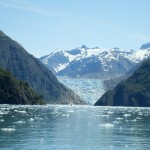
There are about a dozen glaciers in the park that come right down to the water, which they call tidewater glaciers. There are easily that many more that don’t, some of which can be seen from the water. We visited 4 or 5 of them, and took our kayaks up to hike near the mouth of one that we’d heard was stable. It had a more sloped face, so the calving is not so dramatic (or dangerous to us tiny little humans). This one was where we’d seen the grizzlies, though, so we were still feeling wary! The glaciers are all a jumble of alarmingly blue and white facets, often with waterfalls pouring from them. Some of them had caves and some spires that were fun to try to look through. The Lamplugh glacier had a huge cave at the bottom, which we could yell into and hear our echo come back (although at half a mile, it wasn’t a loud echo). We didn’t see any calving during our glacier visits, but we know it happens all the time. We saw lots of floating ice, similar to our experience in Tracy Arm, and Aria enjoyed scooping some of the small chunks up for later use in a drink. There’s something whimsical about drinking water that hasn’t been in circulation for centuries. We still have a shoebox-sized piece in our freezer, which we’ll probably enjoy when we’re in the tropics. 🙂
The water around the glaciers, be it in Tracy Arm or Glacier Bay is amazing. As we got closer to the glaciers the water turned bright turquoise (Kathy’s word) or aquamarine (Dan’s word) and often became milky from the glacial silt that washed down. Imagine drifting through pistachio-colored milk.
Glacier Bay is truly a gift of nature that was fortunately set aside as a national treasure. The National Park Service works hard to balance the needs of many constituents, and they’ve generated a (long) list of regulations for visitors to comply with, from limited permits to speed limits in whale waters to areas with quiet hours to non-motorized areas. We had heard that these rules were burdensome and invasive and that they made the park just about not worth the trouble. They only allow 25 recreational boats in on any given day, and while a few reservations can be obtained months in advance, most must be requested 48 hours before entry. Since they aren’t in cell-phone territory, this causes some logistics challenges. However, the park staff are very friendly and made things as easy as possible within those parameters. Before getting through to them from Juneau, we actually considered not visiting the park but “making do” with many of the other spectacular places nearby. While these other places are certainly also beautiful, we were enthralled by Glacier Bay. We did not find the rules to be at all burdensome, although keeping track of which rules applied to which locations was sometimes a little tricky as the boundaries are always in flux. We actually extended our visit by two days, by radioing the ranger station just before our permit expired, because we just weren’t ready to say goodbye to the whales. Our last night there was in another of those magical spots. We had numerous otters and porpoises come to visit us and several whales spouted nearby that evening. It’s with somewhat heavy hearts that we turn our boat around and head south, to close this chapter of our travels and begin the next.

Posted in Uncategorized | Comments Off on 7-22 Glacier Bay

7-10-2011 – Tracy Arm, Alaska

Our first day’s experience with icebergs was amazing. We spent a full day in the Tracy Inlet, visiting both of the forks at its head (cleverly named North Tracy Arm & South Tracy Arm). This inlet is roughly 25 miles long and was carved out by the Sawyer glacier. It’s very deep, with nowhere shallow enough (or protected enough from floating ice) to anchor, so we spent the night before in a largish cove at the mouth and got up early to spend the entire day motoring up to the glaciers and back. Between the waterfalls, icebergs & glaciers, the scenery was so spectacular that we were all exhilarated after our day and not at all exhausted like most long days with the engine running.

When we started out, there were a few large icebergs in sight and we were nervous about maneuvering near them and getting too close. We kept someone on the bow continuously watching for floating ice, and communicating by walkie-talkie with the person at the helm which pieces looked most worrisome. As the day progressed, we learned more about them and became more confident in ourselves and our boat. The ice ranges in size from huge icebergs, many the size of an automobile or even slightly larger, and on down to tiny ice-cubes. Those in the know call the small-to-midsize pieces “bergie bits”. The smallest pieces melt away more quickly because of the larger amount of surface area, so you mostly see only really big bergs once you get several miles away from the actual glacier and as you get closer the sizes vary more. Ice is less dense than water, which is why it floats, but it’s not a *lot* less, so it floats low in the water. There is a lot more under the surface than above, which is scary to anyone navigating a small boat nearby. You don’t want to get too close and hit something hard with a lot of inertia! We had seen photos of people in small boats using pike poles to fend off the ice. Kathy played around with our pole a bit, pushing at a few mid-size chunks, but we soon decided that this was unnecessary. We traveled slowly (1-5 knots, depending on how “crowded” it was) and the ice traveled even slower! But we did appreciate having a concrete hull nonetheless!

We were surprised at how much the ice varies in color. Some pieces look white, some look clear, some blue and some black. The blue ones apparently are the densest, from low down in the glacier where all air bubbles have been squeezed out. The black ones are from somewhere along the glacicer’s edge, where it was able to accumulate dust or rock particles. A few times we were confused by these guys, thinking that there was an uncharted rock in our path – only to realize that it was floating along with the rest of the ice! The ice melts away forming crazy shapes, with lots of curves and protrusions that defy description. Like cloud-watching, it’s easy to invent fun names for the characters passing by, but they change significantly as your angle of view changes. Sometimes it melts unevenly in such a way that the whole berg then becomes imbalanced and it can roll without warning. Since you don’t know what it’s shaped like down below, you don’t know what’s going to come up!


We enjoyed a beautiful cruise up the inlet, seeing waterfalls and dramatic cliffs. The floating ice thickens over the last few miles until you’re so focussed on charting a course that you’re no longer noticing the land. 🙂 At the end of each arm is a section of the glacier, coming right down to the water in both cases. Although it varies over time, we couldn’t get any closer to the South Arm than a few miles, and the North Arm was clear enough that we could work our way as close to the face of the glacier as one would dare (in our case it was about a quarter of a mile. We turned off the motor and just floated for about 45 minutes. There were 4 or 5 other boats in the inlet on the same day as us, a few private motor-boats and a few charter adventure tours. One of the tour boats launched a dinghy with 3 or 4 people, who went up quite close to the face of the glacier. The face of the glacier must have been 250 feet, a quarter mile wide, and we have no idea how long it was coming down the valley! We felt like tiny specks floating in front of it. After a couple of the other boats left, and we were thinking about getting moving again, we started to notice a few bits of ice falling into the water. We were enjoying hearing the cracks and splashes, when a huge chunk calved. It looked like the whole cliff wall was falling, although it was in fact a pretty small part of the total face. It created a giant wave which rocked everyone in the bay. We were all a little worried that we were going to go for a real ride, but by the time it got out to us it was only a couple of feet tall. Kathy happened to catch this in a movie from our camera.  See link below! We left shortly afterwards, carrying with us the awestruck sense of having witnessed Mother Nature at work. This glacier is retreating, and it was curious to note that our GPS showed us being in the middle of the glacier on our navigation chart.

https://youtube.com/watch?v=owFV_5WPDHE%26hl%3Den_US%26feature%3Dplayer_embedded%26version%3D3

Next we head to Juneau, in preparation for our visit to Glacier Bay National Park.

Posted in Uncategorized | 2 Comments

7-4-2011 – Ketchikan. Alaska

The 4th of July, and what better place to spend it than in Ketchikan, Alaska? Well, it might have been slightly nicer if we weren’t in the middle of a small gale. The evening’s fireworks display was called off because of the strong gusty winds that were swirling around the town. But there were quite a few locals who had a couple of firecrackers of their own, one person even set off some flares (probably not such a good idea). There were also a series of events all afternoon, includnig a parade that most of the town turned out for – along with several thousand additional cruise ship guests. There were three cruise ships in town that day, which just about doubled the population! The parade was wet, quaint, but enthusiastic. They had military vets, coast guard, and an armored car or two. They had a few floats representing each of the high school classes. They had a marching percussion section and a budding rock star. And they tossed lots of candy and streamers into the crowd. What could be more fun? Afterwards there was a rubber ducky race down the local creek, sponsored by the local Rotary Club, but we ended up missing that one…

Ketchikan is Alaska’s 4th largest city, breaking 8000 citizens. It’s built on some really steep terrain, but they’ve dug in pretty solid into the bedrock. Many of the roads and sidewalks are actually boardwalks or wooden staircases. It’s very picturesque. Who needs a gym when your front door is six flights up from the street? We enjoyed dinner out one night at a pizza place that advertised “We also serve Filipino food”. So we tried the Filipino food, and were tickled to get an entire tilapia fish that was deep fried. Don’t know what the locals would have done, but we didn’t eat the head or tail.


We found ourselves in a marina among lots of really big boats, mostly commercial fishing boats, but a respectable number of recreational boats as well. This was the first time that we’ve ever been in a place where we weren’t hands-down the biggest boat around. The Alaskan Gypsy, a few slips down, was just slightly larger than ours, and had three masts. We got some good advice from Dave & Peg, who had been sailing these waters for over a decade. We were surprised to see several of the boats near us had people watching television in the evenings, rather than enjoying the scenery, the town, or the company of their companions. Our favorite entertainment was the large number of bald eagles that live near town. We saw some mating behavior and some contentious interactions with smaller birds like seagulls, and learned to recognize their calls.

We caught up on some of the chores and repairs, bought a fishing license, and resumed our travels north. The next day, we passed through the Wrangell Narrows. This is a 25 mile stretch that gets as narrow as a tenth of a mile and as shallow as 18 feet (according to the charts), but sees quite a bit of traffic and has a reputation for being a nail-biter. The best way to time this narrows is to begin near the end of the rising tide, which creates a current pulling you in, then continue to travel as it slackens off, and exit on a falling tide, which creates a current pushing you out. Feels very clever! The entire passage is marked with lots of navigation aids, including 62 numbered buoys – the standard “red, right, ,returning” applies heading north, but because of the meandering route it wasn’t always as easy as it sounds. Kathy really enjoyed piloting the boat through this challenging section.
As we exited the narrows, we got our first sight of ice floating in the water: a few icebergs that had broken free from some of the nearby glaciers and were big enough to last more than a week. It was exciting and a bit unnerving to us, and we took turns on the deck up front, on watch. During this same stretch, we saw a huge number of whale spouts, although most were a few miles away and you wouldn’t even notice it if you weren’t looking for it. Also, we caught our first fish this day, a beautiful silver salmon. We didn’t think to take his stats, but it was probably 24″ long and perhaps 15 pounds. We had salmon steaks for dinner, and Aria made lox which we had for breakfast several days later – yumm! We’re all a bit conflicted, and clumsy, about killing the fish. Someone had told us that a shot of vodka to the gills would kill a fish more quickly and humanely than a blow to the head, so we gave that a try. It did not seem to do the trick, and we ended up having to get the “fish-whacker” to do the trick. Later that night, we caught 3 other small fish of different sorts, which we didn’t really know what to do with so we threw them back. One was a flat-fish, perhaps a flounder or a tiny halibut. We’ve got so much still to learn! Since then, we’ve caught a second silver salmon, and this one was a female so we’ve been enjoying caviar with rye bread or bagels. Life is good!

If you are adventuresome and very lucky, you occasionally experience a magical place which resonates with your soul and stays with you for many years. We spent that night in such a place. Sandborn Canal is just a skinny little inlet on the chart but once inside we had a sense of relief and wonder at how spacious, pristine and peaceful it was. There were steep hills covered in evergreen trees all around. Lush meadows The air was so quiet you could hear the birds coming to their evening rest half a mile away. Sandborn Canal inspired us to start a new list – of places that we hope to return to. After we’ve seen everywhere else, of course. 🙂

Posted in Uncategorized | 1 Comment

6-29-2011, Namu and Klemtu, B.C.

So we’re making good time, cruising through the Queen Charlotte Islands in Northwestern British Columbia on our way up to Alaska.  It’s quite beautiful here, even more dramatic than the scenery further south, with lots of snow-capped mountains and blindingly white waterfalls.  We’re traveling through the Inside Passage, which is partially composed of long very narrow waterways which are deeper than they are wide.  Since this is a major thoroughfare, it’s not unusual to pass other boats, and it can be a bit intimidating when encountering a large cruise boat or a tug pulling a barge.  We’ve been trying to time our days so that the tidal currents through these passages are going our direction.  Most of the currents peak out at 2 or 3 knots (we’re generally traveling around 7 or 8), but the first one we encountered went up to 15 – we wouldn’t really want to be riding those waves in either direction!

The terrain is getting more remote, the towns fewer and smaller.  Monday evening we stayed in a place called Namu that used to be a thriving community built around a cannery.  Many canneries in these waters have gone out of business, as refrigeration has been added to the fishing boats and they haven’t needed to depend on shore-based ice.  This town of a couple thousand residents is now a ghost town, with only three residents who have been hired by the landowner to man a tourist outpost.  The place is falling into disrepair, but the woman we talked with had planted lots of flowers and created a greenhouse where she was able to grow peach trees along with lots of veggies.  She told us there were three rules: no drugs, stay 20 feet apart when walking on potentially rotten wooden walkways, and don’t feed the (grizzly) bears (either intentionally or otherwise).  We took a short walk up an old road into the forest, but didn’t go far afield.  🙂  There was a wonderful sunset that night, and we’ll post a few photos on the Photos page.

We’ve pushed through several long days, with the idea that we’ll appreciate having more time to dawdle through the Alaskan wilderness.  Tuesday evening we stopped in another town named Klemtu.  It’s been difficult to find places to anchor, because the shores drop off steeply in most places.  If it’s shallow enough to drop an anchor, then it’s often too close to the rocks.  So we pulled into the Klemtu harbor and tucked into a corner that wasn’t directly in the way of the main traffic.  The charts we’ve got for this area are pretty old and not as detailed as we’re used to – we’re combining information from our navigation program, some paper charts that were hand-me-downs from a friend we made in Astoria (thanks, Dave!), and an iPhone app that Dan downloaded for our summer vacation two years ago.  From all we could tell, the bay was 65 feet deep and sloped up to 20 or so.  Sounds good.  When we dropped the anchor, we were exactly on the 65 foot notation.  By the time we’d finished putting out our anchor-line, we were at 32 and our calculations were that the overnight low tide would bring it down to 24 feet around 6:45.  Since we draw 10 feet, this seemed reasonable.  So we had a pleasant dinner and went to bed, intending to get an early start in order to time a pass through a narrow passage.

At 3:30, we woke up to the depth gauge alarm, saying that we were in less than 20 feet and the depth was dropping quickly.  How could that happen!?  We considered pulling anchor and moving, getting a *really* early start on our day, and a few other options, but by this time we were only in 15 feet of water – and then Dan noticed that the boat seemed to be tilting forward.  We were aground, and unable to make a move!  We lowered the dinghy and headed into town, uncertain whether there was anything to worry about – or anything to be done about it.  We wandered around town for a few hours in the early morning, before the town woke up, catching glimpses of our boat from time to time and seeing it tilt more and more each time we did.  It stopped around 20 degrees off vertical, tilting forward and to the port side.  We wandered around town for a few hours, talked with a couple of early-rising townspeople.  One woman told us that boats go aground here several times a year, and that last year the crew of a wooden boat had gone around town knocking on doors looking for help to support their masts to prevent them from breaking under the strain.  Yikes!  We watched a number of bald eagles and another type of eagle (mottled brown and gold) moving around the shore and trees, and saw some really large crows in a number of places around town.  We whiled away the time until the tide had come back up to the same level where we’d left the boat, and then made our way back to the dinghy and motored back across the bay.  When we got back home, we poked around looking for damage to the boat, but things were in remarkably good shape.  Quite a few things had fallen off the table-tops, and a few broken, but nothing significant.  Thanks goodness we live on a cement boat!  We cautiously started all systems and headed back out into the channel to resume our travels north.

Since then, we’ve traveled up the Princess Royal Channel and Grenville Channel, admiring majestic waterfalls and astoundingly brilliant rainbows.  There have been a few short-lived wildlife viewings, including Dall porpoises, orcas, other unidentified whales and nearly innumerable bald eagles.  We ran into a little rough water in Dixon Entrance but we’ve finally made it to Alaska. Aria’s comment upon sighting the houses on the outskirts of Ketchikan was, “where are all the igloos?”:)  Life is good.

Posted in Uncategorized | 2 Comments

6-23-2011, Campbell River, B.C.

After leaving Victoria we worked our way up the Strait of Georgia sailing whenever possible; at least a little while each day.  Along the way the pressure water pump started leaking like a sieve and running almost continuously. We started turning off the circuit breaker whenever we were done using the water.  This rapidly got very old and we stopped in Nanaimo to replace it.  We anchored in Nanaimo Harbor. The next morning we took the dinghy into town and found a good chandlery (with a serious pirate motif) that just happened to have a 24V variable-speed pressure water pump that fit the bill and only took about 20 minutes to swap out.

On the way up the strait of Georgia from Nanaimo to Campbell River we had a gentle, little, low wind, fully intentional jibe, and the second to last wooden boom on Lungta snapped smartly in two.  It was the mainsail boom so we spent the next few days sailing with only 4 of 5 sails.

There’s no harbor in Campbell River so we crossed Discovery Passage  to Gowlland Harbour where we spent the night; there are lots of bald eagles here. David’s plane was diverted from Campbell River to April Point Resort due to … low tide! (Go figure. :))  Fortunately since we just happened to have anchored near there the night before, the four of us took the dinghy to the resort dock and watched a couple of Bald Eagles snatching salmon entrails from the water. (folks from the resort were cleaning the fish and tossing them into the water for us to watch.) Wow! It was a perfect photo op and the eagles made the most of it.

Watching my father fly off in the little sea plane was very sad.  I don’t know when I’ll see him again.  The day after dropping David off we headed up to Desolation Sound for a few days of poking around some spectacular and remote coastline.  Desolaton Sound is breath-takingly beautiful.  The first half hour after we arrived the three of us were all whispering as if we’d just stepped into a cathedral.  We arrived around 9pm, and went for an hour’s paddle during a blazing sunset.  The next day we took the dinghy out to a small island nearby that our friend Sergei had mentioned to us.  We tromped through the rain-forest enjoying the huge trees and lovely ferns.  We poked around the tidepools a bit, especially enjoying the brilliant purple starfish.  This is one of the most spectacular places we’ve all been, and it sounds like there’s more to come as we continue our way north.

On Monday we pulled into Campbell River to fix the burned up VHF antenna…Oh wait, did we forget to mention the little fire that broke out while we were away from the boat exploring Desolation Sound in the dinghy?  It was a really small fire and a really nice guy from a neighboring boat was nice enough to grab a fire extinguisher and put it out.  Sometimes I am SO glad we have a cement boat!  We think we’ve figured out what caused the short.

On the way back from Desolation Sound to Campbell River we spent a half an hour watching three Orca dining at the foot of Quadra Island.

Now we’re staying in the government marina in Campbell River, repairing some of the things that we mentioned above (boom, antenna – you were paying attention, weren’t you?)  We’ve repaired the tear in the sail that the boom made when it swung down from the broken end.  We’ve spliced the antenna wire and reworked it into the fitting in the deck.  We’ve bought a 20′, schedule 40 aluminum tube and we’re in the process of removing the stainless end caps from the old boom and re-attaching them to the new one. We expect to finish that up tomorrow, hopefully in time to catch the mid-day slack tide as we head up into the Seymour Narrows and Johnstone Strait beyond.

We’ve consistantly met wonderful people as we’ve traveled.  In Desolation Sound We met Julius and Suzanne, on Emerald Steel, a beautiful steel gaff rigged 38 footer.  We hope they remain friends for years to come.  In Campbell River we’ve met Alex and Ramona and last night the five of us shared a really nice dinner on Lungta with some VERY fresh Sockeye Salmon.

More to come, I’m sure, and we’ll catch you up the next time we have an internet connection…

– Dan & Kathy


Posted in Uncategorized | 2 Comments